Key Details
- Read by: Susan Boyce delivers Bachrach's investigative prose with authority and gives individual testimony accounts enough tonal variation to feel distinct.
- At its heart: Near-death experience testimony, the limits of clinical death models, consciousness and what persists
- Vibe: Serious and immersive, with a current of quiet urgency beneath the reporting
- Short version: The most credible NDE audiobook for skeptical listeners, built on journalistic rigor and the voices of both death travelers and their doctors.
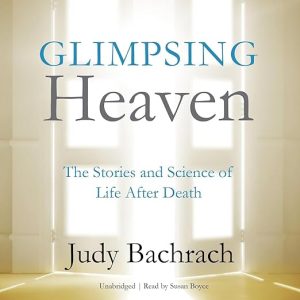
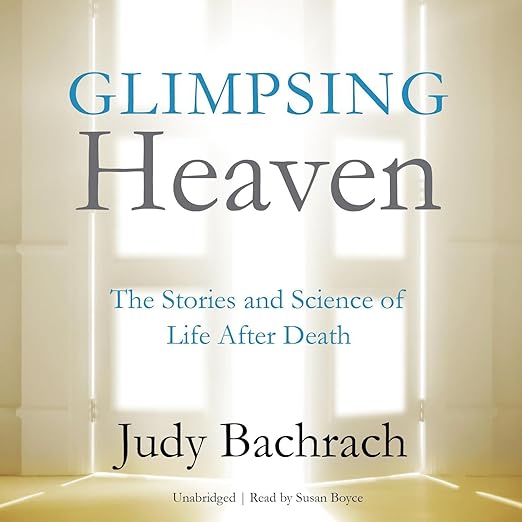
Judy Bachrach approaches near-death experiences the way a skilled investigative journalist approaches any contested empirical question: by accumulating testimony, cross-referencing accounts, and pressing the medical professionals who manage the moment of clinical death for what they actually believe rather than what their institutions officially endorse. Glimpsing Heaven, narrated by Susan Boyce, is the result of that inquiry. This audiobook is more rigorous than its subject matter might lead you to expect, making a case that the medical establishment is significantly behind the evidence on what happens at and just after the moment of clinical death. Boyce's narration over 6 hours and 11 minutes gives the material the focused, unhurried treatment it deserves, maintaining the book's investigative register throughout.
Boyce's Narration and the Physicians' Reluctant Concessions
Boyce's narration is an excellent match for the material. Bachrach writes with the controlled urgency of someone who knows their subject will be dismissed before the evidence is examined, and Boyce reads with a corresponding clarity and authority that keeps the book in the register of serious inquiry rather than sensationalism. Reviewer John de St. Jorre calls Bachrach "a first-rate investigative journalist and elegant, persuasive writer" producing "a rich and compelling account" - a characterization that holds up through the full runtime. Boyce handles the individual testimonies with appropriate tonal variation: the accounts of what people experienced while dead range from serene and beautiful to disorienting and strange, and Boyce gives each voice enough distinct quality to make the parade of testimonies feel like encounters with different people rather than a single continuous narrative stream. That differentiation is harder to achieve than it sounds over six hours of material.
The most structurally interesting choice Bachrach makes is spending as much time with the physicians and nurses as with the people who had the experiences. Some of the medical professionals she interviews are dismissive; others have reached privately held views they do not advertise publicly, for obvious professional reasons. These carefully worded acknowledgments - that what patients report during clinical death cannot be explained by the current models of brain activity - are what give the book its argumentative weight. A collection of testimonials alone would be easier to dismiss. A collection of testimonials plus reluctant medical concessions is something different.
Vivid Recollections and an Unwilling Return to Life
Reviewer The Rebecca Review notes that Bachrach "paid attention to details that make the recollections in this book so vivid," adding that the quality of the storytelling makes the accounts compelling beyond their mere content. What separates this from the NDE testimony collection genre is exactly that attention to detail and the willingness to pursue the medical side of the question rather than settling for the experiential side alone. Bachrach interviews scores of death travelers and their accompanying physicians and scientists, and the cumulative weight of that documentation - hundreds of documented experiences, cross-referenced and examined for consistency - builds an argument that is harder to dismiss as anecdote than the individual testimonies would be in isolation.
The title's question - if you caught a glimpse of heaven, would you choose to come back to life - turns out to be one the book answers with something more complex than a simple yes or no, because many of the accounts involve return as unwilling rather than chosen. Death travelers who came back did not all want to. Several describe the return as a loss, a forced departure from somewhere they experienced as profoundly real and profoundly peaceful. That unexpected dimension is where the book most distinguishes itself from prior NDE literature: it focuses not just on what people saw but on what it cost them to come back, and what that cost reveals about the experience itself.
Altered Priorities Are the Sociology Behind the Comfort
Reviewer DK, approaching forty and grappling with health issues and a longstanding fear of death, describes finding the book comforting in a way that went beyond simple reassurance. That dimension of the book is real: for listeners who fear death, the cumulative weight of documented experiences in which consciousness persists, observes, and in many cases encounters something described as profoundly beautiful does provide a particular kind of comfort. Bachrach maintains journalistic distance from the metaphysical conclusions her evidence might support - she presents the experiences and the medical context without asserting that she has proven an afterlife. That restraint is what keeps the book credible to readers who would otherwise be skeptical of the subject matter entirely. She is not arguing for a conclusion; she is documenting a pattern and asking why the medical community has been so slow to take it seriously.
The audiobook is classified in sociology, which reflects Bachrach's emphasis on the documented social and behavioral changes that follow near-death experiences, rather than on metaphysical claims alone. Death travelers who return consistently report altered priorities, decreased fear of death, and changed relationships. These behavioral shifts are observable and measurable regardless of one's view on what caused them, and Bachrach gives them appropriate weight alongside the experiential accounts. Boyce's narration maintains this dual register - empirical and intimate - throughout, never allowing the book to tip into either pure sentiment or cold clinical detachment.
Skeptics Get a Fair, Rigorously Reported Hearing
Listeners who are skeptical of NDE literature but willing to give a rigorously reported account a fair hearing will find Bachrach's journalistic approach a more satisfying entry point than testimonial collections or overtly spiritual frameworks. Those already persuaded by NDE evidence will find the medical dimension of the book valuable as additional support. Listeners who fear death and are looking for an empirically anchored counterweight to mortality anxiety will find what DK found: not a definitive resolution of the mystery, but a dense accumulation of accounts that makes the prevailing medical assumption harder to hold without reservation. Susan Boyce's narration makes the runtime feel well-used, and the book's measured tone keeps it in reach for listeners who would turn away from a more strident treatment of the same material.