Quick Take
- Narration: David Hunt self-narrates, and his comic timing, built across three books now, is the engine that makes the footnotes and asides land the way they are supposed to.
- Themes: Australian federation, labor movement, colonial contradictions, the making of a nation through scandal and absurdity
- Mood: Wickedly funny and historically grounded, though slightly less consistently energetic than the earlier books in the series
- Verdict: Book 3 of the Unauthorised History of Australia. Funnier in isolation than some reviews suggest, but best appreciated after Girt and True Girt, where Hunt’s particular method has already earned your trust.
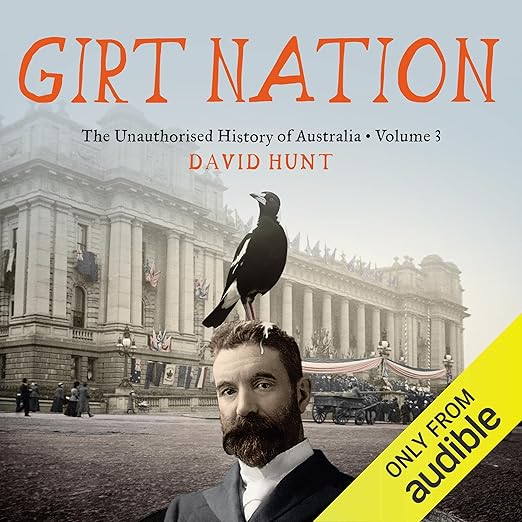
I want to be clear about one thing before anything else: Girt Nation is the third book in David Hunt’s Unauthorised History of Australia series, following Girt and True Girt, and the reviews for this volume are meaningfully shaped by comparison to the earlier ones. If you are new to Hunt and start here, you will probably find it genuinely funny and packed with Australian history you didn’t know existed. If you have already worked through the first two books and found them exceptional, you may find the third operating at a slightly lower pitch. One reviewer describes it as not as funny and a bit heavy on political judgment. That comparative assessment matters when reading the ratings.
For the uninitiated: David Hunt writes Australian history the way essentially no one else does. He has a compulsive commitment to the outlandish detail, the deflating footnote, and the historical figure whose biography contains something so improbable that you have to stop and acknowledge it before you can continue. Girt Nation covers Australia’s transformation from colonial aspiration to federated nation, roughly the 1880s through the early 20th century, which is a period dense with exactly the kind of material Hunt lives for: political charlatans, worker uprisings, feminist polymath visionaries whose progressive credentials coexist uncomfortably with nativist assumptions, and an Essendon Football Club trainer who injected his players with crushed dog and goat testicles. That last detail is in the synopsis and is not the strangest thing in the book.
The Cast He Has Assembled
One of the pleasures of the Unauthorised History series is Hunt’s roster of historical figures, whom he resurrects with the affection of a satirist who actually loves his subject. In Girt Nation, the introductions include Alfred Deakin, described without obvious exaggeration as a Liberal politician who consulted dead advisors through a medium and whose supernatural advisors apparently improved his legislative record, and Catherine Helen Spence, a feminist polymath who advocated simultaneously for free contraceptives, easy divorce, and immigration restrictions to prevent the Chinese from destroying what she had struggled to build. Hunt is not interested in tidying these figures into legibility. He presents their contradictions because the contradictions are the actual history, not a distraction from it.
The federation debates themselves receive extended treatment, and Hunt navigates the constitutional and political complexity of turning six colonies into a single nation with the same irreverent energy he brings to everything else. The humor doesn’t prevent the underlying argument from being clear: federation was a messy, contested, intensely political achievement produced by people with mixed motives and considerable contradictions, and the democracy it produced was both genuinely significant and genuinely limited in who it included.
Where the Comedy Meets Its Limits
Hunt’s method is most interesting when it encounters material it cannot joke its way through. The chapters on Jandamarra, the Bunuba leader who led armed resistance against the colonial expansion of Western Australia, shift the tonal register deliberately. The joke engine does not disappear, but it slows. The violence and dispossession of the frontier wars are present and named rather than obscured by irony. This is the version of Hunt that earns the serious historical credibility his comic approach can sometimes obscure: the one who understands that making you laugh about federation politics is not the same as making you laugh about the people who were killed for the country that federation built. He does not conflate the two.
The labor movement chapters have similar moments of tonal weight. The strikes of the 1890s, the suppression of worker organizing, the emergence of the Labor Party from the wreckage of those defeats: Hunt handles this material with genuine political engagement beneath the humor. The jokes are present, but the underlying argument about class and power in colonial Australia is not sacrificed to them.
Three Books of Self-Narration and What That Sounds Like
Hunt reading his own book is, at this point in the series, a known quantity for returning listeners. His comic timing is calibrated specifically for the footnotes and asides that are one of the Unauthorised History’s structural features: the parenthetical observation that undercuts a heroic claim, the biographical detail delivered in a tone of theatrical mock-surprise. These require very precise delivery, and Hunt’s accumulated practice across the earlier volumes means the timing in Girt Nation is precise even when the material is slightly less reliably funny than what came before. A professional narrator might read the footnotes more cleanly. They would not read them funnier.
Start With Book One, Stay for Book Three
Start with Girt if you have not already. The comparative reviews for Girt Nation almost universally assume familiarity with the series, and Hunt’s method lands harder when you have spent time with it. That said, the book works as a standalone if you are willing to accept the series as context. The characters do not carry over, and the historical period covered here is entirely self-contained. Australian listeners who want to understand the federation period with their sense of humor intact will find this essential. Those who want unironic, conventional narrative history will find the accumulated jokes wearying at length.
Frequently Asked Questions
Do I need to read Girt and True Girt before Girt Nation?
Not strictly. The historical content is period-specific and self-contained. But Hunt’s method, tone, and comic style are best understood after experiencing the earlier volumes, and the reviews for Girt Nation consistently describe it in comparison to them. Start at Book 1 for the full effect and the highest enjoyment of what Book 3 is doing.
Is Girt Nation historically accurate despite the comedy?
Yes. Hunt’s jokes are grounded in documented history. The details he presents are real, even when delivered in a tone of theatrical disbelief. He takes the research seriously, and the footnotes in the print edition, which he reads aloud in the audiobook, are part of the argument rather than decoration.
The reviews suggest Book 3 is weaker than Books 1 and 2. Should that worry me?
Only in comparison. The critical review rates it lower than the earlier volumes, citing less consistent humor and more apparent political judgment. On its own merits, Girt Nation is an entertaining, well-researched history of a genuinely interesting period. The diminished return is a series problem, not a standalone one.
How does Hunt handle the more difficult aspects of Australian history, like the frontier wars?
With more gravity than his reputation for comedy suggests. The chapters on Indigenous resistance, particularly around Jandamarra, shift the tonal register deliberately. Hunt adjusts to what the subject requires rather than using irony as an escape hatch from uncomfortable material.