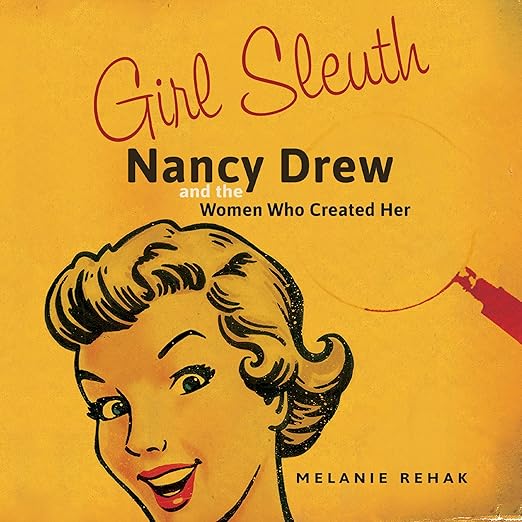
- Narrator: Melanie Rehak narrates her own research with measured, curious pacing that favors credibility over theatrical performance.
- Subjects: publishing history and ghostwriting, credit and erasure, twentieth-century American girlhood
- Tone: Absorbing and detail-rich
- Bottom line: A page-turning, well-researched biography for anyone who grew up on Nancy Drew and wants to know who actually wrote her.
Eighty million copies into her run, Nancy Drew still gets treated like a mystery herself, and that puzzle is exactly what this audiobook sets out to solve. I put Girl Sleuth on during a long stretch of shelf-reorganizing, the kind of chore that calls for something absorbing rather than background noise, and found myself abandoning the boxes within the first hour. Melanie Rehak traces how a fictional sixteen-year-old detective who first appeared in 1930 became durable enough to survive the Depression, World War II, and a sixties feminist reclamation, and she narrates her own research in a voice that sounds genuinely curious about the answer rather than rehearsed.
Rehak Narrates Her Own Archival Digging
Rehak structures the book around a genuinely satisfying detective-story question of its own: who actually wrote Nancy Drew, and who gets credit for a character everyone assumes sprang fully formed from a single author's mind. The answer runs through Edward Stratemeyer, the children's book mogul who built an entire fiction factory on ghostwritten series, and two very different women who kept the character alive after his sudden death. Mildred Wirt Benson, a pioneering Iowa journalist, wrote the earliest volumes on a work-for-hire contract and never expected credit. Harriet Stratemeyer Adams, her father's well-bred daughter, took over the family business as CEO and shaped Nancy into something closer to her own idea of an American woman. Rehak keeps both threads moving without letting either woman flatten into a simple hero or villain, which is harder to pull off than it sounds given how tempting it would be to pick a side.
Rehak's own narration works because she already spent years living inside this research, and it shows in how she paces the reveals. As one reviewer, Jenny, put it, Rehak "enjoys her subject matter and has done good research on the two women", and that enjoyment translates into a reading voice that leans into the fun parts, the syndicate's assembly-line plotting memos, the internal battles over how tough or ladylike Nancy should be, without losing the more serious thread underneath about who owns credit for cultural work women did anonymously for decades. She is not a trained voice actor, and some stretches feel more measured than theatrical, but for a book built on primary-source archival digging, that steadiness reads as credibility rather than a limitation.
A 1930 Succession Crisis Behind Nancy Drew's Debut
The larger case Rehak makes is that Nancy Drew is not just a beloved character but a genuine barometer for how American ideas about girlhood shifted across the twentieth century. The book tracks her from the Depression-era version, tough and self-reliant because her original writers needed her to be, through a wartime Nancy and into the years when, as the synopsis notes, she was "taken up with a vengeance by women's libbers" looking for a heroine who solved her own problems without waiting for rescue. Rehak treats each revision of the character, and there were many, as evidence of a real argument happening offstage about what girls were allowed to want. That argument stays more interesting than a straightforward publishing history because it keeps circling back to the two women actually doing the writing and how little control either had over the version of Nancy the public fell in love with.
Edward Stratemeyer died suddenly in 1930, the same year Nancy Drew launched, and the succession crisis that followed anchors some of the book's best chapters. His daughters inherited a publishing syndicate neither had been groomed to run, and Rehak spends real time on how quickly Harriet Adams had to learn a business her father kept deliberately opaque even to his own family. That improvisational, high-stakes period, a debut character and a leadership vacuum arriving in the same year, gives the book's middle section a genuine narrative engine beyond just chronicling one franchise's history.
Girl Sleuth won the Edgar Award for Best Biography and made the Chicago Tribune's Best Book of the Year list, and the audiobook earns that pedigree by refusing to write like an academic monograph. The synopsis promises "a narrative with all the page-turning pace of Nancy's adventures", and Rehak mostly delivers on that, especially once the story reaches the Stratemeyer Syndicate's internal power struggles after Edward's death, which play out with genuine tension over who would run the business and how. A reviewer named mph called it "a page turner like the Nancy Drews which inspired it", and while I would not put it quite that high, the chapters covering Benson's newspaper career and Adams's boardroom maneuvering do move with real narrative drive rather than the plod of straight biography.
Saffron Wanted More Feminist Analysis, Got History
Not every listener will find the pacing equally rewarding. Saffron, who gave the book three stars, called it "a somewhat dry, interwoven biographical sketch" and wished for more feminist and cultural analysis layered into the history rather than research presented mostly straight. I understand the complaint: Rehak places Benson's and Adams's lives carefully "into the historical context of gender biases", in Saffron's words, but she tends to let the facts imply the argument rather than making it explicitly, and listeners hoping for a more pointed academic thesis about authorship and erasure may want a denser, more analytical treatment than this one offers. The book sits closer to narrative history than cultural criticism, and it is worth knowing that going in.
Audio format also creates one minor complication for a book this rooted in archival sourcing. Rehak occasionally references specific documents, letters from the Iowa Women's Archives, syndicate records held at Yale's Beinecke Library, that a print reader could flip back to check, while a listener simply has to trust the citation and keep moving. It rarely disrupts the narrative flow, but anyone who likes to cross-reference sourcing while reading nonfiction should know that audio makes that harder here, as it does with most archival history.
Measured History Rather Than a Feminist Polemic
Girl Sleuth rewards anyone who grew up on Nancy Drew and never once wondered who actually sat down to write her, along with listeners generally interested in twentieth-century American publishing history and the often-invisible labor of women ghostwriters. Karen Joy Fowler's blurb calls it a book that "sheds light on perhaps the most successful writing franchise of all time", and that framing holds up: this is as much a business history of the Stratemeyer Syndicate's assembly-line model as it is a biography of two specific women, and fans of either angle will find plenty to hold onto across the nine and a half hours.
A tightly argued feminist critique isn't what Rehak delivers here, and listeners hoping for one, the kind Saffron's review wished for, may come away wanting more edge than the author is willing to supply. The pleasure of Girl Sleuth comes from patient archival digging rather than provocative argument or breathless Nancy Drew trivia, so readers should adjust expectations before starting: this is measured cultural history, not a polemic.