Quick Take
- Voice: Mike Dawson matches McGowan's direct, operational tone, delivering case recaps with the no-frills authority of someone who spent considerable time with the source material.
- Big ideas: FBI undercover work, institutional loyalty, the psychological cost of sustained deception
- Atmosphere: Propulsive and candid with occasional reflective depth
- Worth it?: A memoir that earns its extraordinary-claims premise through specific operational detail, though the case structure can feel episodic for listeners wanting sustained narrative arc.
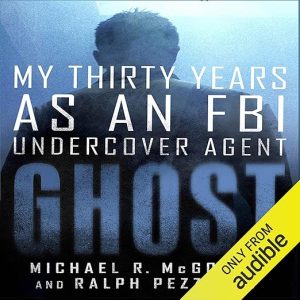
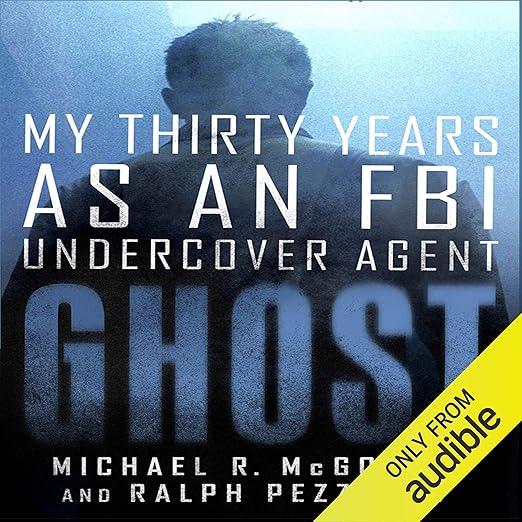
Michael R. McGowan's credentials as an FBI undercover operative are not the kind that invite skepticism. Over a career spent going further undercover than virtually any agent in bureau history, he accumulated more than fifty undercover cases, a number that represents a statistical outlier so extreme that the memoir's subtitle reads more like a documentation problem than a marketing boast. The audiobook of Ghost, narrated by Mike Dawson across eight hours and forty-five minutes, is a direct-address account of that career: from international drug busts to the Russian and Italian mobs, from biker gangs and contract killers to corrupt unions and SWAT work, and eventually to El Chapo himself and the Sinaloa Cartel.
The review from m.s. medaglia captures something important about this book's release context: it appeared while the FBI as an institution was under sustained political attack, and McGowan's portrait of the bureau from inside an undercover operation is the opposite of the caricature being constructed in public discourse. This is not a book about policy debates or departmental politics. It is a book about what it costs, practically and personally, to build a false identity credible enough that international drug traffickers trust you, and then to live inside that identity long enough to gather actionable evidence. The psychological dimension of that sustained performance is what gives the memoir its real substance beyond the case summaries.
Mike Dawson's narration is appropriately unflashy. McGowan's writing style is operational rather than literary, presenting cases with the efficiency of someone who has debriefed hundreds of times and knows how to sequence information for clarity. Dawson matches that register without imposing a dramatized overlay that would undercut the material's authenticity. The Boston Marathon bombing case and the El Chapo infiltration receive extended treatment and benefit from Dawson's sustained, even delivery; the gravity of those cases doesn't need theatrical amplification, and the narration correctly trusts the content to carry its own weight rather than performing significance for the listener.
The episodic structure, where each major undercover case receives its own substantial section, is both the book's organizational logic and its primary limitation. Listeners wanting a single sustained narrative arc will find the case-by-case structure produces a listening experience closer to a curated set of long-form investigative reports than to a conventional memoir. That is not a disqualifying quality, particularly for listeners familiar with true crime or law enforcement reporting as a genre, but it means the emotional accumulation of the book is lateral rather than vertical. Each case adds breadth to the portrait of McGowan's career rather than deepening a single thread.
Why It Works in Audio
The audiobook format serves this material well because McGowan's cases are fundamentally performance-dependent narratives. Undercover work is about voice, manner, and credibility under pressure. A narrator who can convey the controlled calm required to walk into a meeting with cartel members while wired for sound is a better guide to those scenes than static text on a page. Dawson's performance communicates that composure without making it feel theatrical, which is the correct choice for a memoir arguing that professionalism and courage are not the same as drama. The distinction matters here: McGowan's account is more compelling for its absence of braggadocio than it would be with it.
Reviewer David Stowe's note that meeting McGowan at a library event made the events feel "pretty incredible" reflects the verification challenge inherent in undercover memoir: by definition, the operations described were designed to be invisible. The institutional corroboration is present through documented cases and known outcomes, including the El Chapo prosecution, but the internal experience of sustained deception is necessarily self-reported. That is a structural feature of the genre rather than a failing of this specific book.
Before You Commit to Ghost
The fifty-plus undercover cases in McGowan's career cannot all receive equal depth across eight hours and forty-five minutes, and some cases receive more attention than others. The selection and sequencing reflect McGowan's own judgment about which operations best illustrate the variety of his work and the institutional culture of the FBI undercover program. Listeners interested in specific case types, organized crime versus cartel operations versus domestic extremism, will find the depth varies. The El Chapo material and the biker gang infiltrations are among the most thoroughly developed; the corrupt union cases, while historically significant, receive less extended treatment.
Best Suited For
True crime and law enforcement memoir listeners are the primary audience, particularly those with existing interest in FBI institutional culture or organized crime investigation. The audiobook is appropriate for adults; the operational violence described in cartel and contract killer cases is presented without graphic elaboration but is substantive. Listeners who found books like Bryan Burrough's reporting on American organized crime engaging will find this audiobook provides a useful first-person complement to that reported journalism. The eight-hour-forty-five-minute runtime is sustainable across a few listening sessions without losing track of the case structure, which is a practical consideration for memoir at this length. Listeners who want to understand what sustained undercover work actually involves, not at the level of Hollywood dramatization but at the level of building identities, managing documentation, coordinating arrests, and carrying the psychological weight of living as someone else, will find this audiobook provides a more detailed account of those mechanics than any fiction-based treatment of the subject. McGowan's career is genuinely unusual, and the audiobook makes that unusualness concrete rather than merely asserting it.
Is the Ghost audiobook a full narrative memoir or more of a case-by-case account?
More the latter. McGowan structures the book around individual undercover cases rather than building a single sustained narrative arc, which gives the audiobook the character of a curated series of investigative reports unified by a single operator's perspective.
Does this audiobook require prior knowledge of FBI procedures or organized crime?
No. McGowan explains institutional context as needed, and the case narratives are self-contained enough that listeners without background in law enforcement can follow the operational sequences and stakes clearly.