In Brief
- Read by: Rebecca Lowman keeps a steady, clear-eyed register through relentlessly grim material without tipping into melodrama.
- At its heart: urban homicide, policing and race, structural neglect
- Vibe: Sober and urgent
- Short version: Essential true-crime journalism that rewards patience through its more repetitive stretches.
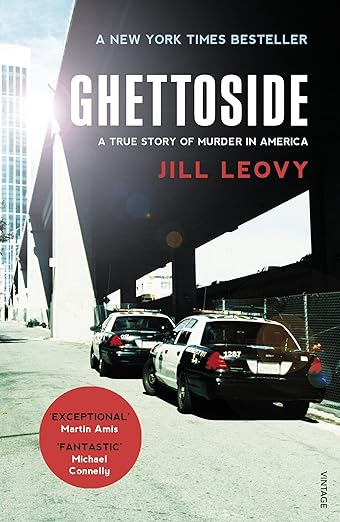
Bryant Tennelle was eighteen years old when he was shot dead on a spring evening for no reason anyone could immediately explain, one more name that could easily have vanished into an unsolved file. Jill Leovy spent the better part of a decade embedded with the LAPD's homicide units before writing Ghettoside, and this audiobook opens with exactly the kind of case that usually disappears: young, Black, male, killed on a residential street, few witnesses willing to talk. Leovy's decade covering crime for the L.A. Times gives her an unusual vantage point most true-crime writers never get: she wasn't parachuting in for a single case, she was tracking the same detectives, the same neighborhoods, and the same recurring names across years of daily reporting before she ever sat down to write this book. That sustained proximity is part of why the granular procedural detail here feels earned rather than assembled after the fact from a handful of interviews. What separates this book from the true-crime podcasts and streaming documentaries covering similar ground now is the specific detective assigned to close it, a blond, surfer-turned-cop named John Skaggs whose obsessive thoroughness becomes the book's real engine.
What We Made of It
Leovy's actual argument runs against the grain of most policing debates: the problem in neighborhoods like the one Tennelle died in isn't too much law enforcement, it's too little of the right kind, specifically the sustained investigative attention that turns a homicide into a solved case with real consequences. She explodes the surrounding myths about policing and race by tracing, case by case, how impunity itself becomes a driver of more violence, since men who believe they can kill without real risk of being caught keep killing. It's a more complicated argument than either side of the usual policing debate wants, and the book earns it through the sheer accumulated weight of specific, documented cases rather than through abstraction or ideology. The title itself carries a specific meaning within the book: Ghettoside is Leovy's own term for the under-resourced, lower-priority side of the homicide desk that handles cases like Tennelle's, distinct from the more heavily staffed units chasing higher-profile crimes. Naming that internal hierarchy directly, rather than leaving it implicit, is part of what makes her critique land as documented reporting rather than opinion.
Reviewer Beverly puts the book's neglect plainly: 'This book came out in 2015 which begs the question, in an era where true crime shows, podcasts and social media accounts are so popular, how on earth is it that so few people are talking about this book?!' It's a fair question. Ghettoside predates the true-crime boom by years and reads, in retrospect, like the serious journalistic backbone that boom has mostly lacked, built on a decade of embedded reporting rather than secondhand research.
The Best Parts of Ghettoside
Rebecca Lowman keeps a steady, clear-eyed register through material that could easily tip into either melodrama or numbness, neither of which would serve Leovy's reporting. She doesn't dramatize the violence for effect, and she doesn't flatten it into statistics either; she lets the specific human details, a mother's reaction, a detective's private doubts, carry the emotional weight the prose already contains. This audiobook also carries a notable pedigree: the original text was read on BBC Radio 4, which signals a book already built with spoken delivery in mind, and it went on to become a multi-award-winning international bestseller well before this production existed.
Skaggs himself is the book's most compelling figure, a detective whose refusal to treat any victim as a statistic makes him something close to a genre hero inside a work of straight nonfiction. Watching Leovy build his methodology case by case, and hearing Lowman's narration track his growing obsession with getting it right, gives this thirteen-hour audiobook a narrative propulsion that pure policy writing on the same subject usually lacks entirely. The book's emotional register depends on treating each victim, not just Tennelle, with the same specificity Leovy brings to the detectives investigating their deaths. That choice runs against the flattening instinct so much crime reporting falls into, where victims become a body count and detectives become the only figures worth remembering by name. Skaggs's specific method, tracking down reluctant witnesses through patient relationship-building rather than intimidation, runs counter to a lot of pop-culture cop-show shorthand, and Leovy documents that patience in granular, almost procedural detail. It's slower and less cinematic than a television interrogation scene, but it's also the actual mechanism by which cases like Tennelle's get solved in the real world, which is precisely Leovy's point about what closing the gap in unsolved homicides actually requires. The pairing of his personal conviction with her institutional critique is what keeps the book from tipping into either side of a stale debate.
What Might Not Land
Reviewer simon's complaint is worth taking seriously: the book can feel like 'a decent magazine investigation journalism piece stretched thin over hundreds of pages,' and by the back third it does grow repetitive. That repetition is partly the point, since the murders themselves are repetitive and routine in exactly the way Leovy argues American society has allowed them to become, but it's still a real pacing consideration across thirteen-plus hours. Listeners expecting a single tightly plotted case should know upfront that Ghettoside moves between multiple homicides and investigations rather than following one narrative line start to finish.
W. Ponton, Jr., a career law enforcement officer, found the book 'fascinating' specifically because it 'discredits several of the explanations and excuses of police management for unsatisfactory homicide closure rates,' which is a useful clarification: this is a book critical of police management and institutional neglect, not a broadly anti-police polemic. Skaggs and his fellow detectives are, if anything, the book's heroes. That distinction matters for anyone deciding whether this fits their expectations going in, especially listeners approaching the subject warily from either direction.
The Right Listener for Ghettoside
Readers of serious true-crime journalism with a structural, sociological bent, fans of books like Evicted or Random Family, and anyone interested in how policing and race actually intersect on the ground will find this audiobook essential. It rewards patience and pays that patience back with real insight rather than easy outrage, one documented case at a time.
Skip it if you want a single fast-paced whodunit mystery, since Ghettoside is closer to sustained investigative journalism than genre crime fiction, and its thirteen-plus hours move at a reporter's pace rather than a thriller's. Listeners who need constant narrative momentum may find the middle stretch slow going, though the payoff for sticking with it is substantial.
A Few Questions About Ghettoside
Does the Ghettoside audiobook take a pro-police or anti-police stance?
Neither exactly. It's critical of police management and institutional neglect specifically, while treating detective John Skaggs and his colleagues as genuine heroes for their investigative persistence.
Is the narration of Ghettoside able to sustain the book's repeated case studies?
Yes. Rebecca Lowman's steady, clear-eyed delivery avoids both melodrama and numbness, letting the specific human details in each case carry the emotional weight.
Does this audiobook work if I haven't read other true-crime journalism?
It does, though listeners familiar with structural nonfiction like Evicted or Random Family will recognize the approach fastest and know what pacing to expect.
How does the Bryant Tennelle case anchor the rest of the audiobook?
His murder opens the book and represents the routine, easily-overlooked kind of case Leovy argues gets systematically under-investigated, setting up the argument the rest of the audiobook builds on.