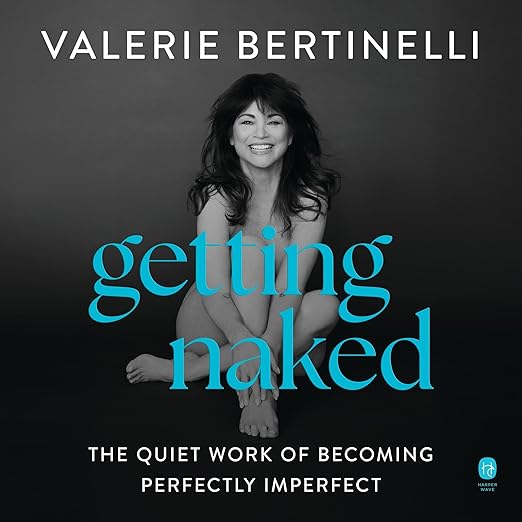
Pauses and a Catch That Prose Cannot Replicate
Valerie Bertinelli reading her own memoir is not a production decision made for convenience. It is the audiobook's entire argument. Getting Naked is about stripping away the performance of competence and polish that Bertinelli has spent decades maintaining in public, and hearing her voice the admission that her value 'depended on perfection' in her own words, with her own pauses and the warmth and occasional catch that prose alone cannot replicate, makes the book something qualitatively different from what it would be in another narrator's hands. This is a memoir about unlearning the script that says women must please, endure, and stay silent, and Bertinelli's self-narration is the first act of that unlearning.
At just under six hours, Getting Naked moves quickly through territory that could easily have expanded into something twice its length: menopause, divorce, generational family trauma, body shame, the false math of female worth that links appearance to value, and the slow, unglamorous work of self-compassion. Bertinelli moves through it all with what reviewers consistently describe as 'disarming humor,' which is accurate. She is funny in the way that people who have processed genuine pain are often funny: precisely, without sentimentality, and at her own expense.
Extra Stories the Page Doesn't Have
The self-narration is the production's defining asset. Reviewers report sobbing through certain chapters, and one notes that Bertinelli 'inserts little extra stories along the way' beyond what appears on the page, small asides and personal clarifications that only the author could add and that transform the audiobook into something slightly richer than the print version. That kind of author-present intimacy is rare in memoir audio, and Bertinelli delivers it without the self-consciousness that sometimes makes author narrations feel like public readings rather than genuine conversation.
The book's central reckoning is with what Bertinelli calls 'generational pain,' the patterns around body image, emotional suppression, and the performance of cheerfulness that she received and transmitted without fully examining. Her mid-sixties perspective gives the material a clarity that younger memoir writers often lack; she is not processing in real time so much as returning to the site of old damage with the distance to see it clearly. Listeners who have navigated similar territory, specifically aging, divorce, or the inherited emotional furniture of difficult families, will find that clarity useful rather than distancing.
The humor that runs throughout serves a structural purpose beyond entertainment. By keeping the tone from tipping into therapeutic earnestness, Bertinelli maintains access to listeners who would resist a book that asked them to feel their feelings on cue. The comedy makes the harder emotional passages easier to receive, not by undercutting them but by arriving first and establishing trust.
Bertinelli's background as a television personality, specifically as someone who has been photographed, discussed, and publicly evaluated for the majority of her adult life, gives the body-shame sections of Getting Naked a specific resonance. She is not describing the private experience of an ordinary woman learning to accept an aging body; she is describing that experience compounded by decades of professional environments where her appearance was literally part of her job description and publicly commented on by strangers. That layering, private struggle amplified by public scrutiny, is one of the things that makes Bertinelli's version of this familiar territory feel distinct rather than generic.
Her Voice Carries the Imperfection of Honesty
The book's brevity is both its strength and its limitation. At under six hours, Getting Naked does not have the space to dwell at length on any single period of Bertinelli's life or any single pattern of emotional inheritance. Readers familiar with her earlier memoirs, which covered her marriage to Eddie Van Halen and her well-documented relationship with food and weight, may find that Getting Naked assumes some of that prior context rather than re-establishing it. For listeners new to Bertinelli's public story, certain passages may feel more allusive than fully developed.
The book explicitly frames itself as a reckoning rather than a recovery narrative, meaning the ending does not promise transformation so much as direction. Some listeners may find that less satisfying than a more resolved arc. Others will find the honesty about how long-term self-acceptance actually works, namely gradually, incompletely, and with ongoing effort, more useful than a tidy conclusion.
The decision to structure Getting Naked as a reckoning rather than a transformation narrative is one Bertinelli makes explicitly, and it is worth understanding what that choice means for the audiobook's emotional arc. A transformation narrative would end with a clearly different person, someone who has arrived at self-acceptance and can demonstrate it. Bertinelli refuses that framing. What she offers instead is testimony from someone in the middle of the ongoing work: still dealing with the harsh inner critic, still navigating the aftermath of divorce and public scrutiny, still learning how to hold the generational patterns she received rather than simply transmit them unchanged. That ongoing-ness is less comfortable than a resolution, but it is more honest, and Bertinelli's own voice in the narration carries the imperfection of that honesty rather than performing its completion.
Personal Testimony Instead of a Program
Women in midlife who are processing similar terrain, aging, changing bodies, the aftermath of long relationships, and inherited emotional patterns, will find Bertinelli's framing both specific and widely applicable. Fans of her earlier work will get a longer view of themes she has returned to across her writing. Listeners who respond to memoir as a mode of companionship rather than instruction, specifically the sense that someone else has been in your particular kind of difficulty and found language for it, will find this audiobook well-suited to that need. Those looking for practical self-help tools or a structured psychological framework should look elsewhere; Getting Naked is personal testimony, not program.
- Voice: Valerie Bertinelli reading her own memoir is the core of the audiobook's appeal; her pauses, humor, and unscripted asides create an intimacy that a hired narrator could not replicate.
- Big ideas: self-acceptance and body image, generational trauma and family patterns, aging and reinvention
- Atmosphere: Warm, funny, and emotionally honest without tipping into therapy-speak
- Worth it?: A compact but substantive memoir that earns its author narration; best for listeners who want companionship through familiar territory rather than a program for transformation.