Quick Take
- Narration: Self-narrated by Curtis D. Haines, who brings the credibility and candor of someone who has actually lived the financial ruin and the recovery he describes.
- Themes: Passive income through real estate, financial independence, leveraging assets over time
- Mood: Direct and motivating, with a practitioner’s honesty about numbers and process
- Verdict: A short, personal, and unusually transparent entry-level real estate investing guide, strongest for listeners who are just beginning to think seriously about financial independence.
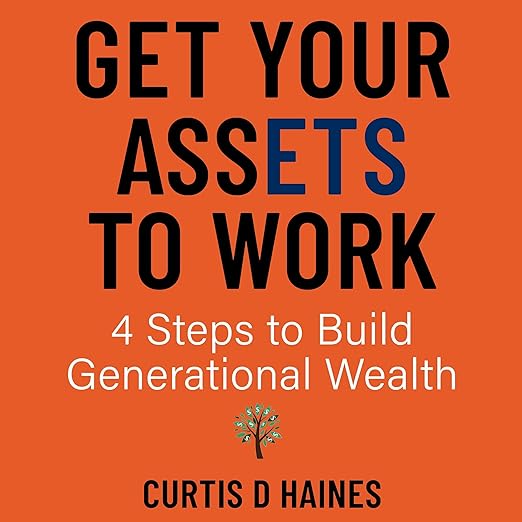
Get Your Assets to Work runs under three hours, and Curtis Haines narrates it himself. That combination, brevity plus the author’s own voice, creates a particular kind of audiobook experience that works well for personal finance content. You are not listening to a professional narrator render someone else’s ideas; you are hearing the person who built the system explain it in their own words, in their own cadence. Haines is not a polished audiobook narrator, but the directness of his delivery is part of what makes this credible.
The book’s premise is established plainly at the outset: saving alone is no longer a viable path to retirement, the traditional safety nets of 401ks, IRAs, and Social Security are insufficient, and the only real path to financial independence is making your assets generate income rather than trading your time for money. Haines cites Warren Buffett’s line about making money in your sleep, which is a familiar touchstone in this genre, but he gets past the aphorism quickly and into the specifics of how he actually executed this after losing everything in the 2008 financial crisis.
Our Take on Get Your Assets to Work
What distinguishes this audiobook from many real estate investing guides is the transparency around actual numbers. One reviewer specifically noted that Haines includes examples of his real financial figures and evaluation processes, which is uncommon in a genre where authors frequently discuss strategy in the abstract while keeping their own numbers private. That specificity is the book’s strongest asset. The path from financial ruin in 2008 to financial freedom within three years is described with enough granularity to be instructive rather than merely inspirational.
The book focuses primarily on multifamily real estate as Haines’s specialty and sole area of focus. He is honest about this constraint: the principles are presented as applicable to other income-producing properties, but his direct experience is with multifamily and the specific advantages of that niche, including tax advantages, leverage, and the scalability of multi-unit portfolios. Listeners interested in single-family residential, commercial, or other real estate categories will need to do additional reading to apply Haines’s framework to their specific interests.
Why Listen to Get Your Assets to Work
The comparison one reviewer makes to Rich Dad Poor Dad is instructive. Haines is operating in a similar motivational and introductory register: the book is trying to shift the listener’s fundamental mental model about money and work before it gets into tactics. But where Kiyosaki famously stays abstract and parable-driven, Haines moves to concrete real estate application fairly quickly. For listeners who have already absorbed the Rich Dad mental model and want the next level of practical detail without wading through advanced investing texts, this is a reasonable bridge.
At under three hours, this audiobook is efficient enough to serve as a commute companion or a weekend listen. It does not overstay its welcome or pad its content with filler. The density of practical information relative to runtime is high, which is genuinely valuable in a genre where books frequently repeat their core argument for two hundred pages.
What to Watch For in Get Your Assets to Work
The book is introductory in scope. Experienced real estate investors will not find new frameworks here, and the discussion of topics like tax advantages and leverage is accessible rather than advanced. This is not a limitation if you are the intended audience, but it is worth calibrating expectations if you already have significant real estate investing experience.
The self-narration is earnest but occasionally uneven in pacing and emphasis. Haines is clearly more comfortable discussing his subject matter than performing it, and listeners who are sensitive to narration quality may notice the difference from professional audiobook production. The content compensates, but it is a practical consideration.
Who Should Listen to Get Your Assets to Work
This audiobook is best suited to listeners who are at the beginning of thinking seriously about financial independence and are considering real estate as a vehicle. If you have read Rich Dad Poor Dad and feel ready to move from concept to the first steps of actual implementation, Get Your Assets to Work covers that gap usefully. Experienced investors, or those with strong existing knowledge of real estate fundamentals, will likely find it too introductory to offer much new. For anyone who wants the author’s own voice and the credibility of firsthand experience, the self-narration is an asset rather than a liability.
Frequently Asked Questions
Does Curtis Haines focus exclusively on multifamily real estate, or does the book cover other asset types?
The book focuses primarily on multifamily real estate, which is Haines’s area of direct expertise. He notes that the principles can apply to other income-producing properties, but the specific strategies, evaluation processes, and examples are drawn from his multifamily experience.
Is this suitable for someone who has never invested in real estate at all?
Yes, this is introductory material presented accessibly. Haines is explicit that he is addressing people starting from the beginning, and the book’s structure moves from foundational mindset shifts to practical first steps without assuming prior investment experience.
How does the self-narration affect the listening experience compared to a professionally narrated audiobook?
Haines is direct and credible but not a trained narrator. The pacing is occasionally uneven and the production quality reflects an independent rather than major-publisher release. Listeners who prioritize content over narration polish will find this manageable; those sensitive to production quality should be aware.
The book mentions Haines rebuilt his finances in three years after 2008. Does he explain the specific steps in enough detail to be actionable?
Yes, and the transparency around actual numbers is the most-cited strength by reviewers. He describes his evaluation processes and includes real financial figures, which is uncommon in this genre. The level of detail is sufficient for a beginner to understand the framework even if individual circumstances will vary.