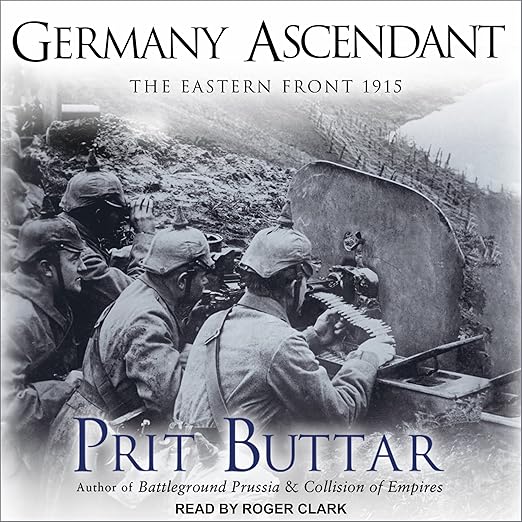
Quick Take
- Narration: Roger Clark brings patient authority to Prit Buttar’s dense operational history, essential for navigating twenty hours of multi-front military detail without losing the listener.
- Themes: Strategic attrition, the forgotten war in the East, the limits of military dominance
- Mood: Rigorously detailed and historically serious, demanding but consistently illuminating
- Verdict: The most thorough English-language account of the 1915 Eastern Front available in audio, essential for WWI historians and serious military history readers.
I started Germany Ascendant on a long train journey across northern Europe and found I was still listening when I should have been watching the landscape outside. Prit Buttar has a way of making even the most complex operational history feel urgent, and the 1915 Eastern Front is complex in ways that the Western Front, which has dominated English-language WWI historiography for a century, mostly is not. The sheer scale of movement on the Eastern Front, hundreds of miles rather than hundreds of yards, means that the narrative involves different kinds of attention than the static horror of the Somme or Verdun demands.
Germany Ascendant is the second volume in Buttar’s four-book history of the Eastern Front in the First World War. The first book covered 1914; this one covers the critical year of 1915, when the German Gorlice-Tarnow Offensive triggered the collapse of Russian forces and came tantalizingly close to knocking Russia out of the war entirely. The failure to achieve that decisive outcome, despite German dominance throughout the year, is the central question of the book: why did stubborn Russian resistance force the continuation of a two-front war that would drain Germany’s reserves of men and equipment even when victory seemed within reach?
Our Take on Germany Ascendant
Buttar’s analytical strength is his refusal to assign heroes. He examines the decision-making of German, Austro-Hungarian, and Russian commanders with the same critical eye, and the result is a picture of institutional dysfunction on all sides. The Austro-Hungarian forces suffered crippling casualties in disastrous offensives, a pattern Buttar traces to strategic overreach and command failures. Russian resistance, which defied German expectations repeatedly despite catastrophic losses, is treated with genuine respect rather than as background color. The result is a military history that is genuinely balanced rather than written from an implicit victor’s perspective.
The geographical scope of the book is one of its most valuable features. From the bitter fighting in the Carpathian Mountains, where the altitude and terrain made every engagement a logistical nightmare, to the sweeping German advances through Poland and the Baltic states, to the almost medieval battle for the fortress of Przemysl and the destruction of Serbia, Buttar is tracking simultaneous campaigns across an enormous front. Roger Clark’s narration is essential here. Twenty hours of operational history with multiple theaters, multiple national armies, and dozens of commanders requires a narrator who can maintain clarity across the full scope, and Clark does this well. His pacing is deliberate and his pronunciation of Russian, German, and Polish place names and personal names is consistent, which matters more than it might seem when those names are the navigational landmarks of the narrative.
Why Listen to Germany Ascendant
The case for this audiobook is simple: if you are interested in the First World War, you are missing most of what happened if you focus only on the Western Front. The scale and ferocity of the 1915 Eastern Front exceeded anything that occurred in France or Belgium, and its political consequences, including the eventual collapse of the Romanov dynasty and Russia’s exit from the war via revolution, shaped the twentieth century as directly as anything that happened at Ypres or the Marne. Buttar is the most thorough English-language historian working on this subject, and this book fills a gap that Western-centric WWI histories leave conspicuously empty.
At 4.5 stars across 247 ratings, the audience response reflects genuine appreciation from listeners who bring serious historical interest to the material. One reviewer who rated the book’s coverage of specific areas at a perfect five described the research as meticulous covering all participants in detail. Another praised Buttar for discussing strategy and tactics at just the right level of detail and complexity, satisfying history buffs without becoming incomprehensible to non-experts.
What to Watch For in Germany Ascendant
One reviewer noted that the book could have used more social and political background to explain why and how decisions were made. That is a fair criticism of a predominantly operational history: Buttar focuses on campaigns and command decisions rather than on the social conditions that produced them. The political implications of the 1915 campaigns are present but not emphasized, and readers who want to understand the Eastern Front within its broader social and political context will need to supplement Buttar with other sources.
The map situation is also worth flagging. Several reviewers noted that the maps are insufficient relative to the complexity of the operations described. In an audiobook context, this limitation is even more significant than in print. Listeners would benefit from having a detailed map of the Eastern Front open while listening, and the World War One Eastern Front is well-mapped in numerous atlases and online resources.
Who Should Listen to Germany Ascendant
Serious students of the First World War who have exhausted Western Front histories and want to understand what was happening simultaneously in the East will find this essential. Military history readers who want operational detail, command analysis, and genuine geographical engagement with the scale of Eastern European warfare in 1915 will find Buttar among the best available guides to this material. Casual history listeners or those new to WWI who want an accessible overview should start elsewhere before committing to twenty hours of operational depth. Reading or listening to the first volume in Buttar’s series first is not strictly necessary but will provide useful context for the 1914 events that Germany Ascendant builds on.
Frequently Asked Questions
Is it necessary to have listened to the first volume of Prit Buttar’s Eastern Front series before starting Germany Ascendant?
Not strictly necessary. Buttar provides enough context that the book works as a standalone history of 1915, but readers who want the full arc of the Eastern Front from the beginning will benefit from starting with the first volume, which covers 1914.
How does Roger Clark’s narration handle the density of operational detail across twenty hours?
Clark maintains consistent pacing and clear pronunciation of the Russian, German, Polish, and Austro-Hungarian names that serve as navigational landmarks throughout the narrative. For a history of this complexity, his steadiness is genuinely valuable.
Does the book require supplemental maps to follow the campaign movements?
Reviewers consistently note that the maps included with the print version are insufficient for the complexity of the operations described, and in audio that limitation is more pronounced. Listeners will benefit from having a detailed map of the 1915 Eastern Front accessible while listening. Several online sources provide these free.
How does Buttar treat the Russian military given its catastrophic losses in 1915?
With considerable respect and without condescension. Buttar is explicit that he has no heroes on the Eastern Front, and his treatment of Russian commanders and soldiers acknowledges both the institutional failures and the remarkable resilience of an army that absorbed enormous losses and continued to resist. This balanced approach is one of the book’s strengths.