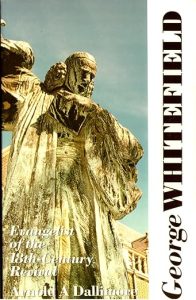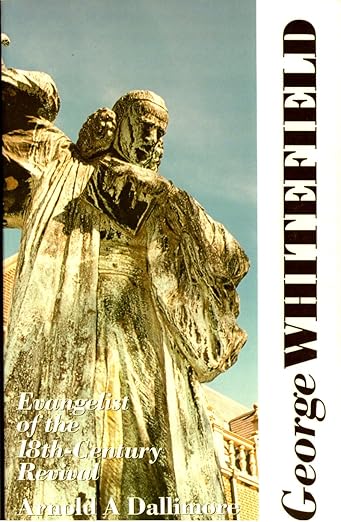
Dallimore's biography earns its reputation as one of the most thorough evangelical histories ever assembled, and this audiobook compresses that reputation into five hours and fifty-five minutes that favor momentum over exhaustive detail. George Whitefield was twenty-six when contemporaries started calling him the greatest preacher the modern world had seen, and this production takes that claim seriously without pretending it needs no scrutiny. Bob Souer narrates, moving briskly through Whitefield's rise from a Gloucester innkeeper's son to the open-air evangelist whose voice reportedly carried to crowds of thousands without a single microphone, a detail that still sounds implausible until you hear how the audiobook builds the case for it.
Franklin Calculated the Crowd by Geometry Alone
What Dallimore's work does well, even at this condensed length, is trace how Whitefield became the connective tissue of the eighteenth-century Great Awakening, preaching across the British Isles and then seven times across the Atlantic to American colonies still a generation away from independence. The book treats his youth seriously, an Oxford student drawn into the intensely disciplined Holy Club alongside John and Charles Wesley, and it does not rush past the theological friction that eventually separated Whitefield's Calvinism from Wesley's Arminian convictions, a split that shaped Protestant evangelicalism for centuries afterward in ways most listeners have never had explained clearly.
The Bethesda orphanage in Georgia gets real attention too, Whitefield's lifelong project and arguably his most personal legacy, and the audiobook treats it as central rather than a footnote to the preaching career. Where the book is more circumspect is on how that same orphanage's finances intersected with Whitefield's public advocacy, a thread listeners should not expect a condensed evangelical biography to chase down with the same rigor a more skeptical modern historian would bring to it, which shapes how much this particular account should be trusted as the final word.
Benjamin Franklin, no friend to organized religion himself, left one of the more famous eyewitness accounts of just how far Whitefield's unamplified voice could travel: Franklin walked backward from the crowd until he could no longer make out the words clearly, then calculated by geometry that Whitefield could plausibly be heard by more than thirty thousand people at once in the open air. That specific, verifiable anecdote does more to establish Whitefield's real-world impact than any amount of biographer's praise could, and it is the kind of detail that makes this audiobook interesting even to listeners with no stake in the theology.
Souer's Quiet Authority Avoids Tipping Into Hagiography
Bob Souer's narration carries the kind of quiet authority that suits admiring scholarly prose without tipping into hagiography, a genuinely difficult balance for material this devotional in origin. His pacing through theological argument and historical narrative alike stays calm and clear, never rushing the harder passages or over-dramatizing the crowd scenes, which lets Dallimore's own research do the persuading rather than the performance.
A real case exists for this material reaching well past its immediate evangelical audience. Whitefield was, by any secular measure, one of the first genuine celebrities of the English-speaking world, a preacher whose open-air sermons drew larger crowds than any public figure of his era managed by any other means, and whose printed sermons circulated on both sides of the Atlantic faster than almost anything else in print. Listeners interested in the history of mass communication, rhetoric, or religious revival as a social phenomenon will find plenty here even without sharing Whitefield's theology.
Seven transatlantic crossings across a single ministry, in an era when a single ocean voyage could take six to ten weeks and carried real risk of shipwreck or disease, says something about Whitefield's commitment that a modern listener can undervalue by default. The audiobook does not dwell on the physical toll of that travel schedule at length, but even a passing awareness of eighteenth-century sea travel adds real weight to how listeners should understand his repeated choice to keep crossing back and forth between two continents for the same cause.
Whitefield's delivery itself was reportedly theatrical enough to impress people who had every professional reason to resist being impressed. The actor David Garrick, one of the most celebrated performers of the era, is reported to have said he would give a great deal of money to be able to say a single word the way Whitefield could. That kind of admiration from a working actor says something real about the specific craft of his preaching, not just its content, and it is a detail this audiobook can use to make an eighteenth-century sermon feel like a genuine performance event rather than a dry historical footnote.
Serious Modern Biographers No Longer Skip Past This
The runtime itself is the first thing to register. Dallimore's actual scholarly biography of Whitefield runs to two dense volumes and well over a thousand pages combined, a project he spent decades researching, so a single six-hour audiobook is by necessity a condensed treatment rather than the complete original text. Listeners hoping for the full multi-volume depth should know upfront that this is a distilled version built for accessibility, not the exhaustive scholarly edition.
Dallimore writes from inside the evangelical tradition he documents, admiring rather than skeptical, and the synopsis gives no clear signal of how much space this condensed edition gives to the harder parts of Whitefield's record, including his advocacy for legalizing slavery in a Georgia colony that had originally banned it, done partly to fund Bethesda's operations. Serious modern biographers no longer skip past this. Anyone wanting a full reckoning with that history should not assume a devotional biography delivers one on its own, and might pair this listen with more recent, more critical scholarship.
The theological rupture between Whitefield and John Wesley, over predestination and the specifics of Calvinist versus Arminian doctrine, gets treated as a major structural hinge in Whitefield's story, and rightly so, since it split the wider evangelical revival into two enduring branches that still shape Protestant church life today. Listeners without a background in that doctrinal debate should expect the audiobook to walk through it in enough detail to follow the stakes, though it assumes some patience with theological nuance rather than simplifying the disagreement down to a personality clash.
Preaching as a Communication Technology Before Radio
This one is a strong fit for listeners already interested in Great Awakening history, students of eighteenth-century religious rhetoric, or evangelical audiences looking for a devotional biography that still respects historical detail. Anyone curious about how mass preaching functioned as a communication technology before radio or print saturation will also find real substance here, condensed as it is.
Skip it if a secular, critically distant biography is what you actually want, or if the abridged scope will frustrate you more than the accessible pacing satisfies you. Readers who need the complete Dallimore text, footnotes and all, should look for the unabridged print volumes rather than expecting this audiobook to substitute for them.
Is this audiobook the full Dallimore biography or a condensed version?
At five hours and fifty five minutes, this audiobook is a condensed treatment of Dallimore's much longer two-volume scholarly biography, built for accessibility rather than exhaustive completeness.
Does this audiobook address Whitefield's advocacy for slavery in Georgia?
The synopsis gives no clear indication either way, and Dallimore's admiring evangelical framing suggests listeners wanting a full critical reckoning with that part of Whitefield's record should pair this with more recent scholarship.