Key Details
- Narration: Dennis Holland delivers Phillip Thomas Tucker's dense historical prose with appropriate gravity, sustaining attention through the book's substantial 27-hour runtime.
- Themes: Revisionist military history, the mythology of American founding, the forgotten faces of war
- Mood: Scholarly and immersive, demanding sustained attention that rewards the patient listener
- Verdict: The most comprehensive account of the Battle of Trenton available in audio form, best for serious history listeners willing to commit to its extraordinary depth.
Phillip Thomas Tucker arrives at the Battle of Trenton not to retell a familiar story but to dismantle one. George Washington's Surprise Attack, this 27-hour audiobook, opens with the premise that the most famous crossing in American military history has been wrapped in romantic myth and convenient legend for two and a half centuries, and that the actual events, involving forgotten officers, soldiers from both sides, and a set of tactical decisions far more complicated than the mythology suggests, are more interesting than what the paintings and textbooks preserve. Tucker has written extensively about overlooked figures in American military history, and his methodology here is forensic rather than literary: he goes into archives, challenges received interpretations, and presents his evidence methodically, letting the accumulated documentation make the argument rather than relying on narrative momentum.
The myths Tucker targets are specific and the debunking is documented rather than gestural. The Hessian drunkenness that supposedly made the Christmas night surprise possible, the idea that Washington conceived the attack strategy alone, Colonel Rall's supposed incompetence as a contributing factor to the German troops' defeat: each of these receives sustained analytical attention. Tucker's argument throughout is that the victory at Trenton was not improbable because of American pluck triumphing over Hessian disorder. It was improbable because of the genuinely desperate circumstances of the Continental Army, the complexity of coordinating a night crossing in brutal weather, and a set of decisions made by people who have mostly been written out of the standard account.
One reviewer calls Tucker "the most in-depth historical reads I have ever had the pleasure of reading," noting his obvious extensive research and the way he consistently brings fresh perspectives to well-known moments. That description is accurate here. The depth is not ornamental. Tucker uses it to make a specific historical argument: that Trenton's outcome was genuinely miraculous, but not in the way the mythology has preserved it. The miracle was produced by human decisions, and many of those decisions were made by people history never bothered to remember.
Holland Sustains Gravity Across Twenty-Seven Dense Hours
Dennis Holland's narration manages a text that is dense with names, dates, unit designations, and geographical specifics. He sustains an appropriate gravity throughout without allowing the academic texture to become monotonous. At twenty-seven hours and eleven minutes, this is a significant commitment, and Holland's consistency across that runtime is itself an achievement. The book has the character of a very long, very well-researched historical argument, and Holland reads it as such rather than attempting to dramatize material that works better as documentation than as performance.
Tucker's use of firsthand accounts, including soldiers and officers from both the Continental Army and the Hessian regiments, gives the battle sequences a ground-level quality that counterbalances the higher strategic analysis. These voices, most of them not famous, are where the book's emotional dimension lives. Tucker is particularly attentive to the Hessian perspective, which has been systematically underrepresented in accounts of Trenton written from the American side. Understanding what the Hessian commanders knew, what they failed to act on, and what structural limitations shaped their responses reframes the battle considerably.
Rall Was No Cartoon Incompetent, Tucker Argues
The book's weight is real. At twenty-seven hours, Tucker is not writing for casual interest. He is writing for listeners who want the fullest possible account of a single pivotal engagement. The middle sections, which cover the logistical and political context leading up to the crossing, can feel like extended setup for readers who arrived primarily for the battle itself. Tucker's view is that context is not optional: the Continental Army's desperate circumstances before Trenton are what make the outcome meaningful, and he allocates substantial time to establishing them.
The revisionist thrust of the book occasionally produces tension between readability and documentation. Tucker's argument requires him to address and refute specific prior claims, which means some passages are structured as historiographical argument rather than narrative. Listeners who engage with this level of historical scholarship regularly will find it entirely familiar. Those coming from more popular history will need to adjust expectations accordingly. The payoff for that adjustment is genuine: few single battles in American history have been examined with this level of archival care.
Tucker's treatment of the Hessian forces deserves particular attention. He resists the standard American narrative in which the Hessian defeat is explained primarily by their moral and physical failings, drunkenness, overconfidence, and poor leadership. His archival research into the German sources, including the Hessian officers' own accounts of the night and the subsequent days, produces a more complex picture: troops who were genuinely competent by the standards of their era, facing a set of circumstances that no realistic planning could have fully anticipated. Rall emerges not as the cartoon incompetent of the mythology but as a commander who made defensible decisions given the information available to him and was defeated by a combination of factors outside any single officer's control. This kind of revisionism is history at its most useful, not overturning a narrative for the sake of novelty but replacing a simple story with one that actually fits the evidence.
Denser Than McCullough, Built for Serious Listeners
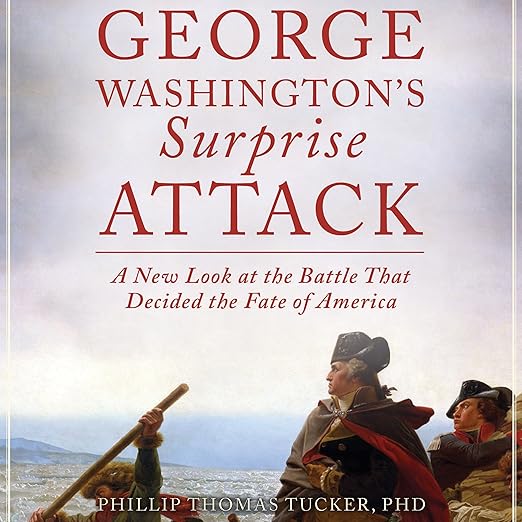
This audiobook is for serious history listeners who want the most comprehensive available account of the Battle of Trenton and are prepared to commit to the depth and runtime that entails. Tucker is not writing popular history in the style of David McCullough or Nathaniel Philbrick, though readers of those authors will find him rewarding if they are prepared for more academic density. Revolutionary War enthusiasts, listeners interested in revisionist military history, and anyone who wants to understand why Trenton mattered beyond the famous painting of Washington crossing the Delaware will find it exceptional. Casual history listeners looking for narrative energy over documentary depth will likely find the investment too demanding for their purposes.
Does the George Washington's Surprise Attack audiobook require prior knowledge of the American Revolution?
Some basic familiarity with the Revolutionary War context helps, particularly around the Continental Army's situation in late 1776. Tucker provides enough historical grounding that listeners with general knowledge can follow the argument, but specialists will get the most from the revisionist historical detail.
At 27 hours, is this audiobook suitable for listeners who prefer shorter historical reads?
Honestly, no. Tucker's method is deeply researched and comprehensively documented, and the runtime reflects genuine depth rather than padding. Listeners who want a more accessible account of Trenton would be better served by shorter popular history works. This one is for committed history listeners.
How does Dennis Holland handle the large number of historical figures and military units in this audiobook?
Holland maintains clarity through the dense cast of Continental and Hessian officers with consistent pacing and a measured tone that keeps the historical argument legible. He does not attempt dramatic characterization, which suits the documentary texture of the material.