Quick Take
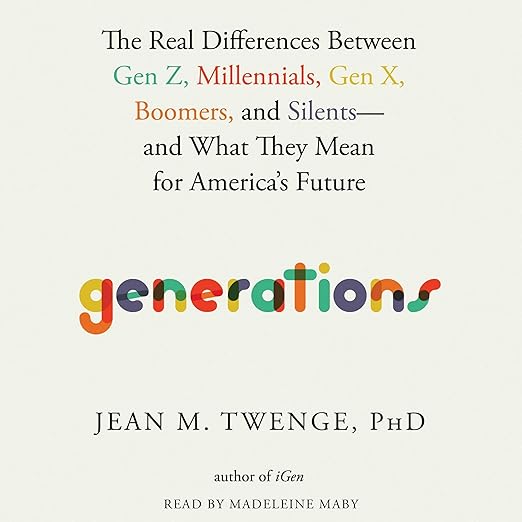
- Narration: Madeleine Maby handles Dr. Twenge's data-heavy prose with clarity and a pace that keeps 39 million data points from feeling like a wall of statistics.
- Themes: Generational identity, technology's cultural impact, social change across six cohorts
- Mood: Analytical and eye-opening, occasionally challenging in its conclusions
- Verdict: A serious piece of social science that will make you rethink generational conflict, the data is its strength, even when the interpretations invite debate.
I started listening to Generations on a Tuesday morning when I was already thinking about a conversation I'd had with my niece about why she experiences the world so differently than I did at her age. Jean Twenge's book didn't answer that question cleanly. But it reframed it in ways I found genuinely useful, and I spent the next several mornings working through nearly seventeen hours of data-driven social science that I hadn't expected to find this readable.
Twenge is the author of Generation Me and iGen, and she has spent decades studying American generational cohorts using large-scale national survey data. Generations is her most ambitious project: a portrait of all six generations currently living in the United States, from the Silent Generation through what she calls Generation Polaris (the generation now being born). The dataset, 39 million people across surveys going back nearly a century, is not window dressing. It's the foundation.
Our Take on Generations
The book's central argument is worth knowing before you start: Twenge rejects the conventional wisdom that generational differences are driven by major historical events (wars, recessions, cultural upheavals) and argues instead that changes in technology are the primary underlying driver. This is a provocative and contestable claim, and Twenge marshals serious evidence for it. The timing of shifts in attitudes toward gender roles, marriage, mental health, sexuality, and income correlates more tightly with technological adoption curves than with specific historical moments, she argues.
Reviewer E. Jones, who offered the most detailed assessment, described this as a spectacular volume representing the culmination of Twenge's career work. Reviewer A. Menon contextualized it as essential reading in an era of rapid geopolitical and technological change. Reviewer Shane, who sits at the intersection of Boomer parents and Gen Z children as a Gen Xer, found particular satisfaction in the generational portrait of his own cohort and especially the attention paid to Gen Z. The book puts in tons of energy into real facts instead of opinion, which is both a strength and a source of controversy for those who find Twenge's conclusions about Gen Z's mental health crisis uncomfortable.
Why Listen to Generations
The breadth here is what distinguishes it. Most generational analysis you'll encounter focuses on one or two cohorts in isolation, the problem of Millennials in the workplace, or the anxiety of Gen Z, or Boomer nostalgia. Twenge puts all six in conversation with each other, which reveals patterns that disappear when you only study one generation at a time. The cross-generational comparisons around political attitudes, religious identity, and sexuality are particularly illuminating, because they show not just how each cohort differs from others but how the direction of change has been consistent over time.
The graphs referenced in the text are, per reviewers, a real asset in the print version. In audio, you lose those, which is a genuine limitation for a book this quantitatively grounded. Madeleine Maby's narration compensates where she can by keeping the statistical descriptions clear and grounded, but there are moments where you'll wish for a visual supplement.
What to Watch For in the Argument
Twenge's work has attracted academic criticism, particularly around her interpretation of social media's role in adolescent mental health. Her causal claims about technology are stronger in some domains than others, and the book doesn't spend much time engaging with competing explanations. Listeners who approach this as journalism, data-informed synthesis rather than peer-reviewed certainty, will get more out of it than those who expect it to function as settled science.
The one non-English review in the dataset appears to be a mislabeled review for a physical product, and can safely be disregarded as a content assessment.
Who Should Listen to Generations
Anyone in HR, education, management, parenting, or policy who needs a structured framework for understanding how different generations communicate and prioritize will find this directly applicable. It's also a genuinely engaging listen for anyone who has wondered why their parents, siblings, or children seem to operate from fundamentally different assumptions. Angela Duckworth's blurb, that the book 'gets you thinking about how appreciating generational differences can, ironically, bring us together', is a fair summary of its best effect.
Frequently Asked Questions
Does the audiobook version include the graphs and charts referenced in the text?
No, the graphs are only in the print version. Madeleine Maby's narration describes the data clearly, but if the visual evidence is important to you, having the print edition alongside the audio is worth considering.
How does Twenge define the six generations she covers, and are the cutoff years standard?
Twenge uses data-driven cutoff points rather than the most commonly cited ones, which sometimes differ slightly from popular usage. She defines them based on when measurable attitudinal and behavioral shifts occur in the survey data, so a few cohort boundaries will feel unfamiliar.
Is Generations controversial among social scientists?
Yes, particularly around Twenge's claims about social media and adolescent mental health. Some researchers argue her causal interpretations overreach the correlation data. The book is best read as a well-supported hypothesis rather than settled consensus.
Do I need to have read iGen or Generation Me before listening to this?
No. Generations is designed to stand alone and covers all six cohorts comprehensively. Prior Twenge readers will recognize her framework and methods, but the book builds its arguments from scratch.