Quick Take
- Narration: Nila’s voice is clear and measured, appropriate for the text’s scholarly yet accessible register, no dramatization where none is needed.
- Themes: Death as transition, ritual and its social function, the multiplicity of Hindu cosmologies across time
- Mood: Contemplative and intellectually generous, with genuine philosophical depth throughout
- Verdict: Devdutt Pattanaik is one of the most reliable guides to Hindu mythology for readers without specialist knowledge, and this subject gives him material worthy of his full approach.
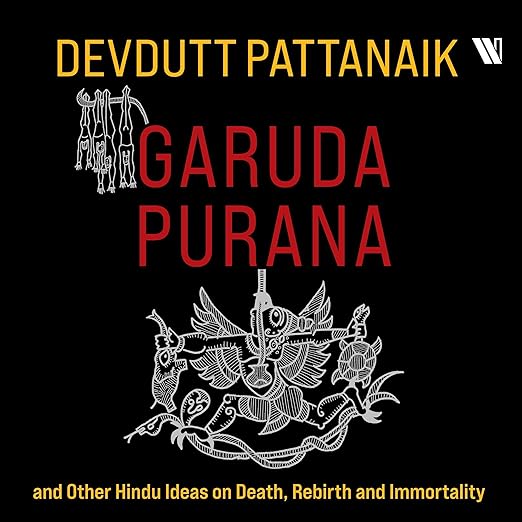
I listened to this one on a Sunday morning while walking through a neighborhood cemetery, which was perhaps a more fitting setting than I had intended when I pressed play and set out. Devdutt Pattanaik opens with a series of questions that sound deceptively simple: Why do Hindus feed their dead ancestors? Why do they prefer burning the dead to building tombs? Does Hinduism have no concept of Judgement Day? I have encountered these questions in academic contexts before, but Pattanaik’s method is to let them sit without rushing toward resolution, to follow the mythological and ritual logic that produces them, and to trust that complexity is more honest than a single tidy answer would be. He is a patient guide, and that patience is what makes him trustworthy.
The Garuda Purana is one of the eighteen Mahapuranas of Hinduism and deals specifically with death, the afterlife, and the journey of the soul. It is traditionally recited during mourning periods as a guide for both the deceased and the living navigating their loss and their obligations. Pattanaik uses it as a starting point rather than a constraint, ranging across the broader Hindu tradition to show how different schools of thought, Vedic, Tantric, Puranic, approach death in ways that are sometimes complementary and sometimes genuinely contradictory. That range is the book’s primary strength and its most intellectually honest gesture. It refuses the false coherence of treating Hinduism as a single, unified system with one definitive answer to every question it raises about what happens when we die.
Ritual Ambiguity and Why Pattanaik Embraces the Contradictions
The most intellectually honest thing this book does is sit with contradiction rather than dissolve it for the reader’s comfort. Death in Hinduism is simultaneously the end of one journey and the beginning of another, a source of grief and a source of pollution, a transition that requires both mourning and a particular kind of ritual celebration. Pattanaik traces how these contradictions are embedded in actual practice, the same tradition that venerates ancestors also considers death inauspicious, a source of ritual impurity that must be carefully managed through specific and precise rites. Rather than explaining one of these positions away, he shows how both emerge from different but internally coherent Hindu frameworks, each with its own emotional necessity and its own community that has sustained it across generations. Reviewers have consistently praised this as a non-dogmatic approach, and the word is precise: Pattanaik is not trying to tell you what to believe, but to show you the architecture of what has been believed across centuries and why it took the shapes it did.
The Beings Pattanaik Introduces: From Preta to Vetala
One of the specific pleasures of this economically sized book, at five hours and fifty-five minutes, it does not overstay its welcome, is the taxonomy of beings it carefully introduces and distinguishes. Bhuta, pishacha, preta, pitr, and vetala each occupy distinct positions in the Hindu understanding of what happens to souls after death, depending on the quality of their death, the rituals performed by the surviving family, and their accumulated karma across previous lives. The pitr are ancestors properly transitioned through correct and complete ritual; the preta are souls stuck in an intermediate state, often because funeral rites were incomplete or improperly performed, leaving them stranded between worlds. This taxonomy is not presented as dry categorization but as a map of anxieties, what the living fear about the dead, what obligations tie families to their ancestors, and what happens when those obligations fail to be met across generations. As a literary scholar, I found these distinctions genuinely illuminating for understanding why death appears in Indian narrative and dramatic traditions in the specific forms and registers it takes.
Narrator Nila and the Question of Active Listening
The narration by Nila is competent and clear, with a calm register that suits the text’s blend of scholarly inquiry and mythological storytelling. This is not a book that calls for dramatic performance or elevated emotion; it is a meditation that requires measured, trustworthy delivery, and Nila provides exactly that consistent quality throughout. The short duration makes this a good companion for a long walk or a thoughtful Sunday afternoon. It is not designed to be listened to as background audio during other activities, Pattanaik’s arguments are dense and sequential enough that half-attention will cause you to lose important threads in his reasoning. This rewards the kind of listening you give a good academic lecture: present, unhurried, willing to follow ideas through their full implications before reaching for the next. One reviewer described it as answering genuine and long-held questions about death rituals in Hinduism, and for listeners with that specific curiosity, it does exactly and comprehensively that.
Who This Book Is For and What You Will Take Away
I want to be direct about which readers will find Garuda Purana and Other Hindu Ideas of Death, Rebirth and Immortality most rewarding, because managing expectations is part of an honest review. This is not a book for readers seeking comfort in the face of personal grief, though it may provide a kind of philosophical grounding that some will find useful. It is also not a book for readers who want a single authoritative account of what Hinduism teaches about death, because Pattanaik’s central insight is that no such single account exists or could exist across the tradition’s enormous range. It is a book for readers who are genuinely curious about how a major world tradition has grappled with death across millennia and multiple schools of thought, who can tolerate complexity without needing resolution, and who want a guide who respects their intelligence. That is a specific and valuable kind of book, and at under six hours of listening time, it asks very little in return for what it provides.
Frequently Asked Questions
Do I need prior knowledge of Hinduism or the Garuda Purana to follow this audiobook?
No specialist knowledge is required. Pattanaik writes for a broad and curious audience and introduces concepts, terms, and figures as they appear throughout the discussion. The book is accessible to listeners from any background, though those with some familiarity with Hindu mythology will find additional layers of context and recognition.
How does Pattanaik’s approach differ from a straightforward translation or recitation of the Garuda Purana itself?
Significantly. Rather than translating or reciting the Purana, Pattanaik uses it as a starting point for a wider inquiry into Hindu ideas about death across Vedic, Tantric, and Puranic traditions. He is interested in the logic of practice and belief rather than scriptural exposition or literal translation.
Is this book suitable for listeners who have lost someone and are seeking to understand Hindu mourning practices better?
It can serve that purpose thoughtfully and without condescension. Pattanaik treats death with philosophical seriousness rather than clinical detachment or sentimental comfort. Listeners seeking to understand why specific rituals are performed will find clear and respectful explanations grounded in mythological and historical context.
Is this available as a free audiobook, and does narrator Nila handle the Sanskrit and Hindi terms with appropriate fluency?
Yes, it is available as a free audiobook through Audible membership. Nila handles the Sanskrit and Hindi terminology with appropriate pronunciation and confidence, which matters considerably for a text where terms like bhuta, preta, and pitr carry specific and distinct meanings that must be clearly distinguished.