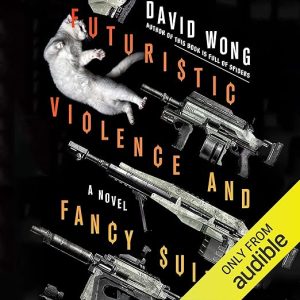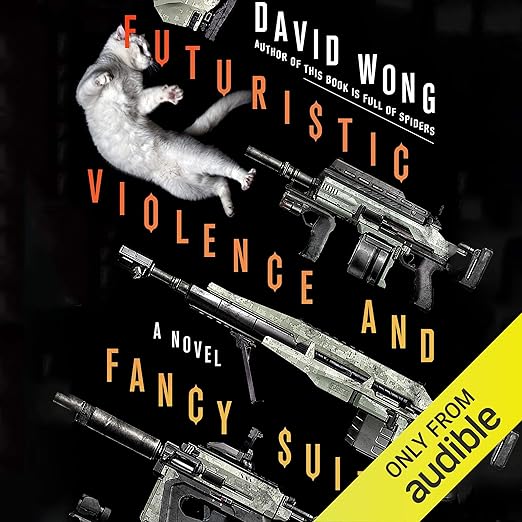
- Narrator: Christy Romano brings Zoey Ashe to life with an energy that suits the character's reluctant-hero arc, irreverent without being grating across the 15-hour runtime.
- Subjects: Corporate power and vigilante violence in a media-saturated future, inherited identity versus chosen self, satirical takes on online celebrity and mob behavior
- Tone: Propulsive and darkly comedic, cyberpunk with a sense of humor about its own absurdity, and occasional genuine emotional depth
- Bottom line: A kinetic, satirically sharp cyberpunk comedy that establishes a compelling protagonist in Zoey Ashe, imperfect but consistently entertaining, and stronger in its back half.
I first encountered David Wong, the pen name of Jason Pargin, through John Dies at the End, which occupies a very particular niche: horror comedy that is funnier than most horror and scarier than most comedy. Futuristic Violence and Fancy Suits is a departure from that mode in setting and tone but not in core sensibility. It operates in a near-future city called Tabula Ra$a, the dollar sign is doing real work there, where everything is livestreamed, violence is spectacular and consequence-free-seeming, and the men who keep order wear exceptionally good suits.
I listened to this one across a week of evening sessions, and the experience shifted noticeably around the halfway point. The first half is fast, funny, and occasionally overwhelming, the worldbuilding comes in dense waves, and Pargin's humor is genuinely abrupt, as one reviewer described it, landing jokes that were set up chapters earlier with the precision of a structural mechanic rather than an improvised gag. The second half tightens considerably. The plot gains real stakes, the humor becomes better integrated with the tension, and Zoey Ashe emerges as a character worth caring about rather than just following.
Is Futuristic Violence and Fancy Suits Worth Your Time?
Zoey is a recent college graduate with, as the synopsis wryly notes, a worthless degree. She did not ask to be inserted into a mob war. She did not plan to inherit her con-artist father's legacy and discover that the legacy was more complicated, and more morally defensible, than she expected. What makes her interesting is that her inherited skill is specifically an aptitude for bullshit: she is good at reading situations, generating plausible-sounding narratives under pressure, and managing the gap between what people believe and what is true. In a city where everything is performance, that is a genuinely useful superpower.
One reviewer compared the novel favorably to Ready Player One, noting that Pargin's version is more grounded and emotionally honest. That comparison has merit. Zoey's father's story, the man who used a talent for con-artistry to build something that functions as a genuine institution of civic protection, gives the book a moral center that elevates it above pure genre exercise. The satire of online mob behavior, of the appetite for spectacular violence as content, lands with more force because there is a human story underneath it.
The Best Parts of Futuristic Violence and Fancy Suits
If you are already a Pargin reader, Futuristic Violence and Fancy Suits represents a genuine maturation of his fiction. The John Dies series works through chaos and accumulation; this book has a tighter architecture. The cyberpunk setting also gives Pargin's satire a more specific target: the logic of attention economies, the gamification of violence, the way celebrity functions in a world where everything is always being watched. These themes have only become more obviously relevant since the book's 2015 publication.
The worldbuilding is dense enough that new readers should expect a steeper entry curve. The city of Tabula Ra$a operates on rules that Pargin establishes by immersion rather than explanation, and the first third of the book can feel disorienting in productive and occasionally unproductive ways. Patience is rewarded. The climax and ending drew mild criticism from a reviewer who found them underwhelming, and that is a fair read, Pargin's final act does not quite match the energy of what precedes it. But the journey is consistently worthwhile.
Before You Commit to Futuristic Violence and Fancy Suits
Christy Romano brings genuine irreverence to Zoey's narration without flattening the character's more vulnerable moments. At 15.5 hours, the read requires a performer who can sustain comic timing across an extended runtime without the humor curdling into schtick. Romano manages this, the jokes still land in hour thirteen the way they do in hour one, which is not a small accomplishment. The voice is a natural fit for Zoey's register: a young woman who is perpetually slightly out of her depth but refuses to show it.
Should You Listen to Futuristic Violence and Fancy Suits?
Readers of cyberpunk fiction who want the genre's trappings with a more satirical and comedic edge will find this genuinely satisfying. Existing fans of David Wong who want to see what Pargin does when he builds a tighter structural architecture are in for a rewarding experience. Those who found John Dies at the End too chaotic or unfocused may discover this more approachable, it is still strange, but stranger with a plan. Skip it if you need your satire to come without significant graphic violence; Tabula Ra$a is not a gentle place, and Pargin does not look away from what that means.
Do I need to have read the John Dies at the End series to appreciate Futuristic Violence and Fancy Suits?
No. This is a completely separate universe and cast of characters. Prior Pargin reading will give you a sense of his humor and worldbuilding style, but Zoey Ashe and Tabula Ra$a stand independently. If anything, some readers who were put off by the John Dies series' chaos found this more approachable because the narrative architecture is tighter.
Does Christy Romano's narration suit a first-person female protagonist in a satirical cyberpunk novel?
Yes. Romano brings irreverence and vulnerability to Zoey in roughly the right proportions, and her comic timing holds across the full runtime. The performance is well-matched to the material's tone, neither too earnest nor too comedic, which is the register the book itself is aiming for throughout.