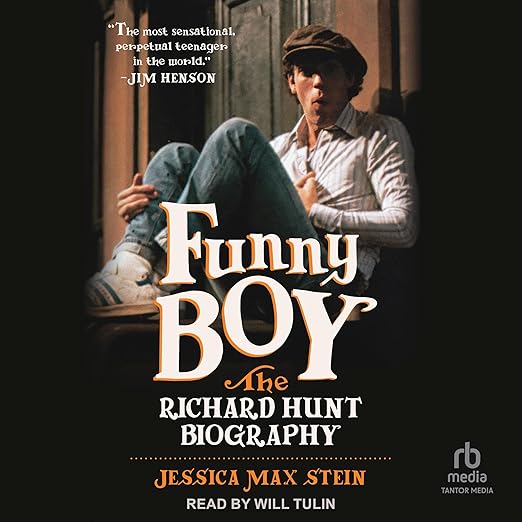
In Brief
- Performance: Tantor Audio credits Will Tulin alone for a biography whose subject was himself a professional voice; no archive audio is promised.
- What it covers: Puppetry and performance, the AIDS epidemic, a career built young, queer life inside family entertainment
- Feel: Warm, admiring, and quietly devastating by the end
- Our call: The Muppet book that finally looks past Henson and Oz, and worth it for the last third alone.
Scooter, Statler, Janice and Beaker are all named in the description, and the man who performed them is nowhere in the title field. This audiobook is filed as Funny Boy, full stop, while the copy's own opening words give the real title: Funny Boy: The Richard Hunt Biography. Two words of subtitle carry the entire subject, and dropping them turns a specific book about a specific puppeteer into a phrase that could mean anything. Anyone scrolling past will never learn what it is about.
The One Performer Behind Scooter and Statler
Richard Hunt was one of the original main five performers in the Muppet troupe, and the range in the description explains why a biography was overdue. Eager gofer Scooter and elderly heckler Statler came from the same person. So did groovy Janice, the perpetually alarmed lab assistant Beaker, and early versions of both Miss Piggy and Elmo. He joined Jim Henson's company at eighteen, and the copy notes that his edgy humor helped push the Muppets toward international stardom.
The March 14, 2024 response does the job the title field refuses to do, writing out the full title and identifying the subject as a puppeteer before recommending it to puppeteer friends and Muppet fans. The same response names the fact the copy states more gently: Hunt died at forty, having crammed acting, directing and the mentoring of a whole next generation into those years.
A Glitzy Celebrity and a Gruff Cab Driver
Beyond the puppetry, the copy is careful to build a whole working life. Hunt acted, directed and mentored the performers who came after him, and the description sketches somebody who lived large, collected a wide and mismatched community of friends, and could talk to a glitzy celebrity and a gruff cab driver with the same appetite. That sociability is the through-line a biography has to sustain across ten hours, and it is what keeps a working life from reading as a list of credits.
Will Tulin is the voice on the file, published by Tantor Audio on July 30, 2024, running 10 hours and 54 minutes. The record double-files it under biographies and memoirs and under LGBTQ+, which is accurate to a life the copy handles openly rather than by implication, and the second shelf matters: somebody browsing queer biography will find this, while somebody browsing Muppet history has only the bare title to go on.
Every Character Exists as a Voice First
Muppet literature has a hole in it, and one five-star from May 2025 names this one with some force: the existing Muppet literature is Henson and Oz, over and over, as though two people had done everything themselves. That response spent years wanting the information about Hunt and the pairing with Jerry Nelson that nobody had written down, and found it here. Fan history has a canon problem, and this book is a deliberate correction to it.
Hearing it read has an odd appropriateness. Every character in the description exists as a voice first, and a biography of a performer whose instrument was his own throat gains something from being spoken rather than scanned. No recording could reproduce those voices, and the page promises no attempt at them, but the material belongs in audio in a way that a book about, say, a set designer would not.
Consider the shape of the life itself. Eighteen years old walking into Henson's company, forty years old at the end, with the AIDS epidemic taking the love of his life and eventually threatening his own. The copy resists making that arc into a tragedy, emphasizing resilience, openness and appetite instead, and the material is strong enough that it does not need the softening. Ten and a half hours is the right length for a life with that much in it.
What Forty Five-Star Ratings Actually Describe
Grief runs through the second half, and buyers should be ready for it. A five-star from March 2025 puts it as plainly as anyone could want, calling the book thoroughly enjoyable and heartbreaking at times in the same breath. The illness that shaped Hunt's last years is not treated as a footnote here, and no content note appears anywhere on the record to prepare a listener who came for stories about Fraggle Rock.
Beyond discovery, that amputated subtitle carries a second cost. Someone who buys on the strength of the Muppet association may expect a troupe history and get a single life instead, told from inside a specific community during a specific decade. That is the better book, but it is not the book the bare title implies, and the description is the only thing on the page correcting the impression.
Unanimity is the last thing to read carefully. Forty ratings sit on the page at five stars exactly and all five written responses agree with them, which describes who bought the book more than it describes how the book performs. A specialist biography reaches specialists first, and the people most invested in a subject grade generously. The enthusiasm is real; a broad verdict it is not.
The Wrong Book for General Muppet History
Muppet obsessives are the obvious core, and the column proves the point: one five-star describes more than forty-five years of fandom and having read virtually everything written about Henson and the troupe, and still calls this a needed addition to the history, full of stories never told before. When a completist says a book contains new material, that is the strongest possible recommendation for the people most likely to buy it.
Listeners who grew up with these shows and never once wondered who was underneath will find the strangest pleasure in it, since the description's list of characters reads like a childhood inventory and then attaches every one of them to a single person. An April 2024 response makes that pitch to parents directly, arguing that anyone whose children enjoyed Sesame Street and the Muppets will want the story of the man behind the puppets.
Queer cultural history is the other way in, and it gets a subject who lived openly inside mainstream family entertainment, and lost a partner to an epidemic that the copy names directly. Puppeteers and performers get a working life described in detail, including the mentoring. Coming to this for a general Muppet history means buying the wrong book, since one performer holds the frame the whole way through, and that is the entire point of it.