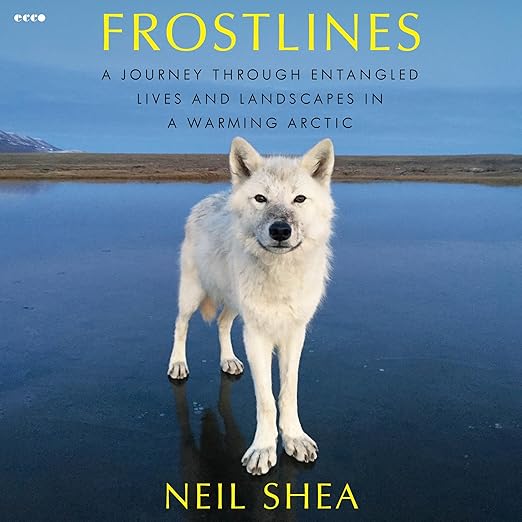
No filler is a strange compliment to pay a book about the Arctic, and it is the one that stayed with me longest after this audiobook ended. It comes from the most detailed notice in the pool, a five-star write-up that calls Frostlines a work "constructed of a series of precisely wrought first-person stories with beginnings, middles and ends." The two words that follow are the actual verdict: "No filler." For a National Geographic writer with decades in the far north, that is the compliment worth having.
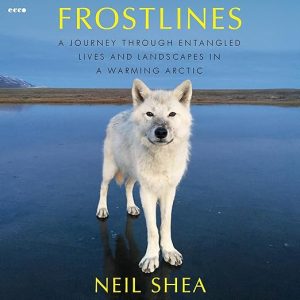
Shea reads his own reporting here, and the ground he covers refuses to sit still: a wolf pack on Canada’s Ellesmere Island, Indigenous hunters across Alaska, Nunavut and the Northwest Territories, caribou herds thinning across the top of North America, the trail of vanished Vikings in Greenland, and the front line of what the publisher’s copy calls "the new Cold War rising between Russia and Europe." His own summary, quoted in that copy, is that he found not one Arctic but many.
What Neil Shea Delivers
Architecture is what separates this from the shelf of Arctic books it joins. The same reviewer notes that Shea "has been reporting on and studying the Arctic for decades" and, more usefully, that the decades never harden into a textbook. That is the standing trap for a career correspondent with twenty years of notebooks, the pull toward organizing everything into a single thesis. Frostlines runs on discrete episodes instead, each with its own arc, which is why you can finish a segment and feel it closed rather than paused.
Agreement among the five written notices is unusually flat. All five awarded five stars. One praises a "Succinct writing style, that seamlessly takes you around the arctic." Another reports the effect I suspect Shea is really after: despite having "a tough time dealing with the cold," the book "made me want to travel north," and it also "made me realize more clearly the dangers of climate change that are upon us." A third settles on "Both beautiful and sobering." Two different books are being praised there, the travel invitation and the elegy, and carrying both at once is the harder trick.
Handing the microphone to the author is the production decision this material forces. The book moves through Iñupiaq, Inuit and Nunavut ground, tracks that Ellesmere wolf pack, and hunts for Norse traces in Greenland, all of it in a first person belonging to the man who was standing there. A hired reader would have to work phonetically through Indigenous proper nouns while voicing somebody else’s fieldwork as "I." Author narration removes that seam, and on a book whose authority rests entirely on having been present, removing it buys more than polish would.
What Neil Shea Gets Right
Six hours and seven minutes is brisk for a book with this much geography in it, and the episodic build is what keeps the brevity from feeling clipped. Each unit resolves. Reported nonfiction rarely offers that, because most of it braids threads across chapters and punishes anyone who stops early. Frostlines lets you stop.
Politics is the half of this book the cover does not sell. The description is blunt about it: how Greenland’s history led to current American interest in the island, how Russia treats the Arctic as a proving ground for confrontation, why drilling in the Arctic National Wildlife Refuge threatens Indigenous people and animals, and why heavier ship traffic in the Northwest Passage carries consequences for the Inuit and for global politics. Arrive for wolves, leave with a briefing on great-power competition. The reviewer who headed their notice "Come for the wolves but stay for the Vikings" had spotted the same swerve and approved of it.
Climate writing usually makes you choose between the science and the people. Parade’s line, quoted at the top of the description, is that the book "helps bring a human story to the science of climate change," which is a fair account of the method: natural history, anthropology and travel writing braided rather than alternated. Yale Climate Connections named it a recommended read. Those are the two endorsements the publisher leads with, and they point at the same strength.
Where Neil Shea Loses Some Ground
Arithmetic first. Forty-one people scored this book to an average of 4.6, and each of the five who also wrote something handed over top marks. Subtract those five and thirty-six silent scores are what hold the number below five, which makes the visible prose a sample of the warmest end of the response rather than its center. I read pools like this as a mood board, never as a measurement.
Depth is the other limit in that pool. Two of the five notices amount to a line each, one of them just "Excellent and engaging read - highly recommend," and only a single reviewer engages with how the book is actually built. Five write-ups against 41 ratings on a December 2025 release is a thin evidence base, and it tilts toward early enthusiasm: the notices land between 17 December 2025 and 10 March 2026.
Expectations set by the bullet list deserve their own caution. The description promises four specific illuminations, Greenland and American ambition, Russian testing grounds, refuge drilling, Northwest Passage traffic, and a book assembled from self-contained field narratives will more likely reach those subjects through scenes and encounters than through dedicated argumentative chapters. That is an inference from the structure the reviewer describes rather than something the notices confirm. Still, if you want policy analysis of the Arctic, this is reportage that touches policy and not the other way round.
Who Should Pick Up Frostlines
Anyone who reads magazine-length reportage for pleasure should start here, along with listeners who want climate writing that stays at eye level with hunters, wolves and caribou instead of retreating into projections. The self-contained structure suits fragmented listening, so a commute or a long walk will not cost you the thread, and no prior Arctic reading is assumed. I would hand it first to anyone who has read a great deal about melting ice and almost nothing about the people who live on it, because the correction Shea offers is a matter of proportion rather than of fact.
Give it a pass if you want one sustained argument, a strict chronology, or the systematic region-by-region survey those bullet points might imply. Give it a pass too if a sobering register is not what you signed up for this month, because the grief in it is structural rather than decorative. Six hours and seven minutes of beauty and loss, read by the reporter who gathered it, is a specific proposition, and everyone who wrote about it thought it was the right one.
Key Details
- Narrator: The author reads his own fieldwork, which is why the first person never sounds secondhand.
- Subjects: Arctic climate change, Indigenous hunting life, wolves and caribou, great-power politics in the far north
- Tone: Cold, spacious, quietly alarmed
- Bottom line: Magazine reportage at its most disciplined, short enough that the episodic build reads as design rather than compromise.
Frequently Asked Questions
Does this audiobook work if I only listen in short stretches?
Better than most reported nonfiction. A five-star reviewer describes the book as a series of first-person stories with beginnings, middles and ends, so segments close instead of trailing into the next chapter. Across six hours and seven minutes that makes it unusually forgiving of commutes and interruptions.
How much of Frostlines is politics rather than wildlife?
Enough that you should know going in. The description names Greenland and American ambition, Russia using the Arctic as a testing ground, drilling in the Arctic National Wildlife Refuge, and Northwest Passage shipping. One reviewer titled their notice around coming for the wolves and staying for the Vikings.
Why does it matter that Neil Shea reads it himself?
The book is first-person fieldwork carrying Iñupiaq, Inuit and Nunavut proper nouns, plus place names from Ellesmere Island to Greenland. Author narration removes the gap between the voice saying I and the person who was actually there, which matters on a book whose authority is presence.
Is the audiobook a fair starting point with no Arctic background?
Yes. Reviewers repeatedly call it succinct and engaging, and one who admits struggling with cold weather still came away wanting to travel north. Shea blends natural history, anthropology and travel writing rather than assuming prior reading, and Yale Climate Connections listed it as a recommended read.