Quick Take
- Narration: Caroline Shaffer delivers each of the twelve profiles with distinct emotional texture, honoring the diversity of the women’s voices without homogenizing them.
- Themes: women’s resilience and resistance, the mythology and reality of the American West, forgotten history
- Mood: Warm, inspiring, and quietly humbling
- Verdict: Twelve sharply drawn miniature biographies that reframe the settlement of the West through the lives of women history typically forgot to mention.
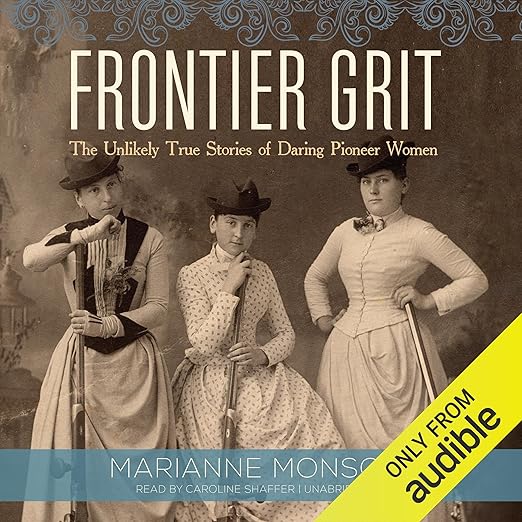
I finished Frontier Grit on a long train journey, somewhere between cities, and I spent the last twenty minutes sitting quietly with it rather than immediately reaching for the next thing in my queue. Marianne Monson’s book does something that collections of this kind rarely manage: it makes each of its twelve subjects feel genuinely distinct. The women profiled here, a former slave named Clara, a girl who disguised herself as a man to become the greatest stagecoach driver of her era, a Native American woman named Gertrude who fought to give her people a political voice, are not presented as interchangeable figures in a genre-painting of Western womanhood. They are specific people with specific circumstances and specific kinds of courage.
The book wears its inspirational ambitions openly. Monson ties each historical story to the experiences of women today, and the connecting tissue is sometimes more thematic assertion than deep argument. But the profiles themselves are strong enough that this doesn’t significantly undermine the experience. When you have twelve lives as extraordinary as the ones collected here, the editorial framework matters less than the subjects themselves.
Our Take on Frontier Grit
Monson is not an academic historian and does not pretend to be. The profiles are narrative rather than scholarly, and the sourcing is not footnoted in the audiobook format. What she does well is synthesis and storytelling. Each entry is compressed enough to maintain momentum but spacious enough to give the subject genuine dimension. Clara’s story, spanning six decades from slavery through freedom and reunion with her daughter, is one of the book’s most affecting, and Monson handles it without sentimentality while still allowing its emotional weight to land fully.
Charlotte’s story, the young woman who hid her gender to pursue life as a stagecoach driver, benefits from Monson’s instinct to resist easy myth-making. She acknowledges the historical complexity of Charlotte’s choices without reducing her to a simple feminist icon. Gertrude’s profile, as a Native American intellectual and activist who worked within and against American institutional structures, is perhaps the most politically nuanced in the collection, and it rewards careful listening.
Why Listen to Frontier Grit
Caroline Shaffer’s narration is a consistent pleasure across the book’s five hours and forty-eight minutes. She brings genuine warmth to the material without sliding into the saccharine register that inspirational collections sometimes invite. Each profile has a slightly different emotional register, and Shaffer adjusts her pacing and tone accordingly. The result is a listening experience that feels varied and attentive rather than uniform.
One reviewer noted that the prose flows exceptionally well, without the rough edges or unclear transitions that even good non-fiction sometimes carries. That observation holds in audio. The book is clean on a sentence level, which makes it an easy and pleasurable listen even when the material being described is difficult, which it sometimes is. Clara’s experiences as a slave and Gertrude’s battles against institutional racism are not minimized in the telling.
What to Watch For in Frontier Grit
At five hours and forty-eight minutes covering twelve subjects, each profile is necessarily compressed. Readers who emerge from a particular story wanting significantly more will need to seek out longer biographical treatments on their own. Several of the women profiled here, including Gertrude Bonnin, known as Zitkala-Sa, have been subjects of full-length books and deserve that extended attention. One reviewer’s comment that the book felt like the tip of the iceberg was meant as frustration but also functions as endorsement: each story is interesting enough to want more of.
The framing, which connects each historical profile to contemporary women’s experiences, is the most editorializing element of the book. Readers who prefer their history without explicit motivational scaffolding may find these connective passages slightly intrusive. They are brief, however, and do not significantly disrupt the flow of the individual profiles.
Who Should Listen to Frontier Grit
This is an excellent listen for anyone interested in women’s history, the American West, and the stories that mainstream historical narratives have typically excluded. It works particularly well as an introduction for younger listeners or for readers who want to identify figures for deeper research afterward. Each profile functions as a starting point rather than a complete account, which can be a virtue if you treat it that way.
Listeners looking for a rigorous historical study will want to supplement it with primary or secondary scholarship. But as a narrative introduction to twelve extraordinary lives, told with care and genuine respect for each subject, Frontier Grit earns its place in the library of American women’s history.
Frequently Asked Questions
Are all twelve women profiled American-born, or do some come from elsewhere?
Monson explicitly includes women who came to the West from all points of the globe, so the backgrounds are genuinely diverse. The subtitle’s reference to global origins is reflected in the collection.
How does Caroline Shaffer handle the tonal range across such diverse lives?
Skillfully. She adjusts her pacing and emotional register for each profile, so the listener experiences genuine variety rather than a uniform inspirational tone across the full runtime.
Does the book address the complicated relationship between settler women and Native peoples?
To some degree. Gertrude’s profile as a Native American activist is one of the book’s more politically nuanced entries, and Monson does not present westward settlement as straightforwardly heroic. That said, the book’s primary orientation is celebration rather than critique.
Is Frontier Grit appropriate for younger listeners, or is the content too mature?
Most of the content is suitable for older children and teenagers, and several reviewers noted the book’s particular value as an introduction to women’s history for younger readers. Clara’s story addresses slavery with appropriate gravity, which some parents may want to listen alongside their children.