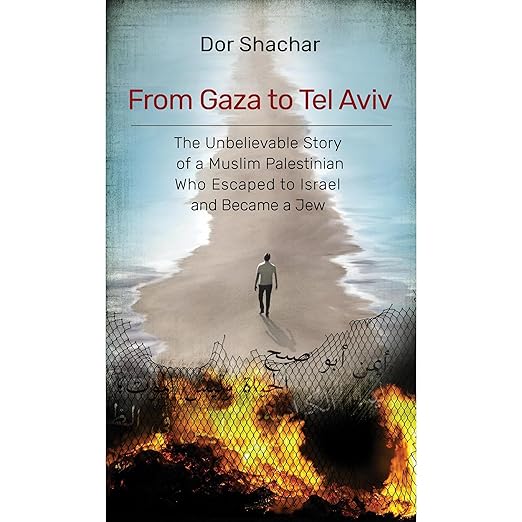
- Subjects: Conversion, survival, exile, chosen identity, advocacy.
- Tone: Urgent, partisan, unsparing.
- Bottom line: A rare first-hand account undercut by a synthetic reading that strips testimony of the one thing testimony needs.
Testimony carries its own rules, and this audiobook follows them from the opening minute. Ayman Abu Soobuch was born in 1977 in Khan Yunis, in the middle of the Gaza Strip, the third child of a Muslim family. What follows is an account of violence, persecution, social exclusion and constant threat: being handed over to the Palestinian Authority, tortured in a Gaza prison, then fighting a second long battle inside Israel against an unsympathetic police force, exploitative employers and the bureaucracy of religious conversion. Four hours and six minutes is the whole of it.
Beyond Imagining, Yet He Persevered
Conversion narrative and political argument arrive here fused together, and the description makes no attempt to separate them. The man who tells this story now travels the world advocating for Israel under a name he chose, Dor Shachar, which the copy translates as a generation of love and the dawn of a new day. That closing frame tells you exactly what kind of book this is. It ends where the argument needs it to end, and the earlier suffering is presented as the road to that destination rather than as material examined for its own sake.
March 2026 brought the response that gets closest to why this story has an audience, framing the improbability at its center. "How a person born in Gaza, steeped in hatred of Jews could even conceive of wanting to be Jew is beyond imagining," it says, before noting that "It is difficult to convert to Judaism even under the best of conditions" and that this man "not only persevered but suffered greatly for it." That reaction is the book's engine. Whether you find it moving or find it too neat will depend largely on what you already think, and the recording makes no effort to meet a skeptical listener halfway.
A Childhood Most Listeners Know Only as a Headline
First-hand accounts of ordinary life inside Gaza are genuinely scarce in English, and the early chapters carry material that no amount of reporting substitutes for: a childhood, a family structure, a neighborhood, the texture of growing up somewhere that most listeners know only as a headline. The description says as much itself, arguing that the honest answer about life there sits in a life story rather than in a news broadcast. On that specific claim the book is on solid ground.
January 2026 supplied a response showing who the natural audience already is, opening with following the author on social media and being anxious to read the fuller journey, then landing on the lesson taken away about pursuing your own path whatever the obstacles. That is the shape of the readership: people who have encountered the advocacy first and want the biography behind it. Coming to the book without that prior contact is a different experience, and a colder one.
Compression works in its favor. Four hours cannot sustain a tract, so the material stays anchored to incident, and the sequence of prison, escape, employment and bureaucratic grinding keeps moving. Listeners who bounce off long memoirs will appreciate that this one asks for a single afternoon and delivers a complete arc inside it, from Khan Yunis to a new name and a public role.
Torture and Paperwork in the Same Flat Register
Virtual Voice reads it, and no material is worse served by that than testimony. The whole force of an account like this rests on a human being reporting what happened to a human being, and synthetic speech puts a flat machine between the listener and the claim. Sentences about torture and about the death of a childhood arrive in the same register as sentences about paperwork. Anyone who has heard a survivor read their own words knows what the difference costs, and here you are paying it for four straight hours.
Love Over Hatred, Light Over Darkness
Written responses arrived before the recording did. The earliest, filed in November 2025, calls this a very important work for anyone wondering what life is really like in Gaza, and a December 2025 entry praises the account of childhood, but this recording is dated February 2026, so those grades belong to an earlier version of the book. Of the five responses visible, three predate the release, and the 4.8 across 56 ratings is best read as a verdict on the text rather than on this edition.
Filing and length both need flagging. The record sits partly under sports and outdoors with an Adventurers, Explorers and Survival tag, which no buyer looking for this book would ever search, and the copy's register is openly partisan, naming specific individuals as monsters and closing on a triad of life over death, love over hatred, light over darkness. Four hours to cover a life from 1977 to the present also means long stretches are summarized rather than shown, and the conversion bureaucracy gets more page time than the childhood does.
Faith and Identity, More Than Geopolitics
Readers of conversion narratives, anyone already following the author's public advocacy, and listeners who want a first-hand account of a Gaza childhood will find the four hours worth spending. A second March 2026 response sums up that constituency in six words, calling it a great book of a hero, and the book is written for people prepared to use that word. Faith and identity are its true subjects, more than geopolitics.
Look elsewhere for balanced reportage, historical background, or any voice other than the one telling the story, because none of those is offered and none is pretended. Listeners who need sourcing before they accept an account will find nothing to check. What this is, plainly and without apology, is one man's witness to his own life, delivered by a machine, and both halves of that sentence should factor into the decision.
Questions Listeners Ask
Is the From Gaza to Tel Aviv audiobook read by a human narrator?
No. Virtual Voice appears in the credit field, which means machine-generated speech rather than a recorded reader. On a survivor's account that costs more than it would elsewhere, because passages describing imprisonment and torture arrive in exactly the same register as passages about paperwork and employment disputes.
Are Ayman Abu Soobuch and Dor Shachar the same person?
Yes. The description tells the story under the birth name and explains that Dor Shachar is the name adopted later, translated in the copy as a generation of love and the dawn of a new day. The listing byline uses the adopted name, which can look like two people at a glance.
Does this audiobook provide historical context on Gaza?
Very little. The book is personal testimony rather than history or reportage, and the copy is explicit that the answer it offers comes from one life story rather than from analysis. Listeners wanting background, competing accounts or sourced claims will need to bring those from somewhere else.
Do the ratings on this page apply to the audio edition?
Only partly. Feedback is merged across every format of a title, and three responses out of the five on display were filed before the February 2026 audio release date. The 4.8 average across 56 ratings therefore reflects earlier versions of the book far more than it reflects this recording.