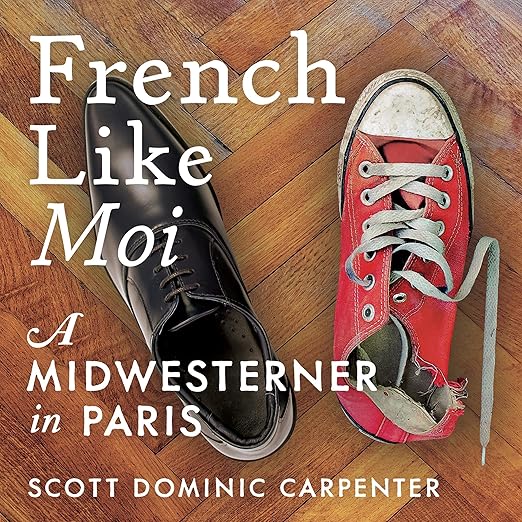
Quick Take
- Narration: Scott Dominic Carpenter reads his own work, which gives the prose its intended rhythms and deadpan timing, though the self-narration occasionally lacks the range a professional might bring.
- Themes: Cultural dislocation, the comedy of expat life, Midwestern identity abroad
- Mood: Dry and amused, with an underlying affection for the absurd
- Verdict: An entertaining collection of essays about living in Paris that works best when Carpenter stops trying to explain France and simply observes it.
I finished this one over the course of several early mornings, which turned out to be the right setting. There is something in the dry, wry quality of Scott Dominic Carpenter’s prose that suits a cup of coffee and a few uninterrupted minutes before the day begins. French Like Moi is not a travel guide. It is not a love letter to Paris. It is closer to a series of dispatches from a man who moved from Minnesota to one of the most culturally opinionated cities in the world and found himself continually, cheerfully outmaneuvered.
Carpenter is a literature professor who had spent years studying French culture before actually living inside it. That gap between academic knowledge and lived experience is where the book finds most of its material. He knows how the cheese conversation is supposed to go. He has read the philosophy. He speaks the language. None of that saves him from getting it wrong in ways that are both instructive and funny.
Our Take on French Like Moi
The book is structured as a collection of linked essays rather than a linear narrative, which suits the audiobook format well. Each chapter is self-contained: a grocery store confrontation, a medical misadventure, a neighborly dispute that escalates through the formal bureaucratic channels the French seem to genuinely enjoy. Carpenter has a gift for noticing the specific detail that makes a cultural difference legible. His observation that Parisians treat the grocery store as a site of intense social negotiation rather than a mere errand is not a new insight, but the way he illustrates it with his own bumbling is genuinely funny.
The book is at its best in those observational moments, and at its weakest when Carpenter reaches for broader conclusions about what makes the French French. Several reviewers noted a tendency toward self-centeredness in the framing, and that is a fair read. There are passages where the Midwestern perspective shades from charming naivety into something that reads more like dismissiveness, and a handful of moments where the authorial voice becomes more interested in scoring a point than in actually understanding the thing being observed. One reviewer used the phrase Ugly American perspective, and while that seems slightly harsh, it points at something real.
Why Listen to French Like Moi
The author narrates his own book, and that is both its primary strength and its occasional limitation. Carpenter has internalized the comic rhythms of these essays in a way that a hired narrator would have to work hard to replicate. The deadpan timing in the funnier passages is his own, and it lands. The limitation is range: where a professional narrator might open up the more tender passages or give different vocal textures to secondary characters, Carpenter defaults to a steady, slightly bemused register throughout. For a book this firmly grounded in one consciousness, that may actually be the right call. What you lose in variety you gain in authenticity.
What to Watch For in French Like Moi
Multiple reviewers note that the first half of the book is stronger than the second. The early essays are tighter, the observations fresher, the comedy more assured. By the later chapters, the format begins to show some strain, as if Carpenter is reaching for material rather than selecting from an abundance of it. One reviewer who has lived in France found the book resonant; another who wanted something more informative was frustrated. The expectations you bring will determine a lot. This is not a book that will teach you France; it is a book that will make you laugh at someone failing to learn it.
Who Should Listen to French Like Moi
Expats and former expats anywhere will recognize the particular comedy of Carpenter’s situation. Listeners who enjoy cultural humor in the vein of Bill Bryson, or who simply find the collision of Midwestern practicality and Parisian formality inherently comic, will have a good time. Skip it if you’re looking for practical insight into French life or deeper cultural analysis. Come to it if you want something light, dry, and genuinely amusing to take on a walk.
Frequently Asked Questions
Is French Like Moi structured as a continuous narrative or as separate essays?
It is a collection of linked essays, each focused on a specific experience or observation from Carpenter’s time in Paris. They can be listened to independently, though they build a cumulative portrait of expat life over the full run.
Does the book require familiarity with French culture or language to appreciate the humor?
No. The comedy largely comes from Carpenter’s outsider perspective, and most of the jokes land on the basis of recognizable human situations rather than cultural specialist knowledge.
How does the author-narrated format compare to professional audiobook narration?
Carpenter brings authentic comic timing to his own prose, which is a genuine advantage. The trade-off is vocal range: he maintains a consistent register throughout rather than differentiating characters or moods the way a professional narrator would.
Is this more of a Paris love letter or a comedy of cultural frustration?
Firmly the latter, with affection underneath. Carpenter is not charmed by Paris so much as he is endlessly baffled by it, and his book captures that more honest, more complicated relationship with the city.