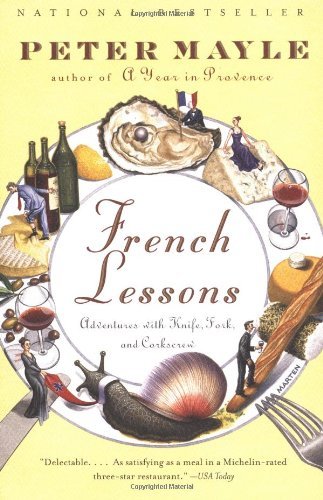
Quick Take
- Narration: Simon Jones brings a warmth and gentle wit to Mayle’s prose that feels entirely natural, as if someone is reading you a letter from a friend who happens to live surrounded by extraordinary food.
- Themes: French culinary ritual, the pleasures of obsessive gastronomy, regional identity through food
- Mood: Indulgent and sun-warmed, like reading on a terrace with something good in your glass.
- Verdict: An unashamed celebration of French food culture that makes no apologies for its pleasures and delivers exactly what it promises.
I listened to French Lessons during a week when I was eating badly and working too hard, which may have been exactly the wrong time, or exactly the right time, depending on how you feel about craving something you can’t immediately have. Peter Mayle’s guided tour through France’s food festivals and culinary obsessions is the kind of book that produces a very specific physical response: you want to eat. Not just anything. You want to eat well, in France, in the company of people who treat the act of eating as the serious business it deserves to be.
Mayle is best known for A Year in Provence, the 1989 book that effectively created the template for the affectionate-expatriate-in-France memoir. French Lessons is narrower in focus: it’s specifically a book about food and drink, structured around a series of festivals, competitions, and rituals that Mayle attended across different regions. The Foire aux Escargots. A marathon where the hydration station offers Chateau Lafite-Rothschild rather than water. A quest to locate the most pungent cheese in France. A Catholic mass in the village of Richerenches where the object of devotion is the black truffle.
Our Take on French Lessons
What Mayle does exceptionally well is find the absurdist joy in French food culture without condescending to it. The marathon where runners pause for wine is funny, but Mayle’s description makes clear that it is also, in some essential way, correct. The French relationship to pleasure, his book argues gently and repeatedly, is not decadence but a form of serious engagement with the quality of life. Listening to him describe the debate over the proper way to prepare an omelet, conducted with the gravity reserved for matters of genuine importance, produces the kind of amused recognition that travel writing at its best is supposed to generate: that somewhere, people have organized their priorities in ways that make your own life look slightly impoverished.
The Richerenches truffle mass is the chapter I found most memorable. Mayle attends a Catholic service where the collection plate receives black truffles, and where the most aromatic and expensive fungi in the world are treated with the solemnity of relics. The passage captures something about the French capacity to invest ordinary objects with ceremony without making that ceremony feel silly. It’s the best kind of travel writing: specific enough to feel real, observed with enough affection to avoid mockery, and strange enough to delight.
Why Listen to French Lessons
Simon Jones is an excellent choice for this material. His narration has the quality of an Englishman who has been in France long enough to have genuine affection for it without losing the outsider’s sense of gentle bewilderment at certain extremes of French dedication. This is the exact register Mayle writes in, and Jones captures it accurately. The five-hour-and-forty-five-minute runtime is perfect for this kind of book: substantial enough to develop the book’s pleasures fully, compact enough to be completed over a long drive or a few evenings.
The book requires no prior knowledge of France or French cuisine. Mayle writes for readers who are curious rather than expert, and his explanations of what makes a truffle extraordinary or why a particular cheese competes for the title of most pungent in the country are woven into the narrative rather than delivered as lectures. He assumes you want to know, and then tells you in a way that confirms you were right to want to.
What to Watch For in French Lessons
This is not a book with a story arc or a thesis. It is a collection of experiences organized loosely by geography and obsession, and the pleasures are episodic rather than cumulative. Listeners who need a book to be building toward something may find the structure somewhat open-ended. It’s better approached as a series of very good long-form essays than as a conventional narrative nonfiction book.
It’s also worth noting that the France Mayle depicts is a particular France: rural, provincial, traditional, organized around festivals and rituals that exist in genuine tension with the modernizing forces that have transformed French food culture since the book’s publication. This is not a book about contemporary French cuisine or Parisian restaurants. It’s a book about deep-rooted regional practices that Mayle found at their most vital, and some of what he describes has changed in the years since.
Who Should Listen to French Lessons
Readers who loved A Year in Provence and want more of Mayle’s company will find this a welcome continuation, narrower in scope but equally pleasurable in execution. Listeners who enjoy food writing with a strong sense of place, think M.F.K. Fisher or Bill Buford, will respond to the specificity of Mayle’s observations. Those who want travel writing with dramatic stakes or geopolitical substance should look elsewhere: this is a book about pleasure, written by someone who takes pleasure seriously, and it makes no apologies for its priorities.
Frequently Asked Questions
Do I need to have read A Year in Provence to appreciate French Lessons?
No. French Lessons stands entirely on its own as a collection of food and travel writing. Familiarity with Mayle’s voice from the earlier book adds warmth but isn’t required, and the subject matter here is more focused on specific gastronomic events rather than the expatriate experience.
Is French Lessons structured as a narrative or as a series of essays?
It reads as a series of linked essays, each organized around a different food festival, competition, or culinary obsession that Mayle attended. There is no overarching story arc. The pleasures are episodic, and the book rewards dipping into individual chapters as much as listening straight through.
Does Simon Jones’s narration suit Mayle’s particular brand of Anglophone affection for France?
Very much so. Jones brings exactly the right combination of warmth and gentle amusement that Mayle’s prose requires, and his performance feels natural to the material in a way that enhances the listening experience.
How does French Lessons compare to more recent food travel writing in the M.F.K. Fisher tradition?
Mayle is more accessible and anecdotal than Fisher, less literary in ambition but more immediately entertaining. He writes for readers who want to enjoy France vicariously rather than readers seeking profound meditation on food and culture. The comparison to Bill Buford’s Heat or Ruth Reichl’s travel writing is perhaps closer in spirit.