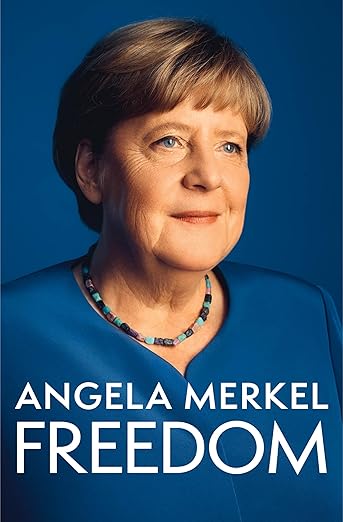
Sixteen years running one of the world's most powerful economies compress into a surprisingly short listen here, and that gap between subject and runtime is the first thing worth knowing before buying this audiobook. Angela Merkel's memoir traces her path from East Germany, before reunification, into the Chancellorship, the first woman ever to hold that office in Germany, and through sixteen years of decisions made in Berlin, Brussels, and beyond. Juliet Stevenson narrates, at two hours and twenty-seven minutes, working out to under ten minutes of listening for every year Merkel spent in power, which is worth sitting with before pressing play.
Two Registers Inside One Political Memoir
The synopsis promises a genuinely comprehensive account: Merkel's rise through the Christian Democratic Union from an East German scientist to the first woman to lead the party and then the country, daily life inside the Chancellor's office, and the specific dramatic nights where far-reaching decisions got made under real pressure. Reviewer Average joe, who lived in Germany for six years, opens by asking 'how to summarize 600 pages in a few lines?', before praising how the book 'displays simplicity and honesty' throughout, even while documenting major political achievement at the highest level.
Beyond the personal biography, the synopsis frames Freedom as a meditation on power itself, Merkel reflecting on politics in a time of increasing confrontation and division and offering what the book calls a timely plea for freedom. That reflective, essayistic layer sits alongside the more straightforward chronological memoir material, giving the book two registers: the personal political history and the broader argument about what freedom actually requires from leadership during unstable periods.
Political memoirs from heads of government tend to split into two camps: the sprawling, multi-volume account built to be the definitive historical record, and the shorter, more reflective essay built around a handful of central arguments rather than exhaustive chronology. Based on the synopsis's own framing, a 'determined and timely plea for freedom' rather than a blow-by-blow governing record, Freedom reads closer to the second camp in intent, even though the print edition's actual length suggests the full version delivers considerably more chronological detail than that reflective framing alone implies.
Stevenson Trusts the Text, Skips the Accent
Juliet Stevenson is among the more accomplished voices working in English-language audiobook narration, known especially for tonal precision and genuine emotional restraint rather than performative range. Those qualities suit a political memoir specifically: a stateswoman's reflections need a narrator who can convey gravity without tipping into melodrama, and restraint of exactly that kind is Stevenson's established strength across her catalog. For material this consequential historically, that measured delivery matters more than flashier narration would.
Reviewer Barbara H adds a genuinely useful production detail: the English translation reads roughly across its first couple of chapters, in her words reflecting 'the work of one too many translators,' before it 'vastly improves past the first couple of chapters.' That is worth knowing going in, both because it sets accurate expectations for the opening and because it means listeners who find the first chapter or two rough should stick with it rather than assuming the whole book reads that way throughout.
Stevenson's catalog spans literary fiction, memoir, and nonfiction across decades of work, and the throughline across that range is consistently the same: she trusts a text's own weight rather than adding vocal color to compensate for material she judges as insufficiently dramatic on its own. A memoir built around measured reflection on power and freedom, rather than dramatic set-piece storytelling, specifically rewards that trust-the-text approach rather than punishing it the way a livelier narrative might reward more theatrical narration instead.
The pairing of a German-born subject with a British narrator is also worth noting as its own small production choice: Stevenson is not attempting a German accent or affect, reading the English translation in her own natural register instead, which keeps the focus on the content and argument rather than on any performed sense of foreignness.
Under Three Hours Signals a Condensed Edition
The listed runtime here, well under three hours, is dramatically shorter than what a comprehensive sixteen-year political memoir, one a reviewer describes running some 600 pages in print, would typically need in an unabridged audio edition. That strongly suggests this specific listing is a condensed, highlights, or excerpted edition rather than the complete memoir, and listeners who want the full, unabridged account of Merkel's Chancellorship should verify exactly which edition they are buying before committing, rather than assuming this audio version carries everything the print edition does.
Reviewer Lupine Smile calls the book 'surprising well paced' and says it 'did not drag', which reads differently once the actual runtime is known: pacing that does not drag across two and a half hours is a much easier bar to clear than sustaining that same quality across the twenty-plus hours a memoir this size would typically run unabridged. That is not a knock on the writing itself, but it does mean the listening experience here is closer to a compressed overview than the immersive, detail-heavy political memoir some listeners may expect going in.
A Guarded Chancellor Asked for Personal Reflection
Merkel built a reputation over sixteen years as an unusually private, reserved public figure even by the standards of career politicians, famously guarded about her personal life and decision-making process while in office. A memoir titled Freedom, built around personal reflection on power, asks her to do something she rarely did publicly during her actual chancellorship, which makes the book's existence at all a meaningfully different proposition than a memoir from a more naturally self-disclosing political figure would be.
Practically, this means a listener specifically wanting the complete memoir should check the audiobook's chapter count or sample a preview before buying, since a short runtime like this one is not always flagged as clearly as an abridgment in a listing's title or description as this specific discrepancy would suggest it should be. Comparing against the print edition's table of contents, where available through a retailer's preview feature, is a reasonably reliable way to confirm scope before committing to any audio edition of a major political memoir like this one.
A Short Listen for Listeners Who Already Know Her
Listeners wanting an efficient, well-narrated overview of Merkel's life and worldview, rather than an exhaustive account of all sixteen years in office, are well served by this specific runtime, and Stevenson's measured narration makes even a short listen feel weighty rather than rushed.
Listeners who already know Merkel's basic political history and want a narrated reflection on her worldview and the meaning of freedom specifically, rather than a first look at her career from the beginning, are especially well matched to a shorter, more essayistic listen like this one.
Readers who specifically want the complete, detailed political memoir, the one covering major decisions across all sixteen years in the depth a 600-page print edition implies, should confirm this audio edition's exact scope before buying, since the runtime here points toward a condensed listen rather than the full account.
The Short Version
- Narration: Juliet Stevenson brings measured, restrained gravity to the material, well suited to a stateswoman's reflective political memoir.
- Themes: German reunification and politics, the Chancellorship, power and freedom
- Mood: Reflective and measured, though compressed given the runtime
- Verdict: A well-narrated but surprisingly brief listen that likely represents a condensed edition rather than Merkel's complete memoir.
Does Angela Merkel narrate the Freedom audiobook herself?
No, Juliet Stevenson narrates this English-language edition.
Is the English translation quality consistent throughout the Freedom audiobook?
One reviewer notes the opening chapters read roughly, reflecting multiple translators, before the translation noticeably improves in the chapters that follow.