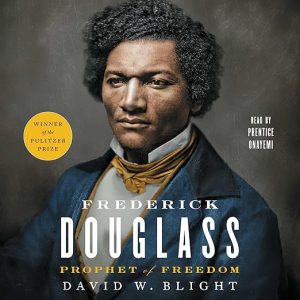
Before You Press Play
- Read by: Prentice Onayemi is the only name attached to this recording, holding thirty-six hours and fifty-seven minutes of analysis, speeches and political context without a second reader.
- At its heart: abolition and oratory, nineteenth-century American politics, marriage and extended family, the making of a public voice
- Vibe: patient, argumentative, built for the long haul
- Short version: A Pulitzer-scale life given a single-voice reading, on a page that tells you nothing about how that reading sounds.
One line in the review column does mention narration. It points at the wrong person. Writing in December 2018, the reviewer who signs as Parker calls Blight's narration engaging and then moves straight to the author's command of the period, so the compliment lands on the prose and not on anybody holding a microphone. That is as close as the five posted responses come to acknowledging that this listing sells an audiobook. Prentice Onayemi, credited with all thirty-six hours and fifty-seven minutes of it, turns up in none of them. That single name ends up being the only account of the listening experience anybody has left behind.
Going Through It Like Christmas Morning Gifts
Blight worked from a private collection the publisher says few other historians have consulted, and from issues of Douglass's own newspapers that surfaced late, and the book is built to spend every page of it. The length follows from that decision. Douglass was born in 1818, escaped slavery in Baltimore as a young man, learned to read inside the household that enslaved him, came up under the mentorship of William Lloyd Garrison, and by the Civil War was the most widely traveled orator in the country. After the war he argued with younger African Americans without ever leaving the Republican party or the cause of civil and political rights.
That research shows in the runtime, and the five responses are unusually clear about what the hours buy. The reviewer who signs as John E. Pepper, who says the number of biographies read goes beyond counting, ranks this among the three finest and calls it the most inspiring, crediting an age close to the one Douglass reached at his death. Rick Maybury names it a personal all-time top ten and wants it assigned in US History and US Civics courses. Ali Mustapha went through it the way a nine-year-old goes through Christmas gifts, hardly the usual verdict on a book of this size.
Onayemi Alone Holds Four Different Registers
Onayemi carries the recording alone, and for a biography of this kind that means holding four registers at once: Blight's analytical prose, Douglass's speeches and letters, the era's correspondents, and long stretches of political argument. No second reader appears anywhere on the listing, and no full-cast note either. What the credit cannot tell you is how the oratory is handled, and for a subject whose whole reputation was built on a speaking voice, that is the one question a listener wants settled before committing three or four weeks of listening to it.
The material Blight adds is domestic as much as political, the part the reviews notice least while changing the portrait most. Real space goes to Douglass's two marriages and to what the publisher's copy calls his complex extended family. Maybury describes the book as a source for understanding a country's cultural and political challenges, successes and failures across the pre-war and post-war eras, accurate enough, though it undersells how much of the drama sits inside one household. Mustapha makes the sharper observation: many biographers fall into a context trap, going so deep into an era that the subject disappears, and this one does not.
Prophet of Freedom Won't Show Up in Search
Douglass biographies are numerous enough that the exact edition matters, and this listing makes identifying it harder than it needs to be. The title field reads Frederick Douglass and stops there. Parker, describing this same work, names it Frederick Douglas: Prophet of Freedom, dropping a letter from the surname and adding a subtitle the listing does not carry anywhere. Anyone searching for Prophet of Freedom will not land here by title alone. The synopsis finds room for the Bancroft, the Parkman, the Lincoln, the Plutarch and the Christopher awards, but the field a search engine actually reads has been trimmed to two words.
Nothing in the five responses describes a listening session. The response filed from the United Kingdom by the reviewer listed as Helsen runs to a single sentence and arrives with its spacing broken apart mid-word, a formatting artifact and not an opinion. The other four are about reading: how it reads, how fast it went, what it should be assigned alongside. For a commitment measured in days of playback that is thin guidance, and it is worth knowing before you spend a credit that the enthusiasm collected here was earned on paper, not in headphones.
Pepper reaches for the word inspiring twice, once in the review title and again in the body, and that deserves to be read as a warning as much as a recommendation. The Douglass assembled here argues with younger African Americans after the war, stays inside party politics, and gets described by the publisher's copy as a fierce critic of the United States and a radical patriot in the same sentence. A listener arriving for a clean hero story gets the escape and the oratory early, then a far more argumentative man for most of what remains.
New to Audio Biography, Start With a Shorter One
Anyone who has read Douglass in his own words and wants the life built around them should start here, and so should listeners drawn to nineteenth-century American politics told through one person and not through a survey. Maybury's suggestion that it belongs on a US History or US Civics syllabus is not far wrong, though a syllabus would assign chapters and this format does not divide neatly. Casual attention will not survive it. The listeners best served already have long-form history in their rotation and want a subject worth the hours.
Because the column says nothing usable about the recording, the honest advice is to sample first. How Onayemi handles the speeches will decide whether this works for you, and nobody on this page has tested that in public. Wait for a shorter book if you are new to audio biography, since thirty-six hours and fifty-seven minutes is a poor place to discover that the format does not suit you. The material is not the risk here; the length and the silence around the performance are.
Listeners who want the Pulitzer-winning life and can give it a few weeks of steady playback will find the research more than justifies the hours. Those who mainly want a portrait of a great public voice have to take the reading on trust, since one name is the only piece of evidence on offer. Onayemi does the work alone, across thirty-six hours and fifty-seven minutes, and the biography underneath is worth every one of them.
Frequently Asked Questions
Is the audiobook of Frederick Douglass the complete biography or a condensed version?
Nothing here indicates a condensed edition, and the runtime supports the full text: thirty-six hours and fifty-seven minutes fits a Pulitzer-scale biography read straight through. Prentice Onayemi is credited as the sole reader, with no second voice named. If you want certainty before spending a credit, the sample is the only check available before you commit.
Why do reviewers call this book Prophet of Freedom when the title field does not?
The listing title reads Frederick Douglass and stops, while a December 2018 response names the same work Frederick Douglas: Prophet of Freedom, subtitle included and one letter missing from the surname. Both versions circulate. Nothing here reconciles them, so match on runtime and publisher instead of on the title string.
Does the audiobook still work if you already know Douglass from his own writing?
That is arguably the best way in. Blight builds from a private collection the copy says few historians have consulted and from late-surfacing issues of Douglass's newspapers, so most of the material adds to what you already know. Readers who know the escape narrative already get the two marriages, the extended family and the postwar political fights.
How much of this audiobook is period context and how much is Douglass himself?
Both, in a proportion one reviewer treats as the central achievement. Ali Mustapha praises Blight for keeping the man visible where other biographers let a period swallow its subject, which is the standard failure of nineteenth-century lives. Expect long passages on abolition, the war and party machinery, all of it tied back to one person.