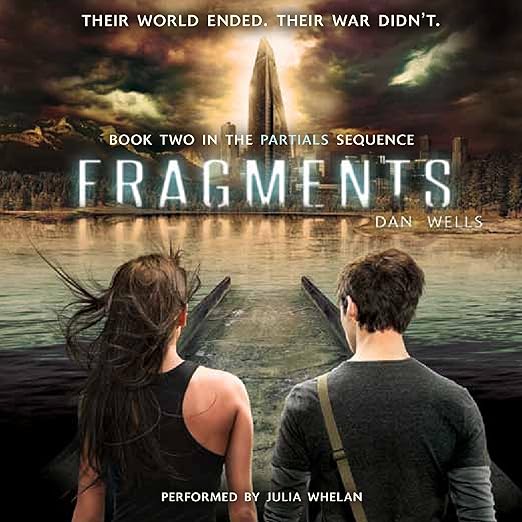
Marilyn Monroe's own handwriting is the real subject of this audiobook, not the postapocalyptic plot described in this listing's attached synopsis and reviews, which actually belong to a different, unrelated book that happens to share the same one-word title. The real Fragments collects poems, private notes, and letters found among Monroe's own papers, intellectual, searching, often unfinished pieces of writing she never intended for publication, gathered and introduced after her death. Julia Whelan narrates, working from Monroe's actual words rather than any invented voice.
A Genre Collision With Kira Walker's Postapocalyptic America
The collision is worth naming precisely: the synopsis and all three attached reviews describe Dan Wells's Partials Sequence book two, a real, unrelated young adult science fiction novel about a character named Kira Walker searching for a cure amid a ravaged postapocalyptic America. That book exists, it's just not this listing, and it's worth saying clearly that nothing is wrong with Wells's novel either, it's simply a separate, well-regarded work that happens to share a one-word title with Monroe's collection. The genre tags attached here, biographies-memoirs, literature-fiction, and specifically Diaries & Correspondence, match Monroe's real book precisely and don't fit the mismatched science fiction content at all, which is the clearest evidence of which book this actually is.
Decades of Private Papers Reveal a Serious Reader
What the real book contains matters more than the mix-up itself. These fragments offer evidence of Monroe as a serious reader and thinker, someone who kept a substantial personal library, by some accounts numbering in the hundreds of volumes, that included serious literary fiction, studied acting seriously under demanding teachers, and wrote reflectively about her own inner life in ways almost entirely absent from her public image. The material is presented honestly as incomplete and sometimes raw, unpolished drafts and private notes rather than finished literary prose meant for an audience.
The project behind the book itself is part of what gives it weight: these pages were kept privately for decades among people close to Monroe before eventually being gathered, transcribed, and introduced for publication. That means listeners are hearing material that was never filtered through a biographer's interpretation or a journalist's framing first, which is a genuinely rare thing for a figure this heavily mythologized and second-guessed by outside observers.
Monroe's serious study of acting, at the Actors Studio under Lee Strasberg's demanding method-acting approach, is well documented and directly relevant to how these fragments read. Notes on craft, on emotional truth, on the discipline of the work itself surface throughout, evidence of an actress who treated her own training with real intellectual seriousness, not just the glamour her career is more often remembered for.
The book's original publication drew significant press attention specifically because of that contrast: a culture already saturated with Monroe's public image encountering, for the first time in her own unfiltered words, evidence of real intellectual ambition underneath it. That reception is worth knowing going in, since it shapes what kind of listening experience to expect, more revelation than confirmation of what audiences already assumed.
Whelan Reads Fragments That Never Resolve Grammatically
Julia Whelan's established register as a narrator, precise emotional restraint, an instinct for inhabiting a voice rather than performing it, is close to ideal for reading someone else's private, unfinished writing without over-dramatizing it into something it was never meant to be, more like overhearing something personal than watching a polished, scripted act. That restraint matters enormously here, since the temptation to add drama to Monroe's own words would badly misrepresent material that's compelling precisely because it wasn't written for performance.
Audio carries a specific value for this kind of book that print doesn't automatically deliver: hearing private notes and poems read aloud creates an intimacy that a silent page of someone else's crossed-out drafts doesn't reproduce on its own. For material never intended to be public in the first place, having it spoken rather than simply printed changes the experience meaningfully.
A real technical challenge sits underneath the emotional one: fragments, by definition, don't always resolve grammatically. A private note or an unfinished poem can trail off mid-thought in ways a finished manuscript never does, and reading that aloud smoothly, without either forcing false closure onto an incomplete sentence or making the incompleteness sound like a mistake, takes real narration skill. Whelan's established restraint elsewhere suggests she treats those unresolved moments as genuine content, not noise to smooth over.
Treat the Runtime and Rating Figures With Skepticism
This isn't a narrative memoir with chapters and a throughline; it's a curated collection of fragments, exactly as the title says, meaning listeners expecting a conventional start-to-finish life story will instead find something more impressionistic and nonlinear, closer to an archive than a narrative.
Given how thoroughly the rest of this listing's metadata is contaminated by the Dan Wells mismatch, the stated runtime and rating figures should be treated with real skepticism rather than assumed to accurately describe this specific product. Confirming details directly before committing to a purchase is a reasonable precaution here in a way it usually isn't.
Too Varied to Flatten Into Image or Tragedy
Because the fragments were written across very different periods of Monroe's life, some as a young student, others much later, the tone and voice shift noticeably from piece to piece rather than settling into one consistent register. Listeners expecting the steady, unified voice of a conventional memoir should adjust expectations toward something closer to an anthology.
Posthumous collections built from a public figure's private papers always carry real ethical questions worth sitting with honestly: material never meant for an audience is now one, decades after the person who wrote it could weigh in on how it's framed or used. That tension doesn't disqualify the book, private writing has illuminated plenty of historical and literary figures well after the fact, but it's a genuinely different kind of listening experience than a memoir someone chose to write for publication.
The range within the material itself is part of what makes it land: entries move between ordinary daily notes and searching, sometimes startling personal reflection, often without warning or transition. That mix is a large part of the book's real value, it resists flattening Monroe into either the glamorous public image or a single tragic narrative, letting her come across as someone whose interior life was simply larger and more varied than either version allows.
Real Substance for Anyone Curious About Her Intellectual Life
Listeners interested in Marilyn Monroe as a historical and cultural figure beyond the public image, readers of literary biography and archival-writing collections generally, and anyone curious about a major twentieth-century icon's private intellectual life will find real substance here.
Skip it if you actually came looking for Dan Wells's Partials Sequence, that book exists, it simply isn't this listing, or if what you want is a conventional linear memoir with narrative momentum rather than a fragmentary, nonlinear archival collection.
Is this Fragments audiobook Marilyn Monroe's own writing or Dan Wells's Partials Sequence novel?
It's Marilyn Monroe's own collection of poems, private notes, and letters. The synopsis and reviews attached to this listing mistakenly describe Dan Wells's unrelated science fiction novel, which shares only the title, not the actual content.
Why do this audiobook's synopsis and reviews describe a science fiction plot?
This listing appears to have pulled in the synopsis and reviews from a different, unrelated book that also happens to be titled Fragments, Dan Wells's Partials Sequence sequel, rather than describing Monroe's actual collection.
Does this audiobook include Marilyn Monroe's actual handwritten pages?
The print edition reproduces facsimiles of her handwritten pages alongside transcriptions; the audiobook naturally conveys only the words themselves, read aloud, without the visual dimension of seeing her actual handwriting.
Who narrates the real Fragments audiobook?
Julia Whelan, whose established restraint reading literary and memoir material elsewhere makes her a strong fit for private, unfinished writing that was never intended for public performance.