Quick Take
- Narration: David A. Martin’s delivery gives the early Church testimonies the gravity they deserve without tipping into academic dryness, navigating theological material with clarity.
- Themes: Early Christian history, patristic testimony, the continuity between apostolic and contemporary faith
- Mood: Reverent and intellectually engaged, accessible without being simplified
- Verdict: Rod Bennett has written the rare early Church history that reads like discovery rather than scholarship, and Martin’s narration makes it a satisfying audio experience for believing and curious listeners alike.
I came to Four Witnesses at the recommendation of a colleague who studies patristics, who described it as the book she gives to people who want to understand the early Church without being buried in source material. Having listened through it twice, once quickly, once with more attention to the theological arguments, I think that description is accurate. Rod Bennett has done something genuinely useful here: he has taken four of the most significant witnesses to early Christianity and made them feel like people rather than footnotes.
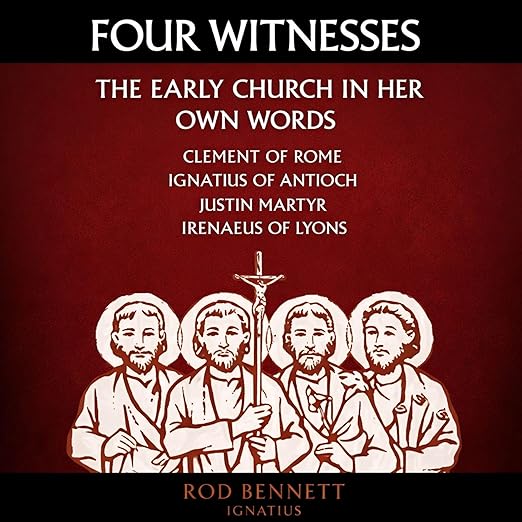
The four figures are Clement of Rome, Ignatius of Antioch, Justin Martyr, and Irenaeus of Lyons. Each left substantial documentation on what the early Church believed, practiced, and argued over. Bennett structures his account around these four lives and writings, drawing extensively from the primary sources while embedding them in the historical context needed to make them intelligible to a modern reader. The synopsis promises all the power and drama of a gripping novel, which is marketing language I would normally treat with skepticism. In this case the claim is partially earned: Bennett writes with a novelist’s instinct for scene and character, which keeps the material alive.
What Bennett Gets Right About Access Without Sacrifice
The central challenge of a book like this is that early Church history is genuinely complex, theologically, historically, and textually, and the audience for popular treatments of it is often split between believers who want confirmation and skeptics who want critique. Bennett is writing for believers, and he is transparent about that. His own journey from evangelical Protestantism toward a deeper engagement with the Catholic tradition is part of the book’s personal layer, most visible in the final chapters, and it shapes the argument throughout.
One reviewer who has read all thirty volumes of the early Church fathers described the book as not only faithful in quoting accurately but also providing valuable historical background that they missed in reading the full set. That is a meaningful endorsement from someone in a position to evaluate the accuracy. Another reviewer who found the book slightly disappointing noted that they had hoped for full texts of the fathers’ writings, which Bennett does not provide. This is worth knowing: Four Witnesses is an introduction and guide, not an anthology. The primary sources are quoted extensively but selectively, in service of Bennett’s argument.
The Patristic Voices and How They Land in Audio
David A. Martin’s narration handles the material with appropriate seriousness. He is particularly effective in the sections where Bennett quotes directly from the four witnesses, giving the ancient texts enough weight to distinguish them from the surrounding commentary without making them feel like a separate register. The theological vocabulary is handled cleanly, Martin does not stumble over Greek terms or stumble over the more complex doctrinal arguments, and the pacing respects the density of the material.
At eight hours and forty-five minutes, the book covers substantial ground without feeling rushed. The chapter on Irenaeus of Lyons, who argued against early Christian heresies with a systematic rigor that anticipates later theological method, is among the stronger sections. Bennett’s instinct to show Irenaeus in his context, the late second century, when the boundaries of orthodoxy were actively contested, makes the abstract theological arguments feel like live debates rather than settled conclusions.
What the Book Asks the Reader to Accept
Four Witnesses has a thesis, and it is not neutral. Bennett argues that the early Church’s testimony is continuous with contemporary Catholic and Orthodox Christianity in ways that challenge Protestant claims to historical authenticity. He makes this argument through the four witnesses rather than through polemic, which is a more effective approach, but listeners should know that the book is written from a particular theological position and is building toward particular conclusions.
One reviewer described the author’s personal final chapters, in which Bennett, as an evangelical Christian, recounts his own inability to find his theological tradition in the early Church’s testimony, as particularly vulnerable and moving. I agree. Those chapters are the most honest in the book, and they earn the argument that preceded them by acknowledging the cost of following evidence to uncomfortable conclusions. Not all readers will find those conclusions persuasive, but the honesty of the presentation is not in question.
Who Should Listen, Who Should Skip
Listen if you are interested in early Christian history, if you are navigating questions about the continuity between the ancient Church and contemporary Christianity, or if you are looking for an accessible entry point into patristic literature that does not require a seminary background. Skip if you are looking for a neutral, academically detached account of early Christianity, or if you want the primary source texts in full rather than curated quotation. This book has a point of view, and it does not hide it.
Frequently Asked Questions
Do you need a background in theology or Church history to follow Four Witnesses?
No. Bennett writes with a general reader in mind and explains historical and theological context as he goes. Some familiarity with basic Christian history helps, but the book is designed as an entry point, not a graduate-level text.
Is this book written from a Catholic perspective, and does that affect its usefulness for non-Catholic readers?
Yes, Bennett writes from a position sympathetic to Catholic and Orthodox claims about continuity with the early Church. Protestant and secular readers will find the argument interesting and the historical material accurate, though they may not share the book’s conclusions. The personal chapter at the end, in which Bennett as an evangelical confronts his findings, adds a dimension of genuine intellectual honesty.
Does David A. Martin’s narration handle the theological and historical vocabulary clearly?
Yes. Martin navigates Greek terms, doctrinal concepts, and the quoted texts from the four witnesses without stumbling. The pacing is measured and respectful of the material’s density, and he maintains a clear distinction between Bennett’s commentary and the primary source quotations.
Is the book primarily about the theological arguments of the early Church, or does it cover the historical and biographical context too?
Both, with the biographical and historical context given significant attention. Bennett places each witness in their specific historical moment, the persecutions, the internal debates, the political pressures, and the theological arguments emerge from that context rather than being presented in abstraction.