Before You Press Play
- Read by: Cyndi B. Galloway is the only credit on nearly fifteen hours of case file, with no sample and no second voice to share the load.
- At its heart: Genetic genealogy, victim portraiture, the machinery of a plea deal.
- Vibe: Methodical and grim, closer to a case file read aloud than to a podcast.
- Short version: Sound on the forensics, unreliable on the page around it; the star badge cannot be trusted.
The two reviews attached to this audiobook were both posted before the date the listing itself gives for its release. Amazon stamps them October 25 and December 31 of 2025; the release date printed on the page is January 14, 2026. Nothing here explains the gap. What those two people describe may be this recording, may be an earlier edition of the same text, or may be neither, and that matters more than usual when the entire star column consists of them. Worth knowing before you hand fourteen hours of listening to a two-person verdict.
Six Labeled Compartments Instead of a Story
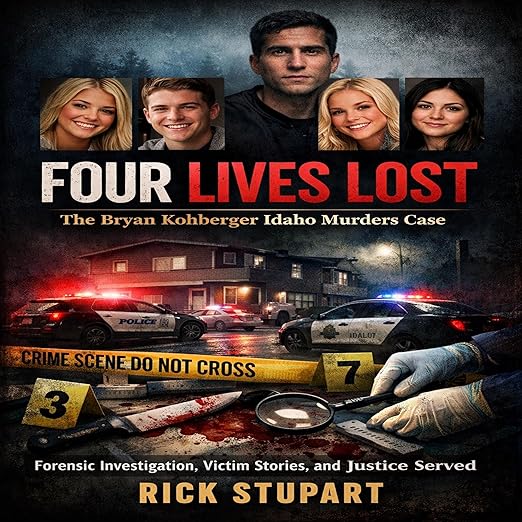
Rick Stupart is writing to a format. This is the fifteenth entry in a series called Infamous Killers: Minds, Motives, and Murders, published by ELC Publishing, and the description advertises its own table of contents: the victims' stories, the crime scene, the digital hunt, the DNA breakthrough, the killer's mind, the legal battle. Six labeled compartments. That is a reference structure rather than a narrative one, and it tells you in advance what shape 14 hours and 48 minutes is going to take. You are not being told a story so much as walked through a case file in a fixed order, which is a legitimate way to build a true crime book and a very different listening experience from the ones that open in a car outside the house and work backward.
The case needs no dramatizing. Four University of Idaho students, Kaylee Goncalves, Madison Mogen, Xana Kernodle and Ethan Chapin, were killed at 1122 King Road in Moscow on November 13, 2022. The investigative hinge, as the description lays it out, is a knife sheath and the genetic genealogy work that turned trace DNA into a family tree and the family tree into a name. The person that name belonged to was a criminology PhD student at Washington State University, studying the discipline that found him. That irony is the engine of the whole book, and it does not need any help selling itself.
The badge over the reviews reads 3.6 from four votes, a number four whole-star votes cannot produce under any rounding rule. Two of those four are visible, and they sit at opposite ends of the scale: a five from Cindy G. and a two from a reviewer signed donna. The two-star response runs to a dozen words and names nothing about the book at all. So the column comes down to one substantive opinion and one shrug.
One Voice, No Cast, No Archival Tape
Cindy G.'s response is the one piece of real signal on this page, and it points at what audio does well with this material. The praise lands on the victim writing: who Kaylee, Madison, Xana and Ethan were to their families, their friends, their university. A book that treats four dead students as people rather than as plot furniture is doing the harder thing, and it is the part of true crime that carries best when spoken, because a reader's pacing can hold a life that a page of bullet points flattens. The review itself misspells Xana as Zana, which is a small argument for hearing those four names said aloud rather than skimmed.
The forensic thread is the other reason to press play. Genetic genealogy is genuinely hard to follow on the page, because it is a branching argument rather than a linear one, and it benefits from being spoken at a steady pace by someone in no hurry. The description promises cell phone data and surveillance footage alongside the DNA, which is the kind of accumulation that actually rewards a long runtime. Fourteen hours is a lot to ask, but it is the right shape for an investigation that ran through thousands of tips and weeks of dead ends before anything broke.
Cyndi B. Galloway carries all of it, and the listing offers no sample and no second credit. What the credit does tell you is the format: one voice, no cast, no archival tape, no interview audio. For a book assembled out of documents and timelines that is the sensible call, though it does mean the whole thing rests on a single reader keeping four young names distinct across a long stretch of procedure.
A Claim No Listener Can Check
The description makes one claim no listener can check: never-before-revealed details about that night. It names no source, no interview and no document, and neither does the page around it. Fifteen entries into a line called Infamous Killers, asking where the reporting came from is not an unreasonable question to raise before buying, and this listing does not answer it anywhere.
Timing is the second thing to weigh. The legal battle the copy promises runs from the arrest through the plea deal that avoided the death penalty, which puts the closing chapters on very recent ground. Cindy G.'s review breaks off mid-sentence while praising the science, so even the enthusiasm here reaches you truncated. Add a release date that both responses predate and the page starts to feel assembled quickly around an event that was still moving.
The third caution is taste rather than quality. This concerns four real people killed in 2022, packaged as entry fifteen in a serial true crime line under a subtitle that stacks three separate promises after a colon. None of that makes the writing bad. It does mean knowing which shelf you are buying from, and it is fair to ask whether a series schedule serves a case this fresh.
Press Play for the Forensic Thread
Press play if you followed the Idaho case in the news and never got the forensic thread assembled in one place. The genealogy sequence, the sheath, the phone records, the surveillance timeline: that material is why the book exists, and a long single-narrator recording is a reasonable way to absorb it. It also suits anyone who already subscribes to this kind of series and knows what the format delivers, which is thoroughness on a schedule.
Look elsewhere if you want reporting with named sources and a chain of custody behind every claim, because the copy promises revelation and documents none of it. Look elsewhere too if very recent true crime sits badly with you, since the plea is barely cold. And treat the star badge as noise rather than guidance, given that it cannot be produced from the votes it claims and that both responses were written before the recording existed. Buy it for the case, not for the page around it.