Quick Take
- Narration: Bob Souer reads with measured, appropriate authority for essayistic political theory; his restraint is exactly right for explicitly partisan material.
- Themes: Automation and postcapitalism, political economy of resource scarcity, the spectrum from communism to exterminism
- Mood: Intellectually charged and speculative, with a clearly declared left political perspective
- Verdict: A sharp, brief provocation for readers already asking the questions Frase is addressing; those seeking balance will find it explicitly unsatisfying by design.
I finished Four Futures on a short flight, which is almost exactly the right context for it. At three and a half hours, Peter Frase’s book is less a comprehensive argument than a rapid-fire sketch of possibilities, and the flight-length format suits the ambition: not to settle questions about automation and political economy but to open four directions and gesture at what each might mean for actual human lives over the coming decades. I landed thinking about it, which is the intended effect, and thinking about it more carefully as I waited for my bag to arrive on the carousel in a terminal full of people whose labor futures the book had just been cataloguing.
Frase is a writer for Jacobin magazine, and the book carries the intellectual DNA of that publication: confident in its Marxist analytical framework, willing to use science fiction and popular culture as theoretical tools, and explicitly not interested in pretending to be politically neutral. One reviewer acknowledged this directly: the book makes clear which of the four futures Frase would prefer, and if you are looking for an unbiased survey of possible outcomes, this is not it. But that transparency is itself part of what makes the book interesting. Frase is not concealing a perspective; he is making an argument with one, and being honest about that is more intellectually useful than the false balance that often passes for objectivity in futures writing.
The Grid and What It Maps
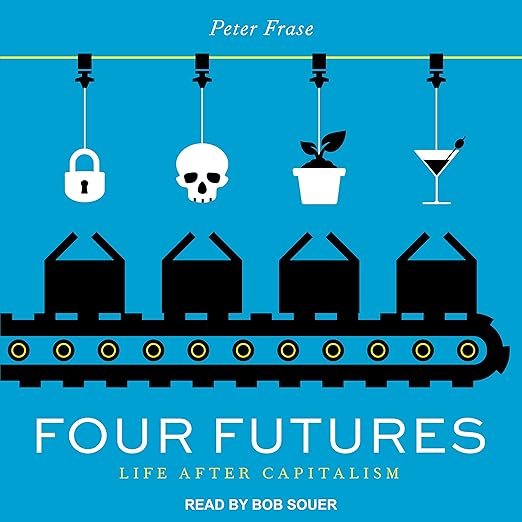
The structural logic of Four Futures is elegantly simple: Frase maps four possible postcapitalist scenarios across two axes, equality versus hierarchy and abundance versus scarcity. The resulting grid yields communism (equality plus abundance), socialism (equality plus scarcity), rentism (hierarchy plus abundance), and exterminism (hierarchy plus scarcity). Each scenario gets a chapter combining social theory with references to science fiction, from Star Trek to Ender’s Game, and the approach makes the abstract feel navigable without making it feel simple or already resolved by the analysis.
The communism chapter is the most fully developed, partly because Frase is most intellectually at home there and partly because the concept of a citizens’ dividend as a possible route toward a post-work society is the scenario he has thought about most carefully over the longest period. The exterminism chapter is the most disquieting: a world of hierarchy and scarcity where an elite class of resource-holders has no structural need for the majority population and faces no meaningful democratic or legal constraint on how it treats them. Frase draws on real-world trend lines rather than pure speculative fiction to make this scenario feel like a genuine direction of travel rather than science fiction dystopia removed from present conditions.
Where the Argument Is Most Vulnerable
The most substantive criticism of Four Futures is that the scenarios are underbuilt. One reviewer captured this precisely: the scenarios are barely sketched before the text goes quickly on tangents, and at first it is difficult to determine whether deeper systematic discussions of each scenario are coming later. They are not. This is a three-and-a-half-hour book, and the ambition of the framework significantly exceeds what that runtime can fully support. Frase makes choices in each chapter that prioritize the interesting edge case or the counterintuitive cultural reference over the systematic treatment of how each scenario would actually be structured, maintained, and challenged from within.
That is a real limitation worth registering clearly before purchasing. Four Futures works best as a starting point for thinking rather than a destination. Its value lies in the vocabulary it provides and the connections it draws between political economy and speculative fiction, not in the completeness of the worlds it sketches. One reviewer found it scattered and surface-level; another found it compelling and accessible. Both descriptions are accurate for the same book, which tells you something about what you should expect from the experience.
Bob Souer and the Demands of the Essayistic Register
Bob Souer is an experienced audiobook narrator with a long track record in nonfiction, and his performance here is appropriately calibrated for Frase’s essayistic register. He reads with even, unhurried authority without injecting enthusiasm or skepticism into the material regardless of how charged the arguments become at their most pointed. For a book with this degree of explicit political orientation, that restraint is exactly right; the text does not need additional emphasis to make its positions clear, and added emphasis would tip the narration into advocacy rather than delivery. At three and a half hours, Souer sustains the register without audible fatigue, and the book’s internal momentum does most of the work of carrying listeners through the four distinct scenarios.
The 4.2 rating from 451 listeners reflects a reasonable spread of responses to a book that is explicitly making an argument rather than surveying neutral landscape. Listeners who share Frase’s political orientation rate it highly; those who do not, or who find the analytical framework constraining, are responsible for the lower scores. This is not a book that is trying to persuade the unconvinced; it is a book for people who are already asking the questions Frase has been thinking about and want a concise, intellectually serious framework for organizing the answers.
Audience Fit and Honest Limits
Listen if: You are interested in the political economy of automation and climate-driven resource scarcity and want a concise, intellectually serious framework for thinking about it; you enjoy the Left’s tradition of engaging with science fiction as political theory rather than as pure escapism; or you want something short and genuinely provocative that will generate conversation and further reading rather than settling the questions it raises.
Skip if: You need extensive empirical grounding and systematic evidence rather than theoretical speculation; you find the Marxist analytical framework more limiting than enabling for this kind of futures thinking; or you want a book that seriously entertains multiple political perspectives rather than working confidently from one declared position. Readers seeking balance will be actively frustrated rather than merely unsatisfied here.
Frequently Asked Questions
Do I need to have read Marx or be familiar with socialist theory to follow Four Futures?
Basic familiarity with left political economy helps, but Frase explains his analytical framework accessibly. The more important requirement is comfort with theoretical and speculative thinking rather than any specific prior reading list.
How does Bob Souer’s narration handle the shifts between social theory and science fiction references?
He reads both registers with the same measured authority, which works well. He does not shift into dramatic performance mode for the speculative scenarios, keeping the tone consistently essayistic and analytical throughout the three-and-a-half-hour runtime.
Is Four Futures genuinely politically balanced, or does Frase have a clear agenda?
He has a clear agenda and does not pretend otherwise. The book makes no secret of which future Frase prefers, and the scenarios he finds most alarming receive the most sustained critical attention. Readers wanting a balanced survey should look elsewhere.
Is Four Futures available as a free audiobook on Audible?
Yes, it is listed at $0.00 for eligible Audible members and through Audible Plus. New members can access this free audiobook through an Audible trial. Check the current listing to confirm availability under your membership.