- Narrator: A compressed survey lives or dies on how clearly each transition is marked, and that burden falls entirely on Brian Richy.
- Subjects: Founding intentions, separation of powers, popular sovereignty, civic refresher
- Tone: Brisk, declarative, classroom-adjacent
- Bottom line: A seventy-five-minute orientation with a clear thesis, sold under a garbled listing you should read twice before buying.
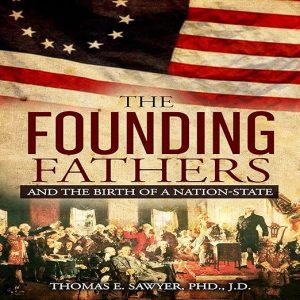
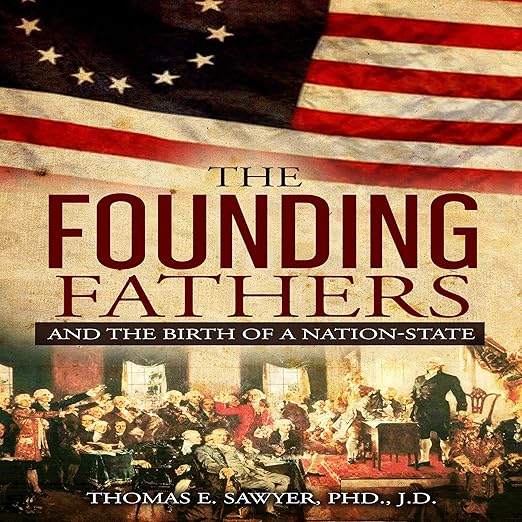
Something is off about this listing before a minute of the audiobook has played, and a buyer deserves to hear about it first rather than last. The product page calls the title Founding Fathers. The description underneath discusses a book called The Founding Fathers and the Birth of a Nation State, credits it to Thomas E. Sawyer where the byline reads Thomas Sawyer, and opens on the words "With the 2020 election year getting ever closer." This recording is dated March 2026. Somewhere between manuscript, print edition and audio release, nobody went back and reconciled the copy.
None of that makes the product worthless, and I want to be precise about what the problem actually is. The description is coherent, detailed and unmistakably about a real book. What it is not is publisher marketing. Read it slowly and it resolves into somebody else's recommendation, complete with a verdict, an assessment of the ideal reader and the phrase "highly recommended as a primer for democratic processes." A review has been pasted into the description field. That is a listing defect rather than a defect in the work, but it does mean everything the page tells you about this title arrives secondhand.
Somebody Pasted a Review Into the Description
Underneath the mess sits a clear and rather old-fashioned thesis. The book's "basic contention," the copy says, is that "political power should originate with the people and flow upward in a reflection of popular interests," and that power running the other direction, from the top downward, describes "a monarchy or dictatorship" instead. Around that spine Sawyer arranges what the description calls "social, political, and philosophical reflections about the intentions of the Founding Fathers," plus the doctrine of separated powers and the places where those written intentions later proved hard to carry out. The stated gap being filled is a real one: most short histories either assume you already know the material or write down to students who do not.
Then you look at the runtime, and the ambition and the container stop matching. One hour and fifteen minutes is what you get. Into that go the instigation and ideals of a republic, the division of authority between branches, and the question of how founding intentions "have been translated over the years under different presidencies from early to modern times." No seventy-five-minute recording covers that ground in any serious sense. The description is at least consistent with itself on this point, calling the book "a basic primer to be used as a refresher course in American ideals and formation." Take the word primer literally and expect an orientation, not a history.
Richy's Signposting Carries a Seventy-Five-Minute Argument
Seventy-five minutes is an excellent audio shape, and that is not a consolation prize. This is a single sitting, roughly a walk or a round trip to work, and the material is argument rather than incident, which is precisely the kind of content that survives one uninterrupted pass. Brian Richy is named as narrator. The demand the format makes on whoever reads a compressed survey is signposting: with no headings to glance at, a listener needs each move between an era, a doctrine and an example to arrive as a distinct change of gear rather than as another sentence. Curiously, the description's own closing line calls the book "especially valuable and well-documented listening," which suggests the copy has been through an audio edition before.
What I cannot tell you is how any of that turns out in practice. The listing carries one rating and one written review, and that review was filed in September 2020, more than five years before this recording existed. No account of the reading itself exists anywhere on the page. The review is still worth your time, though, because it is testimony from exactly the reader the book targets. Writing at five stars, Robert Obst reports having always valued constitutional freedoms while holding "a limited understanding of the thought processes, debates and hardships that our Founding Fathers experienced in producing this incredible document," and goes looking "for a book that describes how the Constitution was conceived in a concis" before the text is cut off. Compression was the requirement, and this book met it.
One Old Review Anchors a 2020 Snapshot
Currency is the first thing to weigh. The copy anchors itself to the 2020 election cycle and then hedges with a parenthetical about any election year, which is a tell. Whatever the book says about founding intentions under successive presidencies stops well before now, so anyone hoping for an argument that reaches the present will be disappointed by several years. Treat it as a historical primer written at a particular moment and the framing stops being a nuisance.
Worth noticing is which parts of the founding that sole reviewer cared about. The freedoms named are the Right to Bear Arms, Freedom of Religion and Freedom of Speech, and what was missing beforehand was any sense of the debates and hardships behind them. That is a fair description of the gap a short primer can actually close, and it tells you the register the book pitches itself in.
Thin evidence is the other problem. A 5.0 average across a single rating is not a consensus, it is one person, and that person was reading a printed book years before the audio existed. My own advice on any listing this thin is to weight the description and the runtime far above the score. Check which edition you are actually getting, too, since the shortened title and the dropped middle initial mean a search for the full name may not lead you here at all.
Students Get a Brisk Refresher, Never a History
Students, teachers and anybody wanting a compact orientation before committing to a serious history should find this useful, along with a listener whose last encounter with the branches of government was a classroom. The sole reviewer models the audience precisely: somebody who valued the freedoms without ever having examined the arguments that produced them, and who wanted that fixed concisely. Teachers looking for something short enough to assign alongside primary documents have an obvious use for a seventy-five-minute survey, and so does a curious listener who wants the reasoning of the founders rather than their biographies.
Give it a miss if you want depth. Seventy-five minutes cannot argue with historians, weigh contested evidence or spend time inside a single convention debate, and a listener expecting citations and counterarguments will run out of book before the argument starts. Both the one-person rating pool and the half-decade-old description are real, and neither is going to improve while the listing sits there. Bought with clear eyes, as a brisk refresher from a writer with a definite thesis about where authority comes from, it does a small job at a length that respects your time.