- Themes: Language acquisition, brain-based learning, stress-free instruction
- Mood: Engaged and participatory, like sitting in on a live class
- Verdict: Michel Thomas's Foundation Spanish audiobook course remains one of the most psychologically intelligent entry points into Spanish, though it asks for 20-30 hours of active engagement rather than passive listening.
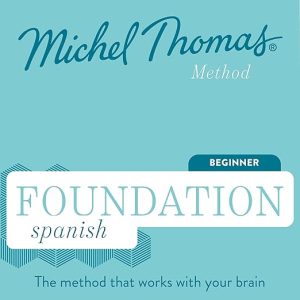
Michel Thomas spent more than five decades studying how people actually absorb language, and the Foundation Spanish audiobook course is the distilled result of that work. You are not handed vocabulary lists. You are not asked to repeat phrases back parrot-fashion. Instead, over roughly ten hours of recorded audio, Thomas and two live students reconstruct Spanish from its component parts, inviting you, as the unspoken third student, to think out answers before they arrive. David Sedaris, writing in the New Yorker, caught it precisely: "The thrill is that you're actually figuring it out on your own." That sense of active discovery is the course's central promise, and it delivers on it in ways most structured language programs never do.
Stress Is the Enemy This Course Removes
What separates this course from competitors is Thomas's foundational insight: stress is the enemy of learning. The course is engineered to remove it entirely. No memorization is required, no homework is assigned, and no writing is involved. Instead, the material is structured so that each new piece of Spanish builds on what you already know, including the thousands of English words that share Latin roots with their Spanish equivalents. The approach draws explicitly on instructional psychology, and the result is a course that feels less like study and more like sustained discovery. That said, this is emphatically not a passive audiobook. The recording pauses. Students make mistakes. You are expected to pause your playback and answer before hearing the correct form. Listeners who treat this as background listening will extract very little from it.
The two students in the recording serve a specific pedagogical function. Their errors are not edited out, because hearing someone stumble and self-correct mimics the kind of real-time processing your brain performs when acquiring language naturally. Thomas's corrections are patient and never condescending, which matters enormously over the course of twenty to thirty hours of total engagement. The recorded audio itself runs just under ten hours, but the recommended completion time is longer precisely because of the pausing and repeating that effective use of the method requires. This is a commitment, and learners who understand that upfront are consistently more satisfied with the results than those who expect a shortcut.
Listening Is the Whole Course by Design
The audiobook format is not incidental to this course: it is the course. Thomas explicitly rejected books and writing from his method because he believed the stress of the page interfered with natural acquisition. Listening is the only mode here, which makes this title genuinely suited to the format in a way that many adapted audiobooks are not. The accompanying PDF, available with purchase, contains supplementary reference material but is not required for the core experience. Commutes, long walks, gym sessions, and any other activity that leaves your hands free and your eyes elsewhere are ideal contexts for this kind of learning, provided you can pause and respond without risk. Driving is trickier: the method needs active participation, not just ambient absorption.
It is worth knowing that the first hour of this Foundation course is identical to the Start Spanish taster, so if you have previously sampled that shorter release, you will be revisiting familiar ground at the outset. After completing Foundation, Thomas's curriculum continues with the Language Builder, then Intermediate, then the Vocabulary Course, and finally the Insider's course. Foundation is genuinely the right starting point for absolute beginners: it assumes nothing and introduces everything that comes after it with the care required to build on solid footing.
Grammar Confidence Now, Vocabulary Breadth Later
Thomas's method is exceptional at building grammatical intuition and sentence construction confidence. It is less suited to the vocabulary breadth you will need for real-world fluency. The course acknowledges this openly, describing itself as a "foundation" from which you can later "add decoration." If your goal is to hold a basic conversation or understand the architecture of Spanish, the course delivers that reliably. If you want to emerge ready for native-speed film dialogue or regional dialect variation, you will need significantly more material beyond this, and the subsequent courses in Thomas's own sequence are the logical next steps.
The recording quality and the classroom dynamic can feel dated to ears accustomed to modern audio production. The original recordings date to 1999, and while the 2019 reissue by Hodder and Stoughton updated the packaging, the audio itself retains the intimacy and slight roughness of a real lesson rather than a studio production. For some listeners that intimacy is precisely the appeal. For others expecting high-gloss narration, it takes adjustment. The lack of a named narrator is by design: Thomas is the teacher, not a performer, and that distinction shapes everything about how the course sounds and feels in practice.
Adults Who Learn by Reasoning Will Thrive Here
Absolute beginners in Spanish who have struggled with conventional textbook methods will find this course genuinely liberating. Adults who learn better through listening and reasoning than through visual memorization are exactly the audience Thomas designed this for. The method also works well for people who have previously studied Spanish in school and want to rebuild their grammatical intuition from the ground up, since the systematic building-block approach clarifies relationships that rote learning often leaves muddy and resistant to practical use.
Anyone looking for a relaxed, passive listen should look elsewhere. The method demands active participation: pausing, reasoning, responding. Travelers wanting instant survival phrases without commitment will also find this a mismatch, since the course is designed for twenty to thirty hours of focused engagement rather than a quick-reference overview. If you are serious about developing real Spanish communication ability and want a method grounded in how the brain actually prefers to learn, this course has few equals as a starting point in the Michel Thomas catalog.
Does the Foundation Spanish audiobook work if you're a complete beginner with no prior Spanish knowledge?
Yes, explicitly so. The course assumes zero prior knowledge and builds from the most basic grammatical structures. Thomas's method is specifically designed to work with learners who have previously found language study frustrating or unsuccessful.
How long does it take to complete the Foundation Spanish audiobook course?
The recorded audio runs about 9 hours and 51 minutes, but the method requires pausing and responding throughout. Thomas recommends budgeting 20 to 30 hours of total engagement to complete the course effectively at the pace that allows proper retention.
Can you revisit sections of this audiobook course, or is it designed as a linear experience?
Revisiting is not just permitted, it is encouraged. Thomas designed the method so that learners can pause, rewind, and repeat any section as many times as needed without penalty. There is no homework and no time pressure, which is central to the method's stress-free philosophy.