Quick Take
- Narration: Gretchen Rubin reads her own work with warmth and precision; her voice suits the book’s crisp, energetic style and the conversational structure of each forty-lens chapter.
- Themes: biography as interpretation, Churchill’s contradictions, the ethics of historical portraiture
- Mood: Brisk and intellectually playful, like a smart dinner conversation that keeps surprising you
- Verdict: A genuinely original approach to biography that earns its ambition, though readers wanting a conventional Churchill narrative will need to look elsewhere.
I was partway through a more traditional Churchill biography – one of those door-stoppers that takes six hundred pages to reach the Gallipoli debate – when I picked up Gretchen Rubin’s Forty Ways to Look at Winston Churchill almost as a palate cleanser. What I expected was a light survey. What I got was something that made me reconsider how biography works as a form, which is a remarkable thing to say about a book that runs just over six hours.
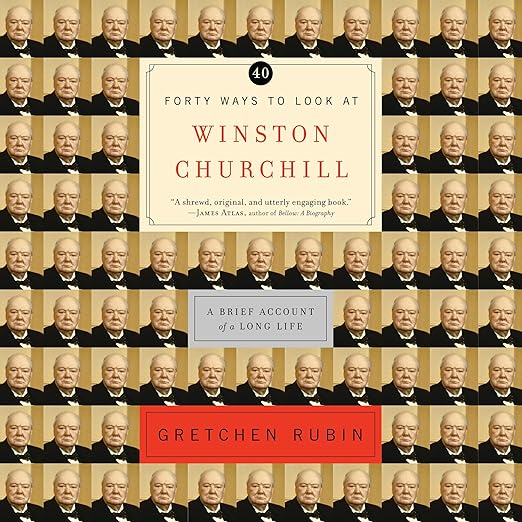
Rubin, who is better known today for her happiness research and The Happiness Project, wrote this book before that career pivot, and it shows a scholar’s ambition and a writer’s ear operating at full capacity. The formal conceit is exactly what it sounds like: forty distinct lenses through which Churchill is examined, each one contradicting or complicating the last. He was an alcoholic. He was not. He was a humanitarian. He was a racist. He was the most quotable man in the English language. He was a bore. The effect is something like a cubist portrait, assembled from contradictory planes that, taken together, produce something closer to the truth than any single narrative could.
Our Take on Forty Ways to Look at Winston Churchill
The book’s central argument, embedded in its structure rather than stated explicitly, is that all biography is interpretation. Every biographer selects, omits, emphasizes, and frames. Rubin liberates herself from that selective pressure by making the selection process visible, presenting multiple frames simultaneously and asking the reader to hold them all at once. One Amazon reviewer called this approach more illuminating than reading dozens of conventional biographies, and that’s not hyperbole. The biographical tradition is so committed to narrative arc and authorial thesis that the form itself tends to flatten its subjects. Rubin’s method restores the fullness that conventional chronological biography often strips away.
The forty chapters vary considerably in length and tone. Some are brief, almost aphoristic sketches. Others develop into sustained arguments. The book never becomes a list, which is the obvious danger of a forty-part structure, because Rubin uses the contrasts and contradictions between lenses to generate genuine intellectual friction. A chapter arguing Churchill’s visionary qualities sits next to one documenting his catastrophic misjudgments. A chapter on his extraordinary personal warmth follows one on his casual cruelty. The juxtaposition is the point.
Why Listen to Forty Ways to Look at Winston Churchill
Rubin narrates this herself, and that turns out to be the right decision. Her voice is precise without being cold, and she reads the more playful sections with a light touch that prevents the book from becoming a lecture. The crisp, energetic prose translates well to audio, and the forty-chapter structure is actually a virtue in this format: each lens feels like a self-contained listening unit, which makes it easy to pick up and put down without losing momentum. At six hours and twenty-one minutes, it moves quickly for the amount of biographical and philosophical ground it covers.
One caveat worth naming: one Amazon reviewer pointed out the book’s silence on Churchill’s role in the Bengal famine and the broader question of his relationship to the British Empire’s worst chapters. The reviewer noted that the imperialism chapter touches some of these issues but doesn’t fully reckon with them. That’s a legitimate observation. Rubin admires Churchill, and while she makes gestures toward critical balance, her own sympathies occasionally shape which contradictions she explores most deeply. For a book that explicitly examines how biography is shaped by the biographer’s perspective, that blind spot is worth knowing about before you listen.
What to Watch For in Forty Ways to Look at Winston Churchill
The book works best if you come to it with at least some existing familiarity with Churchill. Rubin isn’t writing an introduction; she’s writing a sophisticated meditation that assumes you know the basic contours. Listeners who are new to Churchill might find the forty-lens format disorienting without that foundation, because the book’s power comes from the friction between positions, and that friction lands hardest when you already have some investment in the subject. The book also rewards attentiveness to the meta-level argument: Rubin is not just writing about Churchill, she’s writing about what biography can and cannot do, and that second layer is where the book’s real originality lives.
Who Should Listen to Forty Ways to Look at Winston Churchill
Listeners who enjoy biography as a form but have grown impatient with its conventions will find this genuinely refreshing. So will anyone interested in Churchill specifically who wants a sense of the full range of historical opinion on the man rather than one author’s thesis. It’s also quietly useful for anyone who thinks about how history gets written and whose stories get told in which ways. Skip it if you want a chronological narrative of Churchill’s life, or if you’re looking for a comprehensive accounting of his imperial record. What Rubin offers is something different and genuinely valuable: a portrait assembled from disagreements, which turns out to be more honest than most portraits assembled from conclusions.
Frequently Asked Questions
Does Gretchen Rubin’s narration of her own book work well?
Yes. Her voice is well-suited to the material: precise, warm, and intelligent. She handles both the more playful sketch-like chapters and the denser analytical sections with the same even authority.
Is this a good starting point for someone who knows little about Churchill?
It’s better as a second or third book on Churchill rather than a first. The forty-lens format is most rewarding when you have some existing knowledge to push against. Readers coming in cold may find the structure disorienting without that foundation.
Does the book address Churchill’s more controversial legacy, including racism and imperialism?
Partially. There are chapters on imperialism and on aspects of Churchill’s thinking that have aged poorly. However, as several reviewers note, the treatment is not comprehensive, and some significant episodes, including the Bengal famine, receive limited attention.
How does the forty-chapter structure translate to listening versus reading?
It works very well in audio. Each lens is self-contained enough to absorb as a listening unit, and the crisp prose doesn’t require visual re-reading to follow. At six-plus hours, it’s easy to listen in sessions without losing track of where you are.