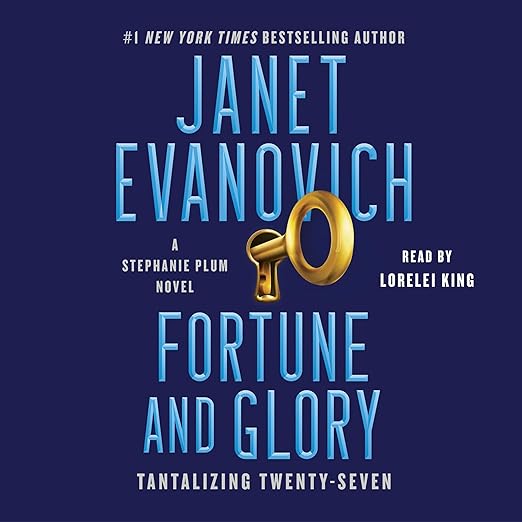
At a Glance
- Narration: Lorelei King, the series' longtime voice, brings practiced ease to a cast she's clearly owned for years.
- Themes: family loyalty, treasure-hunt caper mechanics, an unresolved romantic triangle
- Mood: Breezy, mischievous, and fast-moving
- Verdict: A satisfying, formula-honoring entry for existing Stephanie Plum fans, not a jumping-on point for new ones.
Grandma Mazur's new husband left her exactly two things when he died on their wedding night: a battered recliner and a fortune nobody can find yet. That premise alone tells you where Janet Evanovich has taken the Stephanie Plum series after twenty-six previous entries, and this audiobook edition of Fortune and Glory leans into the absurdity rather than apologizing for it. I came to it already deep into the Plum backlist, half expecting fatigue to have set in by book twenty-seven. It hasn't. Evanovich still knows how to stack a bounty hunter's incompetence, a grandmother's recklessness, and a genuinely dangerous new rival into one propulsive scavenger hunt, and narrator Lorelei King still sounds like she's having fun doing it, which after this many hours in Trenton is no small thing.
Our Take on Fortune and Glory
The treasure hunt itself is a fine excuse for a plot, but the real engine is Gabriela Rose, a soldier of fortune from Little Havana who cooks like a professional chef, handles firearms and mixed martial arts with equal ease, and treats Stephanie less like an obstacle than a mildly interesting rival worth outclassing. That's a step up from the usual Plum antagonist roster of bumbling mobsters and vengeful loan sharks. Gabriela is dangerous in a way the series rarely lets its threats be, and the book is smart enough to let Grandma Mazur's own recklessness escalate right alongside her, since Grandma insists on chasing Jimmy Rosolli's fortune with exactly as much stubbornness as her granddaughter.
Underneath the caper is the long-running question of Joe Morelli versus Ranger, which the synopsis teases as finally coming to a head. I won't spoil where that goes, but Evanovich uses the pressure of the treasure hunt to force Stephanie's hand in ways that feel earned rather than manufactured for the sake of drama. Reviewer Grandma Sue calls the cast 'engaging, larger than life, yet somehow believable,' which is about as accurate a description of this series' whole appeal as I've read anywhere.
It's worth remembering just how sustained this run has been. The New York Times has called Evanovich 'the most popular mystery writer alive,' and that reputation was built one book a year for decades, blending screwball comedy with the genuine mechanics of skip tracing and bail enforcement rather than treating bounty hunting as pure backdrop. Fortune and Glory keeps that hybrid intact: the treasure hunt gives the plot momentum, but the jokes never feel like they're interrupting a more serious story underneath.
Even the title carries a wink: 'fortune and glory' echoes the famous Indiana Jones line about chasing treasure for its own sake, and Evanovich leans into that same pulpy, adventure-serial energy rather than pretending this is a more serious heist novel than it actually wants to be.
Why Listen to Fortune and Glory
Lorelei King has narrated this series for so long that her voice functions as the official sound of Stephanie Plum for most listeners at this point, and while none of the three attached reviews comment on her performance directly, that continuity is itself a real asset twenty-seven books in. King doesn't have to reintroduce Stephanie's exasperated cadence or Grandma Mazur's gleeful menace from scratch here; she's refining a character voice she's owned for decades, and the ease of that familiarity carries scenes that might otherwise read as pure plot mechanics.
Reviewer CQueener puts it simply: 'This author never disappoints,' tracing their loyalty back to One for the Money, the book that started all of this. That's the audience this audiobook rewards most directly, listeners who've logged enough hours with Stephanie to treat a new entry as a standing appointment rather than a discovery. At 4.6 stars, the fan base clearly agrees the well hasn't run dry.
Comic prose has a specific relationship with audio that's worth naming directly: timing that reads as merely brisk on the page can land as genuinely funny out loud, when a narrator knows exactly where to place a pause before a punchline or let a character's exasperation build across a sentence. That's a different skill from narrating a thriller or a literary novel, and it's the specific skill this series has always demanded from whoever sits behind the microphone.
King's reputation extends well beyond this one series across a long, widely respected audiobook career, and sustaining a twenty-seven-book run at this level of energy is its own kind of achievement. Long-running comic series often show wear at the edges by this point, either from a narrator's fatigue or an author's, and the fact that neither shows up here says something real about how both Evanovich and King approach the work.
What to Watch For in Fortune and Glory
The formula is the formula at this point, and even a fan admits it. Shannen Itterley describes the series as 'easy to read, predictable and fun,' the kind of book she reaches for specifically when she wants to relax rather than be surprised. That's an honest, useful data point for anyone deciding whether book twenty-seven is worth the investment: this is comfort listening by design, not a series suddenly reinventing itself at entry twenty-seven.
The Morelli-versus-Ranger tension has also been simmering across enough books that longtime readers have learned not to expect a tidy resolution just because a synopsis promises one. Evanovich raises the stakes here more explicitly than usual, but readers who've watched this triangle stall out before should keep expectations realistic rather than assuming Fortune and Glory is the final word on it.
A harder question sits underneath any twenty-seven-book series eventually: how do you keep stakes feeling real when readers already know, on some level, that Stephanie survives to appear in book twenty-eight? Evanovich's answer here leans on Gabriela Rose's competence rather than manufactured danger, letting a genuinely formidable rival supply tension that pure plot mechanics couldn't at this point in the run.
Who Should Listen to Fortune and Glory
The synopsis is direct about what actually carries Stephanie through this mess: 'an unbreakable bond with her family and a stubborn streak that will never let her quit.' That's the real throughline underneath the comedy, and it's a big part of why this series still generates the kind of loyalty CQueener and Grandma Sue both describe, even at book twenty-seven.
This one is built for existing Stephanie Plum fans: readers who already know Grandma Mazur, already have an opinion on Morelli and Ranger, and want a fast, funny, low-stakes-feeling adventure to fill a commute or a long drive. If Evanovich's comic mystery formula has worked for you across the previous twenty-six books, book twenty-seven gives you more of exactly that, with a sharper antagonist than usual in Gabriela Rose.
Newcomers curious about the series have a much cheaper, more sensible entry point waiting in One for the Money, where the character dynamics that make Fortune and Glory land actually get built from scratch rather than assumed.
A Few Questions About Fortune and Glory
Do I need to have listened to all twenty-six previous Stephanie Plum audiobooks before this one?
You don't need every single entry, but this audiobook leans on established relationships (Grandma Mazur, Joe Morelli, Ranger) that land harder with context. Newcomers are better served starting with One for the Money.
Does Lorelei King narrate the entire Fortune and Glory audiobook herself?
Yes, King is the sole credited narrator, continuing her long run as the series' voice across this twenty-seventh entry.
Is the Joe Morelli and Ranger love triangle resolved in this audiobook?
The story pushes Stephanie toward a decision harder than previous entries have, but longtime readers know this series has teased resolution before without fully delivering it, so go in with realistic expectations.
How does Gabriela Rose compare to Stephanie Plum's usual antagonists?
She's a genuine step up: a trained soldier of fortune with firearms and combat skills rather than the bumbling mobsters and loan sharks the series usually deploys, which gives this entry sharper stakes than most.