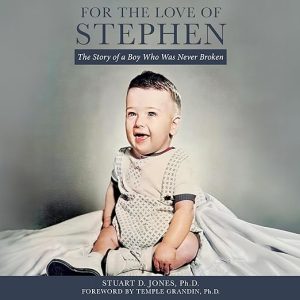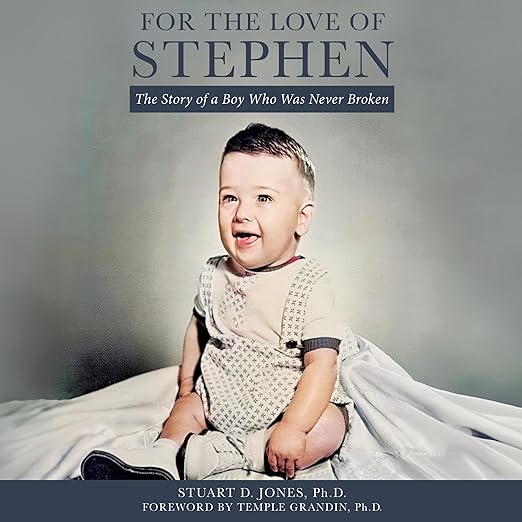
Stuart D. Jones PhD opens this audiobook with a date and a judgment: 1954, the year his brother Steve entered the world fragile and premature, and the word broken, applied by doctors who believed they were being realistic. For the Love of Stephen, which Jones narrates himself across nine hours and twenty-two minutes, is an extended argument against that word. Not an angry argument, but a meticulous, affectionate, satirical, and often funny one. The craft of this memoir lies in how Jones holds all those registers simultaneously without letting any single one overwhelm the others, and the self-narration is where that craft becomes fully audible.
A reviewer described this memoir as written with plenty of humor and hope, structured to encourage, enlighten, and lift the reader up. That description is accurate. But what the audiobook format adds is the particular quality of Jones's own voice making those tonal choices in real time. He knows where the humor needs to land precisely in order to prevent the next difficult passage from becoming unbearable, because he felt the weight of those passages first. That knowledge is not something a hired narrator could access through the text alone, and it is what makes the self-narration here not just a choice but a necessity.
A Life That Spans the Disability Rights Movement
The historical framing is one of this memoir's strongest structural choices. Steve Jones was born in 1954, which means his life spans the entire arc of the disability rights movement in America. From a period when families were routinely advised to institutionalize children with intellectual and developmental disabilities, through the early years of special education legislation, through the ADA, and into the present. Jones traces that arc through Steve's specific experiences: his battles with exclusion from educational settings, his eventual breakthroughs within those systems, his friendships and relationships, and the institutional encounters that illuminate how far the system has come and how much further it has to go.
One reviewer wrote that Jones thoughtfully traces Stephen's journey through the educational system and documents a time when understanding and support were far more limited, praising the balance of historical specificity and personal intimacy. That balance is real and demanding to maintain across nine hours. Jones is a PhD and writes with academic precision when documenting systemic failures, but he switches registers fluidly into the satirical and the personal whenever the argument risks becoming a policy paper rather than a memoir. The audiobook benefits from the self-narration precisely in these tonal transitions, since Jones can read the satirical passages with the timing of someone who experienced the absurdity firsthand rather than simply describing it.
The portrayal of Steve himself is the book's most significant achievement. Jones does not write Steve as a symbol of disability advocacy but as a specific, complete human being: funny, stubborn, loving, resilient, and frustrating in the specific ways that real people are. Another reviewer noted that you will feel like you have gotten to know the family just a bit, and that sense of genuine acquaintance is what distinguishes a memoir like this from an advocacy document. It makes the grief of the final sections land harder, and it makes the humor in the earlier ones feel earned rather than deployed for relief.
Steve as a Complete Human, Not a Case Study
The nine-hour runtime allows Jones to develop Steve as a complete human being rather than a case study. For professionals who work in special education, disability services, or family support, this audiobook provides something rare: a long-form, first-person account of what those systems look like from the inside of a family navigating them across decades. Jones does not write as a policy expert but as someone who lived the consequences of policy decisions, which is a different and often more useful form of knowledge.
The combination of scholarly precision and personal warmth also makes this a valuable listen for family members currently navigating similar systems, particularly parents who are beginning to encounter the same institutional barriers that Steve's family faced in earlier and less equipped decades. The historical scope provides both perspective on how much has changed and honest documentation of what has not, which is more useful than purely inspirational or purely critical framings of the same territory.
Told from a Brother's Perspective, Structurally Different
The memoir is described as by turns satirical, humorous, and deeply moving, and the deep feeling does arrive. Steve's death before the book ends is not a spoiler since the synopsis frames this as a tribute to a man who has already passed. Listeners should know that the final sections carry genuine grief. Jones handles it with the same tonal precision he demonstrates throughout, but unprepared listeners may find the shift from humor and advocacy to elegy more affecting than the opening chapters suggested it would be.
The framing is a brother's perspective, which means the memoir's intimacy is also its limitation in a specific sense. We see Steve through Stuart's eyes, with all the love and occasional blind spots that relationship entails. Jones is self-aware about this, but listeners who want a disability memoir centered in the first-person voice of the person with the disability will find something structurally different here. That is a choice worth acknowledging rather than a flaw, and it is a choice made with obvious care.
Jones's Own Narration Feels Like Sitting With Someone
This audiobook belongs on the essential list for anyone working in disability advocacy, special education, or family caregiving, not because it is a manual but because it makes the human reality of these systems vivid in ways that policy documents cannot. The nine-hour runtime and Stuart Jones's own narration create an experience closer to sitting with someone and hearing their family's full story than to reading a book on a screen.
General listeners drawn to memoirs that hold humor and grief in close proximity, who found works like The Glass Castle or similar family memoirs affecting, will find For the Love of Stephen occupies similar emotional territory with its own distinct moral vision. At five stars from fifty-three listeners, the consensus is unusually clear about what this book does and what it is worth.
Questions Listeners Ask
Why does Stuart D. Jones PhD narrate his own memoir in the audiobook version?
The self-narration is essential to what the audiobook does. Jones reads with tonal precision, knowing exactly where the humor must land before the next difficult passage arrives. A hired narrator could read the words; only Jones can voice this story with the specific authority of a brother who lived it and continues to carry it.
Is For the Love of Stephen audiobook primarily about disability advocacy, or is it a personal family memoir?
Both, inseparably. The personal story, Steve's life from 1954 to his death, is the vehicle for the advocacy argument, and the advocacy argument gives the personal story its larger significance. Jones moves between both registers fluidly, and the audiobook is strongest when they are present simultaneously.
The book is described as humorous, is this audiobook appropriate for someone currently navigating caregiving for a family member with disabilities?
With some awareness of what you are choosing. The humor is real and well-handled, and most listeners describe the audiobook as ultimately uplifting. But the final sections carry genuine grief, and the combination of comedy and elegy can be intense for listeners who are in the middle of their own caregiving journey. Many will find it cathartic.