Quick Take
- Narration: Sasha Sagan reads her own memoir with a quiet, intimate warmth that suits both the personal passages about her father and the more philosophical sections on secular ritual.
- Themes: Secular spirituality and the construction of meaning, grief and inheritance, the scientific worldview as a foundation for wonder rather than its obstacle
- Mood: Gentle, luminous, and genuinely moving
- Verdict: An unusually tender and intellectually honest book about how to build a meaningful life without religious frameworks, made more powerful by Sagan’s own narration and the weight of her parentage.
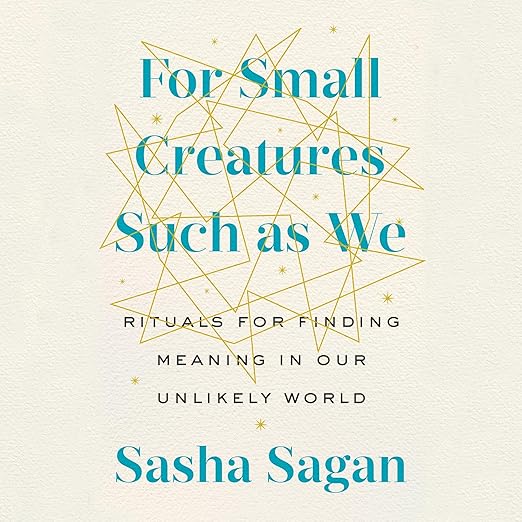
There is a genre of atheist writing that argues its case by attacking the opposition, and there is a different and rarer kind that simply demonstrates, by example and feeling, what a life without religious faith can contain. Sasha Sagan’s For Small Creatures Such as We belongs firmly to the second category, and it is more persuasive for it. I listened to this on a quiet weeknight, stretched out on the couch with the lights low, and found myself genuinely moved in ways I had not anticipated when I queued it up. It is the kind of book that works best when you come to it a little tired, a little reflective, open to something that asks you to slow down and pay attention to what is already there in the world before you reach for anything beyond it.
The premise is both personal and philosophical. Sagan grew up as the daughter of Carl Sagan, the astronomer and science communicator, and Ann Druyan, the writer and producer who collaborated with him on Cosmos. They raised her secular, but not coldly so. What they gave her instead of religion was a sense of the natural world and the cosmos as sources of genuine awe, a framework in which the scientific description of reality produces wonder rather than diminishing it. When Sagan herself became a mother, she began thinking about how to transmit this framework, how to give her daughter the experience of meaningful ritual, of marked occasions, of transitions honored, without relying on the religious structures that provide those things for most of the world’s people.
The Architecture of Secular Ritual
The book is organized around occasions: births, deaths, weddings, anniversaries, holidays, the rhythms of the year. For each, Sagan explores the natural phenomenon or historical origin behind the ritual, separating it from its religious overlay and asking what remains. What remains, she argues, is generally more interesting and more beautiful than the overlay suggested. The winter solstice, stripped of its theological accretions, is still the moment when the tilt of the Earth begins returning the Northern Hemisphere to light. That is a genuinely remarkable thing to gather around a fire about. You do not need to believe in anything supernatural to find it extraordinary or to want to mark it with the people you love.
This approach is not new, as several reviewers have acknowledged. One reader noted they did not find the insights very life-changing because they were already a spiritual atheist, adding honestly that the book was nonetheless really pleasant and enjoyable to read. That is an accurate calibration for the experience. If you are already deep in this territory, having worked through secular humanism or the naturalistic spirituality of figures like Carl Sagan himself, the framework Sasha offers will feel familiar. If you are approaching these questions for the first time, or if you are someone who loves the communal and ritual dimensions of religious life but cannot sustain the belief that underlies them, this book will feel like an arrival rather than a reminder of something you already knew.
The Father at the Center
Carl Sagan died in 1996, when Sasha was in her early twenties, and his presence runs through this book like a continuous current. She writes about him with a love that is neither uncritical nor hagiographic, the complicated filial tenderness of someone who knew the person behind the legend and loved them both. The passages where she describes his dying, and his facing of death without the consolation of an afterlife, are among the most affecting in the book. He approached it, she suggests, with the same scientific honesty he brought to everything else, accepting the reality of the situation without demanding that reality accommodate his preferences. It is a model of secular courage that the book holds up with considerable quiet force.
Richard Dawkins described the book as ringing with the joy of existence, which is a little exuberant as a characterization but not wrong in kind. Good Housekeeping’s description as a wonderful gift for your favorite reader is closer to how I would recommend it: this is a book you want to give to someone you love who is asking the right questions. Someone who has lost a person they love and is looking for language adequate to the experience. Someone who wants to honor their life without a framework they do not believe in. The book is not prescriptive about how to do that, which is part of what makes it generous.
Sasha Sagan’s Narration and the Intimacy It Creates
Sagan narrates her own memoir, and her voice has exactly the quality you would hope for: thoughtful, unhurried, present. She reads the passages about her father with a restraint that makes them land harder than theatrical delivery would. She reads the more abstract philosophical sections with a lightness that prevents them from feeling like a lecture. At six hours and fifty minutes, this is on the longer side for the material, but it never outstays its welcome because Sagan’s voice makes the time feel inhabited rather than merely filled. The book has found its audience among people who share her secular framework, but it deserves a wider readership among anyone who has ever wanted to honor a moment and found the usual scripts inadequate. This is a gentle, luminous argument that the scripts can be rewritten without losing the meaning that the rituals were always really about.
The book works best, in my experience, when listened to in small sections rather than all at once, which is perhaps an unusual recommendation for an audiobook. Sagan’s approach is meditative rather than argumentative, and each chapter on a specific occasion or ritual rewards some time to sit with afterward. The winter solstice chapter, the wedding chapter, the chapter on how she thinks about her daughter’s eventual understanding of death all have a completeness to them that stands alone. The six hours and fifty minutes, consumed thoughtfully, is time well spent.
Frequently Asked Questions
Is For Small Creatures Such as We appropriate for religious listeners, or is it hostile to faith?
It is not hostile. Sagan’s approach is curious and celebratory rather than polemical. She does not argue against religion so much as she demonstrates what meaning-making looks like without it. Religious readers may find much to appreciate in her attentiveness to ritual and occasion even if they do not share her secular framework.
How much of the book is specifically about Carl Sagan, and how much is about Sasha’s own life?
Carl Sagan is a constant presence, but the book is organized around Sasha’s own experiences as a mother, daughter, and person constructing a meaningful secular life. The sections most specifically about him, particularly around his death, are among the most emotionally powerful, but the book’s architecture is Sasha’s own philosophy rather than a biography of her father.
Does the author narrating her own memoir improve or complicate the listening experience?
Improves it significantly. Sagan’s voice has a quality of genuine thoughtfulness that matches the book’s tone perfectly. The passages about her father in particular benefit from being heard in her voice rather than interpreted by a professional narrator who did not know him.
Is this book better suited to people who are already secular, or will it speak equally to people who are questioning their faith?
Both audiences can find value here, but the entry points differ. Secular readers will find confirmation and refinement of ideas they may already hold. People questioning religious frameworks will find a fully developed alternative to explore. The book is more welcoming than argumentative, which makes it accessible regardless of where you are starting from.