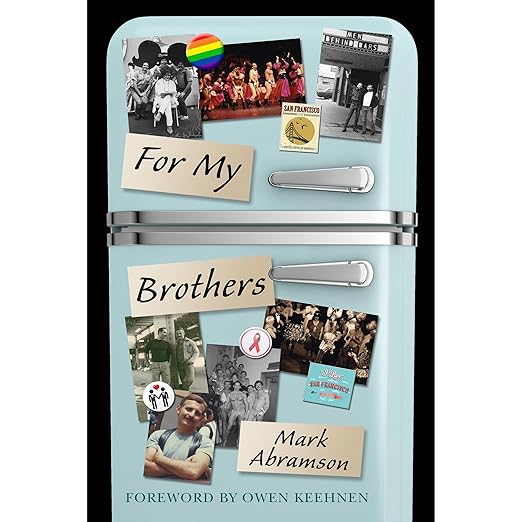
The AIDS crisis of the 1980s and early 1990s has generated a substantial archive of literature, from Paul Monette's devastating Borrowed Time to David France's How to Survive a Plague, but Mark Abramson's For My Brothers occupies a particular niche within that archive. Abramson was a bartender on Castro Street, Haight Street, and South of Market during those years, not a physician or activist or journalist but someone at the counter, watching the community move through grief and organize fundraisers and fill auditoriums with men in sequins for benefits that kept places open and people fed. This audiobook collects the true stories from those years, told from that specific vantage point.
I approached this one as a listener with some familiarity with the period's literature, and what immediately distinguishes For My Brothers is its register. Abramson is not writing a history and not writing a grief memoir in the conventional sense. He is writing episodic accounts of the people he knew and the events he helped organize, with a bartender's ear for character and a clear-eyed affection for the men who did not survive to read this. One reviewer captured it well: 'It isn't a history book. But it is. It isn't a book about AIDS. But it is.'
Before the Drugs Came in 1996
The Virtual Voice AI narration is the audiobook's most significant limitation. Abramson's prose has an intimate, conversational quality, the cadence of someone who has told these stories at a bar over decades, and synthetic AI narration cannot replicate the tonal subtlety that kind of writing requires. The text remains compelling because the material is specific and humanly observed, but listeners sensitive to AI narration will notice the flatness, particularly in passages that depend on warmth or dry wit for their effect.
What the text offers that the narration cannot diminish is specificity. Abramson names names. He writes about Connie Francis, Johnnie Ray, and Christine Jorgensen appearing at fundraisers and community events. He writes about friendships with Al Parker and John Preston and Sylvester and about the dozens of lesser-known men who deserve, as he puts it, to be remembered. The book functions partly as a memorial archive, a record of who was there and what they did before the drugs came in 1996 and the worst of it was over.
Gay Bars Doing What Official Channels Would Not
The Men Behind Bars AIDS fundraisers, which Abramson co-produced, ran for years and raised substantial money for the community during a period when government and institutional support was negligible. The chapters about organizing those events have an energy that reads as both nostalgic and political. These were gay bars and community spaces doing the work that official channels were not doing, and Abramson describes the organizational logistics and the personal relationships behind them with the specificity of someone who was actually there loading equipment and managing performers and watching the community show up for itself.
One reviewer who has lived in San Francisco since 1985 and sung with the Gay Men's Chorus since that period wrote that the book resonated in ways that a more detached history would not have achieved. That personal resonance is the book's particular asset. Abramson is not explaining the AIDS crisis from a distance. He is writing from inside the community that was being destroyed by it, and the accumulation of particular faces and particular evenings gives the book its emotional weight.
For listeners unfamiliar with the San Francisco community geography of the period, some of the street-level texture may require context. The Castro, Haight Street, and South of Market are not described as settings requiring introduction; they are assumed as familiar. The book rewards listeners who bring some prior knowledge of LGBTQ San Francisco history to the audio, but it is not inaccessible to those who do not.
Abramson's account of the Men Behind Bars fundraisers deserves its own note. These events, staged in gay bars with bar staff performing for their communities, became one of the more inventive fundraising formats of the era. The organizational effort behind them, the logistics of coordinating venues, performers, and audiences during a public health crisis that was also a political crisis, comes through in the chapters Abramson devotes to them. These were not professional productions with institutional backing. They were community events run by people doing them alongside their regular work, and that context gives the accomplishment its proper weight.
It Accumulates Rather Than Accelerates
The episodic structure means that the audiobook does not build toward a conventional narrative arc. It accumulates rather than accelerates. Listeners who prefer a single sustained narrative through-line may find the chapter-to-chapter texture fragmentary. But the episodic form is also true to the material: the AIDS crisis was not a story with a clean shape. It was years of loss, interspersed with community resistance and dark humor and people trying to keep going. The book's form follows that reality.
The tone moves between grief, comedy, anger, and tribute without announcing its shifts, and that tonal fluidity is both the book's strength and a potential disorientation for listeners who prefer a more consistent emotional register. Abramson trusts the reader, or listener, to follow those movements, and they generally reward the trust.
The Virtual Voice Limitation for a Book This Intimate
This audiobook is for readers of LGBTQ history and memoir who want a ground-level account of the AIDS crisis in San Francisco rather than a clinical or activist history. It is particularly valuable for listeners with a connection to that community and period, but it is accessible to anyone interested in how communities organize and survive catastrophic loss. The Virtual Voice narration is a real limitation for a book this intimate, and listeners who are sensitive to AI narration should factor that in. But the writing is strong enough and the material specific enough that For My Brothers earns its place in the literature of the era.