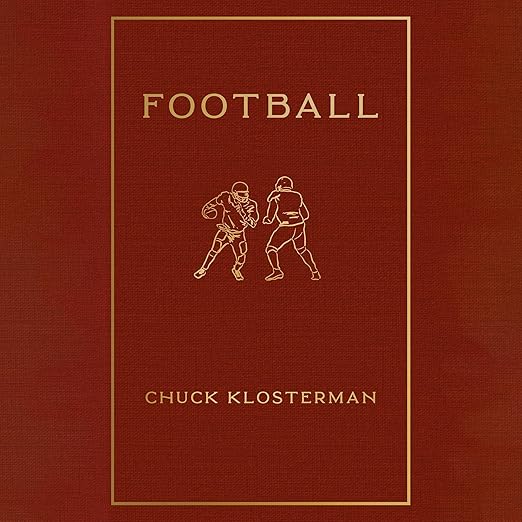
Quick Take
- Narration: Klosterman reads his own book and it is the only narration this book could have, his sardonic timing, deliberate digressions, and genuine enthusiasm make the nine-hour runtime feel like a long conversation with someone who happens to be funnier and smarter than you.
- Themes: football as American hyperobject, the morality of violence and spectacle, cultural theory applied to sport
- Mood: Witty and provocative, occasionally wandering in the best way
- Verdict: The most intellectually ambitious football book written in decades, and one that works even if you barely watch the game.
I am not a football fan. I have never been a football fan. I have, at various points, been in rooms where football was on television and have felt the particular social alienation of being the person who does not understand why everyone just reacted that way. I mention this because it seems relevant to my experience of listening to Chuck Klosterman’s Football over two very long walks in early February. By the end of the second walk, I understood something about American culture that I had been circling for years without being able to name. That is not a small thing for a nine-hour audiobook to accomplish.
Klosterman is a cultural critic whose books, from Fargo Rock City to But What If We’re Wrong?, have consistently located the most revealing questions inside the most mundane-seeming cultural phenomena. Football is his most sustained application of that method, and the scale of the subject matches the ambition. In 2023, 93 of the 100 most-watched programs on US television were NFL football games. That is not merely a sports statistic. It is a sociological fact that tells you something profound about what holds American culture together, and what it is willing to accept in order to hold together.
The Hyperobject Argument and Why It Works
Klosterman borrows the concept of the hyperobject from philosophy, phenomena so large that their true dimensions are hidden in plain sight, and applies it to football with considerable precision. The book argues that football is not merely the country’s most popular sport but is embedded in nearly everything that explains what America is, even for people who barely pay attention. The Chomsky passage that one reviewer highlights, where the political theorist diagnoses football viewing as conditioning irrational submission to authority and group cohesion to leadership symbolism, appears early and sets up the book’s central tension: Klosterman takes this critique seriously while also taking his own love of the game seriously. He does not resolve that tension. He inhabits it.
This is the move that separates the book from both the defensive boosterism of sports writing and the dismissive condescension of cultural critique. Klosterman is a football psychotic, as he describes himself, who is also capable of asking whether that psychosis reveals something troubling about American culture. The willingness to hold those two positions simultaneously without collapsing into comfortable resolution is what makes this an interesting book rather than just a smart one.
Essays That Reward Patient Listening
Football is structured as a series of more or less self-contained essays rather than a single linear argument. This is both a strength and a potential frustration depending on what you bring to it. The six-man Texas football chapter, where small-town religious football culture merges with Dallas Cowboys mythology and a boy in North Dakota, is genuinely eccentric in the best sense. The chapter on gambling and war is one of the best things I have heard in an audiobook this year. The assessment of Jim Thorpe and Jim Brown as the game’s greatest figures is argued with the rigorous care of a philosopher who has spent months on the problem.
The chapters on race, on the television relationship, on the morality of acceptable risk, all of them operate at a level of genuine intellectual engagement that sports writing rarely achieves. A reviewer who considers this among the finest argued prose Klosterman has ever written is not being hyperbolic. The media analysis sections in particular trace connections between earlier Klosterman essays on football and television and show how decades of thinking have accumulated into a unified perspective. That intellectual coherence across a career is what distinguishes this from being simply another smart essay collection.
Klosterman Narrating Klosterman
I have listened to enough author-narrated nonfiction to know that celebrity writers reading their own books can disappoint in both directions: too stiff, or too casual to hold up across hours. Klosterman is neither. His voice has the quality of someone who has thought through every sentence, not because he rehearsed it but because the thinking is inseparable from the way he talks. His comedic timing in the funnier passages lands because it is built into his diction rather than performed on top of it.
Who This Book Is For and Who It Will Frustrate
The book’s title choice is itself a Klosterman move. Walter Camp, Yale’s legendary coach a century ago, wrote his unified theory of the game and called it Football. Klosterman has consciously claimed that title for a new era, which is either audacious or grandiose depending on whether you think he earns it. Having now listened to the full nine hours, my view is that he does, narrowly, by virtue of the intellectual coherence that accumulates across what are ostensibly disconnected essays. The hyperobject thesis stated at the beginning is alive and functioning in the final chapter in a way that retrospectively justifies the book’s ambition. That is the thing Klosterman has always been reaching for across his career: the insight that is both obvious once stated and genuinely illuminating in the stating. Football is the fullest realization of that ambition he has produced.
A reviewer who found the word choices occasionally ridiculous for a sports book was not entirely wrong. Klosterman uses vocabulary that signals his intellectual commitments, including references to Zizek, Stephen Jay Gould, and hyperobject theory. If that signals pretension to you, this is probably not your book. If it signals that he is taking his subject seriously as cultural theory rather than sports commentary, it is your book entirely. One reviewer who rarely watches American football described enjoying it quite a bit. A viewer who expected lighter fare gave it three stars and noted that it does make you think, which is perhaps the most honest possible assessment of what this book sets out to do and successfully delivers.
Frequently Asked Questions
Is Football worth listening to for people who do not follow the NFL and have little interest in the sport itself?
Yes, more than you might expect. The cultural theory and media analysis that constitute the book’s core do not require football knowledge, and Klosterman provides enough context for non-fans to follow the specific game and player references. One reviewer who rarely watches American football describes enjoying the book quite a bit.
Does Klosterman self-narrate this audiobook, and how does his performance compare to a professional narrator?
He does self-narrate, and the consensus is that this is the right choice. His sardonic timing and deliberately discursive style are embedded in his voice in a way that would be very difficult to perform from outside. Listeners familiar with his other work will recognize the voice immediately; newcomers will adjust within the first chapter.
Is Football structured as a single argument or as separate essays, and does that structure affect listenability?
Separate essays that accumulate into a larger argument. This structure works well in audio because each chapter functions as a contained listening unit, you can pause between essays without losing the thread. The tradeoff is that the overall thesis is established through accumulation rather than a clear linear argument, which some listeners will find more engaging and others more diffuse.
How does this compare to Klosterman’s earlier books for listeners who have already read his work?
Reviewers who have followed Klosterman’s entire output consistently describe Football as reaching a new apex, the sustained focus on a single subject bringing out a depth and rigor that his more scattered earlier collections gestured toward but did not fully achieve. Even readers who preferred his more personal earlier work acknowledge this as his most ambitious book.