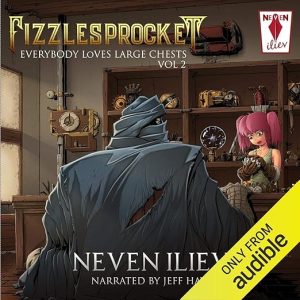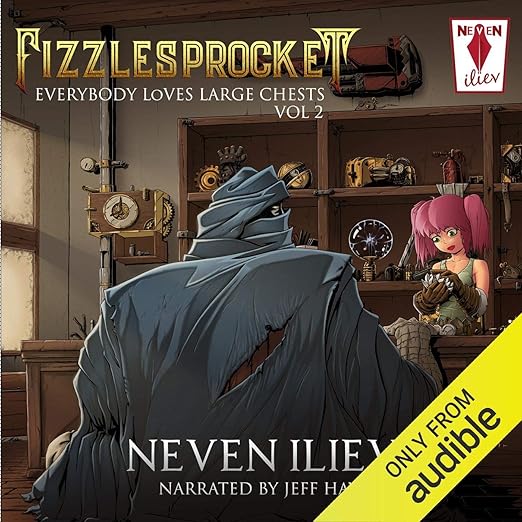
Volume two of Everybody Loves Large Chests opens on an empire in a state of full panic, and the audiobook's best running joke is that the creature responsible for all of it has no idea any of this is happening. Neven Iliev builds ten hours and twenty-two minutes of geopolitical crisis, elven sabotage and divine surveillance around a protagonist who spends the same stretch of story working out how a wagon turns. That gap between what the world believes and what the listener knows is the whole comic engine, and when it fires, this second volume is very funny. When it stalls, the machinery of empires and gods grinds on past the point the joke needs.
First, the Big Picture
The setup is played completely straight. A city burns to ash, a whole province vanishes under a spreading cloud of death, and the humans do what nations reliably do: they blame the neighbors to the north. Centuries of bad blood between the Lodrak Empire and the elves of the Ishigar Republic flare back up and open war starts looking inevitable. Investigators, opportunists, schemers and the gods themselves all converge on the same question of who set this in motion, and not one of them is anywhere near right.
Against all of that, the point-of-view character is a mimic. One five-star reviewer compresses the creature's entire worldview into six words that also serve as their review title: “Is it shiny? Is it Tasty?” The capitalization is theirs, and so is the logic, which is roughly the consideration the protagonist brings to a continental emergency. The same reviewer notes that this mimic “managed to survive and thrive through the first book”, which is the other half of the appeal. Power arrives here by accident and misunderstanding rather than by design, and the accident is the point.
What volume two does well, on the evidence of people who have read further than most, is the surrounding world. Ian Mitchell, who followed the story on Royal Road Legends long before these books existed, calls it “Wonderfully naughty great fun.” and singles out the cast: “The characters are fun. The whole world has a great humor to it”, and there the review runs out. Volendi, at four stars, is more measured, and useful precisely because of it.
The comedy holds because Iliev commits to the premise at scale rather than winking at it. Every serious faction in the book pours real resources into hunting a mastermind who does not exist in the form they imagine, and all of that apparatus is aimed at a creature whose ambition tops out at understanding basic cartage. Ten hours is long enough for that irony to accumulate weight instead of wearing thin, and the escalating gap between the two halves of the story is what keeps the runtime moving.
The reading credit belongs to Jeff Hays, and the material makes very specific demands of whoever accepts it. A comedy built on dramatic irony needs a performer who refuses to signal the joke: the instant a reading nudges the audience, the distance between the world's terror and the protagonist's obliviousness collapses. Add human officials, elven operatives, actual deities and the explicit adult material the publisher flags, and the register has to shift repeatedly without the deadpan ever slipping. Not one of the three visible reviews says a word about the recording, so a verdict on the performance would be pure invention. What I can set out is exactly what the job requires.
For anyone already inside the series, the practical argument is continuity and cleanup. Mitchell describes returning to the material as “a real treat to reread the story after a nice cleanup”, a precise compliment rather than a vague one: the serialized version was rougher, and the published volumes have been edited into shape. Mitchell also warns that “This story goes on for quite a while past this book.” Volume two is a waypoint on a long road, not a stopping place, and the audiobook makes most sense as one leg of a much longer listen.
Weak Spots in Fizzlesprocket: Everybody Loves Large Chests - Vol. 2
Start with the obvious. This is volume two and it does not brief you. The first book's events are load-bearing, the protagonist's earlier survival is treated as settled history, and nobody explains what a mimic is or why an imperial intelligence apparatus has failed to notice one. Begin here and you will spend the opening hours reverse-engineering a premise the book assumes you already find funny.
The publisher's own content warning is blunt and worth repeating in full: profanity, gore, violence, explicit adult content. That is not boilerplate. The listing also files this under a Horror tag, which sits strangely beside a comedy label until you notice the gore line in that same warning. My read is that the tag reflects a handful of genuinely nasty individual scenes rather than the book's overall temperature, which stays firmly comic. If explicit material inside a humorous fantasy is a problem for you, no amount of comic timing will make it work.
The dissent worth weighing comes from Volendi, who enjoyed the book enough to plan on continuing and who still put the reservation plainly: “It just wasn't the engrossing read the first one was”. Diminishing returns on a joke premise is the standard failure mode of comic series, and a four-star verdict from a returning reader carries more information than a five-star from a first-timer. Worth knowing too that the star average sits on a rating pool small enough that one more vote would move it, a sign of how new this listing still is rather than of anything in the writing.
Is This One for You?
Anyone who came out of volume one wanting more of the same machinery will get it, expanded. If the pleasure of the first book was watching a fundamentally unwise creature generate international incidents while pursuing snacks, this one scales the consequences up to a war footing without changing the creature at all. Fans of absurdist progression fantasy, of the web-serial tradition Mitchell came from, and of comedy that stays committed when a wink would be easier, are the core audience. That runtime is a real commitment, but the pleasure is cumulative rather than front-loaded.
Give it a miss if you are new to the series, if explicit content inside comedy bothers you, or if you want a protagonist with a recognizable arc. Give it a miss too if you need a crowd behind you first, since the feedback pool is thin and the written reviews describe the writing rather than this recording. My advice to a curious newcomer is unglamorous: start at volume one, work out there whether the joke belongs to you, and let that answer decide this.