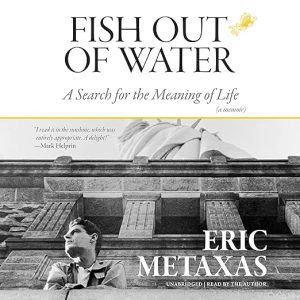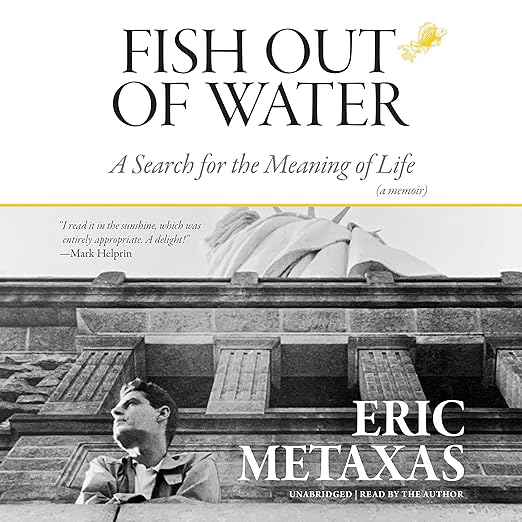
Eric Metaxas has spent two decades asking other people about the meaning of their lives, first on his radio show and then on stage at Socrates in the City, so a real structural irony sits at the center of Fish Out of Water: the interviewer finally has to sit in the chair himself. This audiobook, narrated by Metaxas across seventeen hours and twenty-five minutes, ends up feeling less like a typical celebrity memoir and more like the best episode of his own program, the one where the host stops performing curiosity about other people's struggles and admits he had a few of his own.
A Drift Toward an Abyss of Meaninglessness
The book traces Metaxas from a Queens childhood split between Greek and German immigrant traditions through what the synopsis calls his 'riotous but successful years' at Yale, and the pleasure of the early chapters comes from watching a genuinely funny writer describe people who sound too vivid to be invented: aunts, uncles, and family friends who read like a cast a novelist would have to tone down for plausibility. Metaxas has built a career writing about other people's extraordinary lives, Bonhoeffer and Martin Luther among them, and it shows here in how carefully he sketches minor characters who appear for only a page or two.
Where the book turns is the part the synopsis only gestures at: a drift 'toward an abyss of meaninglessness' after the Yale years, once the family affection that carried him through childhood no longer felt like enough on its own. Metaxas doesn't rush this section, and to his credit, he resists making the low point sound tidier in hindsight than it must have felt at the time. The result is a memoir that earns its subtitle, A Search for the Meaning of Life, rather than just wearing it as marketing copy.
A Talker Who Can't Talk His Way Out
The title itself does double duty. 'Fish out of water' describes the literal outsider feeling of a first-generation American kid who never quite matched either his Greek relatives or his German ones, but it's also a fitting description for a natural talker who spends the book's hardest chapters unable to talk his way out of his own despair. Metaxas earns that title rather than just borrowing a common idiom for it.
Being a five-time New York Times best-selling author before ever writing about himself gives the book an unusual vantage point: Metaxas already knows, from the outside, what makes another person's life story worth several hundred pages, and he applies that same editorial instinct to his own material rather than indulging in the shapeless completism a lot of first-time memoirists fall into.
Metaxas Hearing Robert Plant on the Radio
Self-narration is the entire argument for choosing the audio edition here. Metaxas has spent years learning how to time a laugh line and let a serious beat land without over-explaining it, skills that come directly from hosting live interviews rather than reading a manuscript cold, and that broadcasting instinct is audible in how he paces his own comic asides against the memoir's darker passages.
Reviewer Gail Zimmerman zeroes in on a single moment that captures why the audio format suits this material: Metaxas hearing Robert Plant's 'Heaven Knows' on the radio during his search for meaning and half-praying that the song itself would answer him, a scene built entirely around sound and coincidence. Hearing Metaxas narrate his own recollection of that moment, rather than reading it silently on a page, closes the distance between the memory and the listener in a way a hired narrator, however skilled, would have to work much harder to earn.
The synopsis promises 'Runyonesque characters,' a specific and accurate comparison, Damon Runyon's Broadway hustlers and eccentrics share a certain vivid theatricality with the aunts, radio producers, and college friends who populate this memoir, and a self-narrator who already knows exactly which relative's voice he's imitating in his head has a real advantage in bringing that theatricality across without it curdling into caricature.
The seventeen-hour runtime also gives Metaxas room he wouldn't get in a shorter format: enough space to let a single family anecdote breathe for several minutes before pivoting, which is closer to how he actually tells stories on his radio show than a tightly edited written chapter would be.
His Literary Circumnavigation Has Only Begun
Seventeen and a half hours is a genuine commitment for a memoir, and listeners expecting a tight, plot-driven account of one dramatic turning point should recalibrate: this is a slow, cumulative portrait built from accumulated detail, closer in shape to a long-form radio conversation than a three-act redemption story.
The book's back half leans more explicitly into questions of faith than the opening chapters advertise, and listeners drawn in purely by the 'mischievous' comic tone the synopsis promises should know the mischief gives way to something more searching well before the end. That shift is handled with genuine craft rather than a sudden tonal lurch, but it's worth naming plainly rather than letting a listener discover it by surprise partway through hour twelve.
One reviewer, writing under the handle Lux et Veritas, Yale's own motto, offers praise so ornate ('his literary circumnavigation has only begun to assemble the armada') that it reads more like a fellow alum's inside joke than a straightforward recommendation. It's a charming detail and a clue to the kind of loyal audience this book already has, but it's worth weighing against the plainer, more specific reactions from other listeners when deciding whether the material itself, not just affection for its author, will hold seventeen hours of attention.
At a 4.6 average across nearly a thousand ratings, the reception has been consistently warm, and the specific praise reviewers keep returning to, sincerity, humor, emotional honesty, lines up closely with what the synopsis promises rather than overselling it. That consistency is worth noting for a memoir genre where enthusiastic early reviews sometimes cool once a book reaches a wider, less pre-sold audience.
This Time Metaxas Is the Subject Himself
This suits listeners who already know Metaxas from his biographies or his broadcasting work and want the origin story behind that public voice, along with anyone drawn to immigrant-family memoirs that balance real comedy against real searching. Yale alumni and Socrates in the City regulars will find plenty of material written directly for them, but the book doesn't require that familiarity to land.
It also works well for listeners newer to Metaxas entirely, since the book stands on its own without requiring familiarity with his other biographies; the same instinct for finding the telling detail in someone else's life is simply turned inward here for the first time.
Skip it if a tight, fast-moving memoir is what you're after, or if seventeen hours of one man's interior search for meaning sounds like more commitment than the subject warrants for you personally. Listeners who want Metaxas the biographer rather than Metaxas the subject should start with one of his books about someone else instead.
The Short Version
- Voice: Eric Metaxas narrates his own memoir with a broadcaster's timing, landing both the comedy and the harder passages without over-explaining either.
- Big ideas: immigrant identity, ambition and disillusionment, faith and meaning, family and belonging
- Atmosphere: Warm and wry, turning more searching in its second half
- Worth it?: A rewarding, unhurried listen for anyone who already knows Metaxas's voice, though its seventeen-plus hours ask for real patience.
Common Questions
Does Eric Metaxas narrate the Fish Out of Water audiobook himself?
Yes. Metaxas reads his own memoir across all seventeen hours and twenty-five minutes, bringing the same broadcasting timing he uses on his radio show and at Socrates in the City.
Is Fish Out of Water mostly funny or mostly serious?
Both, in roughly that order. The earlier chapters lean into comic, 'Runyonesque' family stories, while the back half turns toward a more searching account of Metaxas's drift toward meaninglessness after Yale.
How long is the Fish Out of Water audiobook?
Seventeen hours and twenty-five minutes, a substantial commitment closer to a long-form conversation than a tightly plotted memoir.