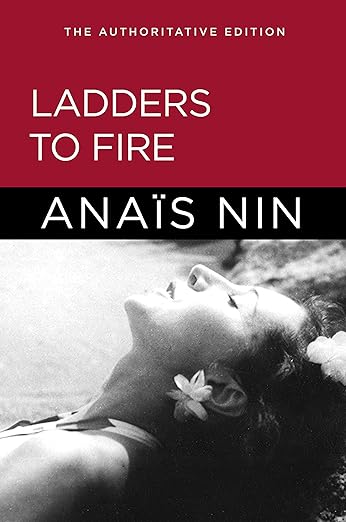
Nin's first novel is what the description on this audiobook sells, and the title field says something shorter. The copy is unambiguous: this is a new authoritative edition of Ladders to Fire, complete with character descriptions, a publishing history, an author's chronology and the original prologue Nin wrote for it in 1946. The listing calls itself Fire. The category tag calls the book diaries and correspondence. Three fields, three different answers, and a buyer who knows Nin's bibliography will recognize immediately that at least two of them cannot be describing the same object.
Interior Weather Rather Than a Plotted Event
Lillian is the way in, and the copy chooses its illustration well: a restless spirit trapped in a conventional marriage who crosses a street and is neither attacked nor harmed, yet feels every horror as though it had happened to her. That passage is quoted at length in the description, bracketed typo and all, and it is a fair sample of the method. Nin writes interior weather rather than event. Through Lillian, Djuna, Sabina and Jay, the copy says, she examines the destruction in woman and woman's struggle to understand her own nature, which is the register the whole novel operates in.
A March 2012 five-star supplies the most balanced assessment on the page, and it comes from someone who had read the diaries several times before starting the fiction. The novels carry the same brilliant prose, that response says, but being more contrived they satisfy less. What it enjoys is watching Nin build characters by mixing and matching traits taken from herself and from people she knew, a game of recognition set against long philosophical passages. That is an unusually precise description of what these books are, and it doubles as a warning for anyone expecting narrative momentum.
Water Colors on Silk, and Four Novels to Follow
Water colors on silk is the phrase a December 2014 five-star reaches for, and it stays with you. That response argues for this as the place to begin with Nin, praising writing that put language to feelings the reader did not know could be described, or had ever existed at all. Set that beside the March assessment and you have the honest range of reactions to this material: one reader finds the fiction thinner than the journals, another finds it the door into everything. Both agree entirely about the sentences.
Cities of the Interior is the frame that makes the ambition legible. The copy states that this novel opens a sequence Nin named herself, and then lists the four that follow: Children of the Albatross, The Four-Chambered Heart, A Spy in the House of Love, and Seduction of the Minotaur. Read as book one of five rather than as a standalone, the lack of conventional resolution stops being a flaw. The description also makes a historical claim worth weighing, that the novel was an early attempt to address a woman's quest for completeness in a male-dominated world, which places it decades ahead of the conversation it belongs to.
One Hundred Fifty-Two Pages Against Eighteen Hours
One hundred fifty-two pages is what the page count field claims, against a runtime of eighteen hours and forty-nine minutes. Do that division and you get roughly eight pages an hour, which no human reader has ever produced. The two fields are describing different products, and the abbreviated runtime format plus the invisible formatting characters sitting inside the publisher and language values point the same way: this record has been assembled from more than one source. Whether the file holds the single novel or something longer, the listing gives you no way to tell.
Empty series fields are the second half of that problem. The copy names a five-book cycle and this volume's position in it, and both series boxes on the record sit blank, so nothing tells a browsing buyer that four more novels follow. A January 2016 response mentions enjoying the five-part series, which suggests some listeners have found the rest; nothing on this page helps them do it. If you want the sequence, you will be searching by the four titles in the description rather than by any series link.
Henry Miller is how many readers arrive, and a November 2010 five-star documents the route precisely: Tropic of Cancer first, then Nin as Miller's counterpart, then a used-bookshop copy of Delta of Venus, then a visit to the Miller library at Big Sur before returning to her work. That is worth knowing because it shapes the review pool. A significant share of this column came to the novels through the erotica and the biography rather than through the modernist project, and the 4.0 average across forty-one votes reflects a readership arriving with mismatched expectations.
A Three-Star Review That Just Says No Comment
Patience is the entry requirement, and the January 2016 four-star gives the best instruction anyone has left here: read it slowly, take it in. That is the correct approach to prose this dense, and it argues for the audio edition being the harder format rather than the easier one, since a recording sets a pace that a page does not. Readers of the diaries, students of modernist fiction, and anyone interested in early attempts to write female interiority without apology are the natural audience.
Nobody should treat the star average as guidance. Four of the five written entries carry actual text and the fifth, a three-star, consists entirely of the words no comment, which is a grade with no argument attached. Skip this one if you want plot, since almost nothing happens in the conventional sense across nearly nineteen hours, and skip it if you need to know exactly which text you are buying, because between the title, the tag and the page count, this listing cannot tell you.
A Few Questions About Fire
Does the audiobook include the rest of Cities of the Interior?
Nothing on the record says so. The copy names this as the first novel in the cycle and lists the other four titles, but both series fields are empty and no bundle is advertised, so treat the runtime as the only clue and confirm the contents before buying.
Is this a good first Nin book?
The description positions it as her first full-length novel and the opening of a five-book sequence, which is a defensible entry point. Readers who prefer her journals may find the fiction more contrived, and this edition adds character descriptions, a chronology and her original 1946 prologue as support.
What does this audiobook edition add to the novel itself?
The copy promises an authoritative edition carrying character descriptions, a publishing history, an author's chronology and the prologue Nin wrote in 1946. Whether that apparatus was recorded or only appears in print is not stated anywhere, and no companion document is attached to the record.