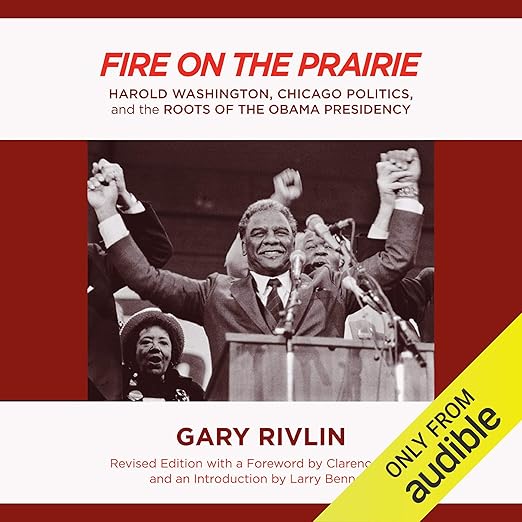
I returned to Gary Rivlin's Fire on the Prairie after reading a profile of a Chicago aldermanic race that referenced Harold Washington's coalition as the founding template for multiracial urban politics. The connection felt abstract until I started this audiobook. Within the first hour, Chicago in 1983 stopped being a historical reference and became a place with specific people, specific wards, specific grievances, and a specific kind of political fight that feels entirely contemporary even at forty years' distance. George Orlando's narration gives the material exactly the weight it deserves across thirteen hours, and what Rivlin has constructed here is one of the better accounts of how American urban politics actually works.
Harold Washington's election as Chicago's first Black mayor in 1983 was not simply a story about race, though race was everywhere in it. It was a story about what it takes to dismantle a political machine that has controlled a major American city for decades, and what coalitions are possible when the traditional power structure fails to adapt to a changing population. Washington ran against Jane Byrne, heir to Richard J. Daley's empire, and against Daley's own son, in a three-way primary that should have been unwinnable. That it was winnable, that Washington built a coalition of Black voters, white liberals, and Latino communities who had all been systematically marginalized by the machine, is the central drama of the book.
Rivlin is scrupulous about the internal divisions within Washington's coalition. Lu Palmer, the Black separatist whose grassroots mobilization was foundational to Washington's primary victory, had a different vision of what a Washington administration should look like than the white liberals who supported the same candidate for different reasons. Jesse Jackson occupied yet another position. Ed Vrdolyak, the opposition's leader, was not simply a racist obstructionist but a figure whose political survival required the machine's continuation. Rivlin gives all of these figures their complexity, and the result is a political history that refuses to flatten into allegory.
Orlando Balances Dramatic Energy With Documentary Restraint
George Orlando's narration suits the material's register precisely. This is political history with genuine narrative drive, and Orlando reads it with the tempo of someone who understands that the story has momentum. He distinguishes the many figures in Washington's orbit clearly enough that the cast, which is large and politically variegated, stays navigable across thirteen hours. His handling of the confrontational scenes in the Chicago City Council, the period of intense opposition that followed Washington's election and became known as Council Wars, has the right combination of dramatic energy and documentary restraint.
Reviewers who lived through this period in Chicago describe the book as 'fantastic' for its capturing of the racially charged atmosphere and for its insight into how media distorts political events. Rivlin's research clearly drew on close access to the principals, and the level of granular detail, who was in which room, what was said in which meeting, which coalition members defected at which moment, gives the audiobook the texture of political narrative rather than political analysis.
Electoral Victory Is Not the Same as Governing
This is a book that benefits from some prior knowledge of Chicago's political geography and history. Listeners who know nothing about the Daley machine, about the significance of the Black Belt on the South Side, or about the structural role of ward politics in Chicago governance will need to pay close attention in the early chapters, where Rivlin establishes the context. He does explain what he needs to explain, but the density of the political landscape means that listeners who come in without background will work harder for the first few hours than those who do not.
The book was originally published in 1992 and has been updated, but some of its framing reflects the political categories of that moment rather than ours. The language around race and politics has shifted in ways that occasionally surface in the text, and listeners should hold those moments in their historical context rather than judging them by current standards. The core argument about multiracial coalition-building, about what Washington's administration revealed about both the possibilities and limits of that politics, remains current.
Rivlin's reporting on the internal dynamics of Washington's administration, particularly the period of Council Wars when the aldermanic majority aligned under Ed Vrdolyak blocked virtually every Washington initiative, reveals something important about the gap between electoral victory and actual governance. Washington won the election and then spent years fighting for the basic capacity to run the city he had been elected to run. That dynamic, a political coalition winning power and then discovering how many levers of institutional resistance remain in the hands of the displaced machine, is a story that has repeated itself in American cities in different forms since. Rivlin's account of the Chicago version is so granular that it functions as a structural primer for anyone trying to understand how political transitions in cities actually work.
Complexity Made Accessible, Never Simplified
Listeners interested in urban political history, in the mechanics of machine politics and what it takes to disrupt them, will find this audiobook a sustained and serious treatment of a genuinely important episode. For Chicagoans, particularly those who lived through the Washington years or who are curious about how contemporary Chicago politics acquired its shape, this is essential listening. For listeners outside Chicago who care about American racial politics and the history of multiracial coalition-building in cities, Fire on the Prairie offers a model case study that repays the thirteen-hour investment. Orlando's narration makes the complexity accessible without simplifying it.
The Short Version
- Performance: George Orlando reads Rivlin's densely peopled political history with steady momentum and enough character distinction to keep the large cast navigable across thirteen hours.
- What it covers: Multiracial urban coalition politics, dismantling machine power structures, race and media distortion in American cities
- Feel: Detailed and politically serious, with the pacing of a well-constructed political thriller
- Our call: A rigorous and specific account of Harold Washington's historic Chicago election, narrated with documentary authority by George Orlando across thirteen hours.
Common Questions
Do I need prior knowledge of Chicago politics to follow this audiobook?
Some familiarity with Chicago's ward system and the Daley political machine helps, particularly in the early chapters. Rivlin does provide context, but the density of the political landscape means listeners without any background may need to invest more attention in the opening hours.
Is this audiobook a balanced account of the 1983 Chicago mayoral race?
Rivlin presents multiple perspectives, including Jane Byrne's camp, Vrdolyak's opposition, and the internal divisions within Washington's own coalition. The book is sympathetic to Washington's project but engages seriously with the complexity of all the players involved.
How does George Orlando handle the large cast of political figures in the narration?
Orlando maintains clear tonal distinctions across the book's many figures without resorting to caricature. At thirteen hours with a very large cast of politicians, activists, and coalition members, his consistency makes the audiobook followable in a way that a less disciplined narration would not be.