Quick Take
- Narration: Jack de Golia reads with the unhurried authority the subject demands, no pyrotechnics, just clear delivery of a dense and genuinely original argument.
- Themes: Fire as ecological force, the Pyrocene as human era, the interdependence of fire and civilization
- Mood: Wide-ranging and sobering, with passages of genuine eloquence
- Verdict: The most intellectually serious audiobook about fire you are likely to encounter, Pyne is the acknowledged world authority, and this book earns that reputation.
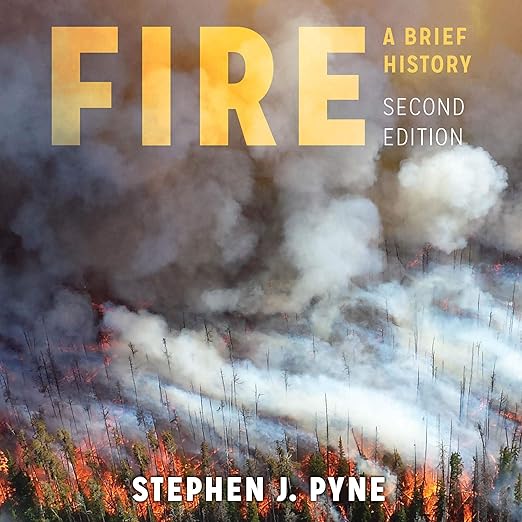
I came to Fire: A Brief History sideways, through a review of Stephen Pyne’s larger works in a geography journal. The reviewer described Pyne as someone who had spent his career trying to make fire legible to people who had reduced it to either a hazard or a romantic backdrop. That framing stuck with me, and when I finally sat down with this audiobook, on a rainy Sunday when the news was full of wildfire coverage, the timing felt almost too apt.
What Pyne argues, across nine brisk hours, is that fire is not incidental to human civilization, it is constitutive of it. The claim that “without dominating fire humanity sinks to a status of near helplessness, a plump chimp with a scraping stone and digging stick” sounds provocative, but Pyne spends most of the book making it feel self-evident. Fire is the technology that makes cooking possible, which is what makes the human brain what it is. Fire is what cleared landscapes for agriculture, maintained grasslands, and allowed pastoralism. Fire is what powers industrial civilization through fossil fuels, which are, in Pyne’s formulation, fire from ancient organic material. The continuity he traces across these forms is the book’s central intellectual contribution.
Our Take on Fire: A Brief History
The Pyrocene concept, Pyne’s proposed name for the current geological era, emphasizing fire rather than human presence as the defining characteristic, is the book’s most provocative offering. The argument is that calling our era the Anthropocene correctly names the agent but misidentifies the mechanism. It is not simply that humans are present; it is that humans, uniquely among all species, use fire at planetary scale. The industrial burning of fossil fuels is not a departure from human fire practice, it is its logical extension.
That reframing has implications for how we think about climate change, wildfire management, and the relationship between indigenous burning practices and modern fire suppression. Pyne is scrupulous about not overstating what the historical and anthropological record can support, but the argument accumulates with real force by the time you reach the new chapter on the 21st century added to this expanded edition.
Why Listen to Fire: A Brief History
Jack de Golia’s narration is appropriately unshowy. This is a book that makes its effects through argument rather than sensation, and de Golia reads it with the patience that requires. The Seattle Times observation that Pyne “writes about fire as if he were on fire” is not the experience of listening to this audiobook, it is more accurately described as listening to someone who has thought about fire more carefully than anyone else alive. That is its own kind of compelling.
The University Press Audiobooks production is clean and well-calibrated. At nine and a half hours, the audiobook covers a genuinely vast stretch, from pre-human fire ecology through aboriginal burning economies through industrial combustion and into the 21st century, without feeling compressed. Pyne is a concise writer, and the brevity of the source text (this really is the brief history it claims to be) means every section pulls its weight.
What to Watch For in Fire: A Brief History
Pyne’s prose is erudite and occasionally dense. He uses “big words sometimes” and draws on fine literature in ways that one admiring reader described as eloquence rather than difficulty, but listeners expecting a populist science read may need to adjust. This is not written down for anyone. It assumes an intelligent, curious reader who is willing to engage with ideas that resist easy summarizing.
The book is also, despite its global ambitions, weighted toward North American and particularly American fire experience. Pyne’s deep expertise is in the American West, and while he ranges across the world’s fire regions, the texture of his examples is often most vivid when he’s writing about landscapes he knows directly. Listeners with specific interest in Australian, African, or Southeast Asian fire histories may find the coverage of those regions more schematic than they would like.
Who Should Listen to Fire: A Brief History
Essential for anyone interested in environmental history, anthropology, or ecology who wants a framework for understanding wildfire that goes beyond immediate crisis coverage. Particularly valuable for listeners wrestling with how to think about contemporary climate and fire policy, Pyne gives you a temporal and ecological scale that the news cycle cannot. Those who want a more narrative-driven fire book might look elsewhere first, but this should eventually be on every serious reader’s list.
Frequently Asked Questions
What is the Pyrocene concept that Pyne introduces, and how central is it to the audiobook?
The Pyrocene is Pyne’s proposed alternative to the Anthropocene as a name for the current geological era, it foregrounds fire rather than human presence as the defining mechanism. The concept appears in the new chapter added to this expanded edition and serves as the book’s capstone argument rather than its organizing premise throughout.
Is Fire: A Brief History suitable for listeners without a scientific background?
Yes, with the caveat that Pyne writes with academic precision and draws on ecology, anthropology, and history simultaneously. He doesn’t simplify, but the argument is built clearly enough that patient attention is rewarded without requiring specialist preparation.
How does the expanded audiobook edition differ from the original book?
It includes a new chapter specifically addressing fire in the 21st century, with particular attention to the Anthropocene (or what Pyne suggests renaming the Pyrocene) and the role of industrial fire in contemporary environmental conditions. The core historical argument remains unchanged from the original edition.
Does the book address current wildfire crises and climate change directly?
The expanded edition does address these concerns, primarily in the new chapter. Pyne provides historical and ecological context for understanding why contemporary wildfire conditions are not simply worse weather, they reflect deep patterns in the relationship between human fire management and landscape. The analysis is substantive rather than polemical.