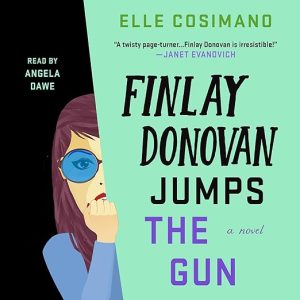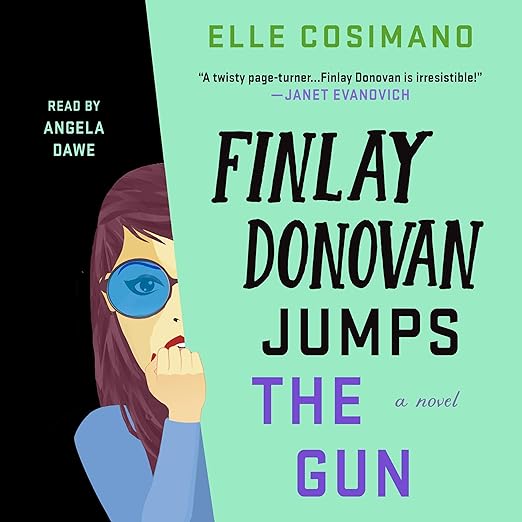
I finished Finlay Donovan Jumps the Gun on an evening when I had been feeling vaguely overwhelmed by competence requirements, which made the experience of listening to a protagonist who is spectacularly, chronically in over her head feel specifically restorative. Finlay Donovan does not have her life together. She has a book deadline, two young children, a nanny who is also her accomplice in accidental organized crime, and a debt to a Russian mob boss that keeps finding new shapes. This is a comedy about inescapable circumstances, and it is a very good one.
Finlay Donovan Jumps the Gun is the third book in Elle Cosimano's series. Finlay and her nanny Vero find themselves enrolled in a citizens' police academy run by detective Nick Nicotero as a cover for investigating an online contract killer, EasyClean, before the cops find him. The Russian mob is supplying the pressure, the citizens' academy is supplying the absurd cover, and Vero's past adds a new complication. Cosimano layers the plot without losing track of any of its threads, which requires more structural discipline than the comic register suggests.
How Finlay Donovan Jumps the Gun Holds Up
Angela Dawe's narration has been the audiobook series' defining advantage from the beginning, and AudioFile Magazine's observation that she provides distinct voices for Finlay and her sidekick Vero understates what she is actually doing. Dawe does not just differentiate the characters. She sustains the emotional logic of a woman who is genuinely in danger while also being genuinely funny, which is a tonal precision that few narrators achieve. The exasperation in Finlay's voice when plans go wrong has the ring of someone who has had too many plans go wrong rather than a performer playing frustration.
The citizens' police academy premise is one of Cosimano's better structural inventions. It gives Finlay access to the investigative world she needs to operate in without requiring her to have credentials she would never plausibly have, and the forensics and firearms training sequences offer Cosimano excellent opportunities for the kind of situational humor the series does best. One reviewer called the setup a perfect cover-up to sleuth out the real criminal, which is accurate, and the humor that comes from Finlay's increasingly surreal dual existence is fully present here.
Why Finlay Donovan Jumps the Gun Works as an Audiobook
The audiobook is unambiguously the best format for this series. Cosimano's dialogue is fast and layered, and Dawe's ability to distinguish characters while keeping the primary perspective consistent means you lose nothing in audio that you would gain in print. The comic timing that makes Finlay's catastrophes funny rather than merely dire is timing-dependent in a way that audio delivers more effectively than page. Several reviewers described listening in one sitting, and Dawe's narration is a significant part of why the pace feels that natural.
The Nick and Finlay dynamic that comes to a head in this third book also benefits from audio. Romance in comedy-thrillers lives on pauses and reactions as much as declarations, and Dawe's understated handling of those moments is more effective than any typographic equivalent.
Weak Spots in Finlay Donovan Jumps the Gun
The third book carries the accumulated weight of the series' character roster, and at least one reviewer found keeping track of the recurring supporting cast challenging. Cosimano populates her world with characters who appear, disappear, and return, and the audiobook does not have the print reader's option to flip back and check earlier appearances. If you are listening to this book in close succession with the first two, the character continuity is manageable. If there has been significant time between listens, some of the supporting cast callbacks will require tolerance for partial recall.
One reviewer also noted that the third book felt slightly more chaotic than its predecessors in its plotting, and that assessment resonates. Cosimano is juggling more threads here than in the earlier books, and occasionally the management of those threads is more visible than it should be. The series still works, but the seams are slightly more present than in the tighter first installment.
The Right Listener for Finlay Donovan Jumps the Gun
Listeners who have followed Finlay from the beginning and want to know where the Nick relationship lands will find the resolution genuinely satisfying. New listeners should not start here. The accumulated backstory that gives Finlay's situation its specific flavor requires the prior books to make full sense. For comedy-thriller fans who have not encountered this series at all, starting with Finlay Donovan Is Killing It and proceeding from there is the correct approach. Janet Evanovich readers who have been disappointed by the Plum series in recent years should find this a worthy successor to that early-series energy.
- Performance: Angela Dawe is the reason this series works in audio. She delivers Finlay's voice with the precise mix of exasperated competence and genuine warmth that the character requires.
- What it covers: Accidental criminality, single motherhood under impossible pressure, found partnership
- Feel: Chaotic and funny with real stakes underneath the absurdity
- Our call: A series that benefits enormously from starting at book one, but for committed Finlay Donovan fans this third installment delivers what the series does best.
Questions Listeners Ask
Does Angela Dawe differentiate Finlay and Vero's voices clearly enough to follow their banter in the audiobook?
Yes, this is one of the narration's specific strengths. AudioFile Magazine specifically cited Dawe's ability to give Finlay and Vero distinct voices, and the rapid-fire exchanges that define their dynamic are entirely legible in audio.
Does the Nick and Finlay romance progress meaningfully in this third book?
Yes. The romantic tension that has been building across the series reaches a significant development in this installment, and several reviewers cited it as the most satisfying element of the third book's emotional payoff.
How much does the Russian mob plot carry over from the previous two books, and is the context recoverable from this book alone?
The mob context is substantial and directly continuous from the earlier books. While the book is billed as potentially standalone, the debt structure and mob boss Feliks's role will be significantly more legible to listeners who have followed the series from the beginning.
Is the citizens' police academy premise played realistically or for broad comedy?
Firmly for comedy, though Cosimano incorporates enough procedural accuracy to keep the satirical version of the academy recognizable. The forensics and firearms training sequences are played for situational absurdity rather than technical authenticity.