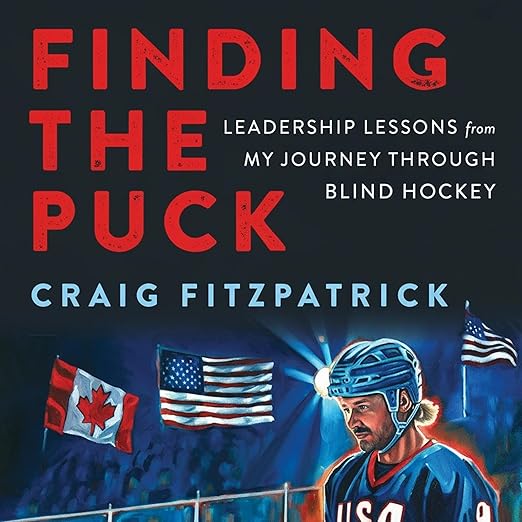
Craig Fitzpatrick's Finding the Puck is the kind of audiobook that changes what you think is possible before it gets to any of its explicit arguments about resilience or leadership. Fitzpatrick is nearly completely blind, has taught over three hundred blind adults and children to play ice hockey at a competitive level, and competed internationally on the US Blind Hockey team while studying the game under NHL trainers. Narrated by Regen Wilson, this memoir makes its case not by lowering standards but by revealing how demanding this version of the sport actually is.
The Only Professional Sport With a Blind League
The fact that ice hockey is the only professional sport to have a blind league is the piece of information that most people respond to with immediate disbelief, and Fitzpatrick uses that disbelief productively. His account of how the game is adapted, quieter pucks, modified rink surfaces, specific positional protocols that replace the visual tracking a sighted player takes for granted, is precise enough to be genuinely interesting as sports writing before it becomes anything else. What follows from that specificity is a portrait of a community that built what it needed from the inside, with Fitzpatrick's Try Blind Hockey program becoming the mechanism by which NHL partnerships and mainstream disability awareness converged around something that existed long before mainstream attention arrived.
The memoir structure places Fitzpatrick's personal experience of losing his sight against the broader narrative of what he built afterward, and Fitzpatrick handles this dual arc without making his own story subordinate to the advocacy mission. His experience of returning to the ice after losing most of his vision, the physical and psychological mechanics of relearning something he had previously done with full sight, is rendered with enough detail that the reader understands it as a specific kind of athletic recalibration rather than a generic comeback. One reviewer, who noted a personal connection to the author but stated explicitly that the review was based solely on the writing's impact, described it as a powerful work of literature. The qualifier about personal connection is worth noting; the reviewers without stated personal ties also rate it at five stars and describe it as genuinely inspiring. The convergence suggests the quality is real rather than social.
Wilson Can Hold Both Registers Without Jarring Shifts
Regen Wilson's narration navigates the memoir and leadership parable sections with clear tonal differentiation. Fitzpatrick structures the book so that personal narrative and applicable leadership principles alternate, which requires a narrator who can hold both registers without the shifts feeling jarring. Wilson manages the transition between Fitzpatrick's more lyrical memoir passages and the direct-address business leadership content that grew out of his competitive experience. At five hours and twenty-nine minutes, the runtime is well-matched to the material; long enough to give the blind hockey community portrait real depth but short enough to maintain the propulsive quality of a story that keeps revealing new dimensions of its subject.
For listeners who came to this book through hockey culture specifically, the audiobook delivers both the sport's particular texture, the speed, the contact, the tactical intelligence required, and the unfamiliar context of what the blind league version of all those qualities actually means. For listeners coming from disability memoir or leadership content, the specificity of the hockey world provides a concrete context for principles that in other books float free of any verifiable application.
Translating Visual Game Knowledge Into Tactile Terms
Pay attention to how Fitzpatrick handles the institutional dimension of his advocacy. His Try Blind Hockey program's partnerships with NHL teams are described as something he navigated rather than something that was handed to him, and the account of those negotiations carries the same kind of tactical intelligence he applies to the game itself. The openness and humility he identifies as core leadership principles are demonstrated in how he writes about the failures and resistances he encountered rather than being stated as lessons and left abstract.
The section covering Fitzpatrick's work at the cutting edge of the business world, which runs parallel to his competitive career, positions the memoir as a leadership resource alongside a sports story. Listeners who pick up this audiobook for the hockey memoir and find the business content unexpected should know that Fitzpatrick earned his way into those sections through the same incremental credibility he built on the ice; they are not an appended self-help component but an organic extension of a consistent analytical mind at work across different contexts.
Fitzpatrick's account of studying the game under NHL trainers while essentially blind is one of the more remarkable passages in the audiobook, and it deserves attention as sports writing independent of the disability narrative. Understanding hockey at the level required to teach it and adapt it required Fitzpatrick to develop analytical and communicative frameworks for aspects of the game that most sighted players absorb visually without ever having to articulate. The process of translating visual game knowledge into tactile and spatial terms, which is what coaching blind players demands, produced a level of technical understanding of hockey fundamentals that his NHL trainer contacts apparently found sophisticated. This is the kind of detail that elevates a memoir above its inspirational summary: Fitzpatrick did not simply find a way to remain in the sport he loved; he developed a new expertise within it that gave him standing among people who had their full visual capacities available to them throughout their careers.
Fluid Between Narrative, History, and Leadership Principle
Hockey fans who want to understand a dimension of the sport they have likely never encountered will find Finding the Puck genuinely revelatory. Disability advocates and anyone working in adaptive sports will value the specific account of how institutional change actually happens from the inside. Business readers who want leadership content grounded in verifiable athletic experience rather than metaphor will find Fitzpatrick's parable sections unusually concrete. Skip it if you require conventional memoir structure; Fitzpatrick moves fluidly between personal narrative, sports history, and leadership principle, and the book works best for listeners comfortable with that kind of thematic weaving.
Quick Take
- Narrator: Regen Wilson gives Craig Fitzpatrick's story the respect it deserves, reading the memoir and leadership parable sections with appropriate tonal shifts and handling the blind hockey specifics with enough precision to convey the technical demands of the sport.
- Subjects: Disability, advocacy, and competitive identity; blind hockey as community and calling; leadership principles from the ice to the boardroom
- Tone: Inspiring without sentimentality, specific enough to surprise
- Bottom line: A memoir that expands the definition of athletic achievement by showing what competitive sport looks like when it is built from the ground up for people the mainstream version excluded.