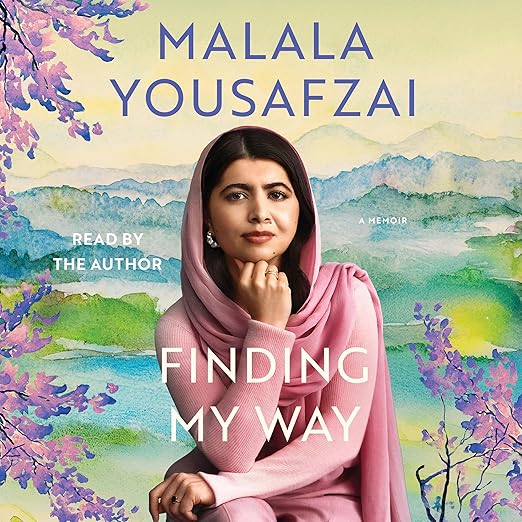
Malala Yousafzai narrates her own audiobook, and that decision carries more weight here than in most memoir credits. Finding My Way arrives billed as an instant New York Times bestseller and a USA Today Best Book of the Year, with the paper itself calling it 'A remarkably intimate and insistently human chronicle of a moral authority's coming of age.' What the description promises, though, is not another retelling of the attack that made her famous at fifteen. It is the version of Malala few have heard: a high school loner who nearly failed her exams, got ghosted, and eventually met the love of her life. Simon & Schuster Audio released the audiobook on October 21, 2025, and it runs just under nine hours.
A Quoted Line, Then a Cut-Off Mid-Sentence
The five reviews attached to this listing read less like typical audiobook feedback and more like personal letters. Kat Thompson called the writing 'very personal and vulnerable' and pointed to a new appreciation for what Malala 'represents and is still yet to become.' Robin Strauss's review opens by calling it, 'A story of a young woman's journey into adulthood,' then goes further, framing the memoir as proof that real change requires 'resilience and fortitude and a rock solid belief in one's mission.' Both reviews treat this as a book tracking an interior life rather than a public one, the anxiety and self-doubt behind a name most people associate with a single act of violence and its aftermath.
One review opens with what reads like a passage lifted straight from the book itself. Chula Gonzalez's write-up leads with a quoted line: 'When I was young and full of hope, I used to say that I wanted to see every girl in school in my lifetime. I don't know if that will happen- most of the time, I feel like it won't. But for every day that God gives me, you will find me working in service to that dream.' Only after that quote does the review add a personal reaction, identifying as a longtime follower of Malala's work and pointing to 'her fight for education and women's rights.' The review cuts off mid-sentence right after it turns to this specific book, so whatever was about to be said about Finding My Way itself is lost to a length limit rather than anything left out on purpose.
Finished in Two Days, Laughing and Crying
Self-narration matters more in a book like this than in most memoirs, because the material is so personal. Finding My Way is not built around the Taliban attack that made Malala Yousafzai a household name. The synopsis frames it instead around friendship, first love, anxiety, and the ordinary business of growing up: nearly failing exams, getting ghosted, adjusting to college after what it calls a 'high school loner' phase. Hearing that account narrated by the person who lived it, rather than performed by a professional reader standing in for her, removes a layer of distance that a traditional narration would otherwise leave in place.
Justafan's review backs this up from the listener's side, describing an early release copy finished in two days and calling the experience one that 'has you laughing and crying throughout.' The review predicts that many listeners will see themselves in these stories, and singles out the University stretch of the memoir as the part that connects most directly to an ordinary listener's own college years. That kind of identification, mapping a reader's own past onto someone else's, is usually the clearest sign that a memoir is landing as intended rather than reading as a victory lap.
One Vote Cannot Produce a 4.7 Average
The listing's numbers do not add up, and it is worth saying so plainly rather than letting the badge speak for itself. The rating counter shows a single vote, yet it displays 4.7 and sits beside five separate written reviews. A single whole-star rating can only ever register as a flat 1.0 through 5.0, never a decimal like 4.7, so whatever is generating that average, it is not the one vote the counter claims to be tracking. This reads like a case where the counter and the review section have drifted out of sync rather than anything about the book itself.
Worth flagging too: justafan's review states outright that it came from 'an early release copy,' posted the same day the audiobook came out. That is a normal way to seed advance listener reaction for a new release, but it does mean at least one of these five accounts was written before general audiences could have heard the finished product themselves. Separately, Nancy Shipe's review is the thinnest of the five, both in length and detail, calling the book 'good quality' and 'very interesting' without elaborating any further, which reads more like a placeholder than a considered response.
One more mismatch worth noting for browsers scanning the category before pressing play: the listing files this under a 'Politics & Activism' tag, which sets up different expectations than what the synopsis actually delivers. Malala's advocacy is present as backdrop, but the synopsis is explicit that the book is built around 'friendship and first love, of anxiety and self-discovery,' not policy or campaigning. Listeners browsing by that tag expecting a political memoir may be surprised to find something closer to a personal coming-of-age story, with the world-stage material largely left to her earlier work.
Yousafzai's Story Without the Headlines This Time
This is a strong pick for listeners who already know Malala Yousafzai as a public figure and want the version of her story that does not lead with headlines: the friendships, the heartbreak, the self-doubt that came with a global platform handed to her before she had finished growing up. Readers of coming-of-age memoirs generally, not just activism-focused nonfiction, should find plenty here, since the synopsis frames the book around identity and self-discovery rather than politics. Teen and young adult listeners working through their own anxiety about who they are supposed to be may find this one lands especially close to home.
Listeners hoping for an extension of Malala's advocacy work, more policy, more speeches, more of the public figure, should adjust expectations going in. The synopsis is explicit that this memoir is about the freedom to define herself outside of what everyone else wants her to be, which means the activism takes a back seat to the person living underneath it. Listeners come away with a fuller, messier picture, which is exactly the trade this audiobook is asking them to make.
- Narrator: Malala Yousafzai narrates her own memoir, keeping the emotional register entirely first person from start to finish.
- Subjects: fame versus ordinary adolescence, first love and heartbreak, reclaiming a personal narrative
- Tone: Intimate and unguarded
- Bottom line: A memoir worth hearing in the author's own voice, especially for listeners who want the person behind the headlines.
Frequently Asked Questions
Does Malala Yousafzai narrate the Finding My Way audiobook herself?
Yes. Malala Yousafzai reads her own memoir for the audiobook edition, released by Simon & Schuster Audio on October 21, 2025. The book covers her life away from headlines, including friendship, first love, and self-doubt, so hearing it in her own voice adds a layer of intimacy a hired narrator could not replicate.
Why does Finding My Way show only one rating alongside five written reviews?
The listing displays a 4.7 average from a single counted rating, which is not mathematically possible, since one whole-star vote can only land on 1.0 through 5.0. Five separate written reviews sit beside that single vote, suggesting the rating counter and the review section have simply drifted out of sync with each other.
Is Finding My Way more about activism or Malala's personal life?
The memoir leans toward the personal side. Rather than retracing the Taliban attack or her advocacy work in detail, the synopsis centers on friendship, first love, anxiety, and self-discovery, tracing Malala from a high school loner to a young woman making peace with her own past on her own terms.
Is the Finding My Way audiobook appropriate for teen listeners?
Likely yes, based on what the synopsis describes. The memoir focuses on friendship, first love, anxiety, and self-discovery rather than graphic or explicit content, and covers experiences, like nearly failing exams and getting ghosted, that mirror common teen struggles. References to the Taliban attack are treated as backstory, not the book's focus.