In Brief
- Performance: Jo Anna Perrin captures the layered complexity of Oline Eaton's Jackie, shifting from the formality of the public figure to the rawness of the private woman, with consistent skill across eleven hours.
- What it covers: feminine reinvention and cultural erasure, media construction of public identity, grief and survival
- Feel: Thoughtful and quietly indignant, excavating what official narratives buried
- Our call: Eaton's audiobook recovers a version of Jackie Kennedy that most Americans never knew, the wanderer, the adventurer, and Jo Anna Perrin makes the journey worth taking.
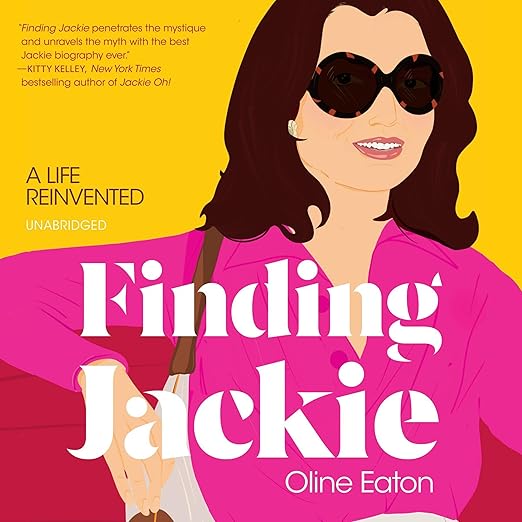
Jacqueline Kennedy's image is one of the most controlled and controlling in American cultural history. The composed face at Dallas, the pillbox hat, the Camelot mythology: these are images that have almost replaced the person, turning a complex human life into a national symbol so thoroughly that the actual woman can be difficult to locate beneath the iconography. Oline Eaton's Finding Jackie, narrated by Jo Anna Perrin and running eleven hours, is an attempt to find her.
This audiobook begins where most Jackie narratives center: the assassination, November 1963. But Eaton uses that moment as a departure point rather than an endpoint, tracing what happened to Jackie afterward, the years that have been, as Eaton argues, culturally erased. This is the version of Jackie who dated and traveled ceaselessly, who scandalized American observers by marrying Aristotle Onassis, who lived abroad, climbed pyramids, cruised oceans, and wandered European cities braless and barefoot.
Wired Into America's Emotional Grid
Eaton's scholarly background is present throughout, but Finding Jackie is not academic in a way that distances the listener. The writing is engaged and occasionally indignant, indignant at the deliberate erasure of a woman's reinvention, at the mechanisms by which American media constructed and then policed Jackie's image across decades. The book treats Jackie's story, as Eaton puts it, as having become 'wired into America's emotional grid,' transmitted through newspapers, magazines, photographs, and television in ways that shaped what Americans were permitted to know and feel about her.
The argument that Jackie's post-Kennedy life has been culturally erased is the book's most provocative and important claim. The cultural record of the widow and the first lady is extensive; the record of the adventurer and the wanderer is thin, because the image of perpetual elegant mourning was more useful to certain narratives than the reality of a woman who rebuilt herself aggressively and on her own terms. Eaton reconstructs that story from primary and archival sources, and the reconstruction is frequently surprising even for listeners who consider themselves well-informed about Kennedy-era history.
Jo Anna Perrin's narration is strong over an eleven-hour runtime that requires sustained tonal consistency. Eaton's prose moves between cultural analysis, biographical narrative, and moments of genuine emotional weight, and Perrin navigates those shifts without oversimplifying the tone. Reviewer D. Waller noted that the book 'starts with the day all of us of a certain age remember' and then traces Jackie's life forward; Perrin handles the opening sequences with appropriate gravity and maintains that engagement across the full arc.
A Narrator's Voice That Does Jackie Justice
The audiobook format suits this material in a specific way. Eaton's argument about the mechanisms of image transmission, how Jackie's story was told through particular media, in particular framings, for particular purposes, lands with additional force when it is heard rather than read. There is something fitting about listening to a story about how a woman's voice was controlled by others, receiving it through a narrator's voice that does her justice.
Perrin is particularly effective in the passages that reconstruct Jackie's later life: the European wandering, the Onassis years, the eventual work as a book editor in New York. These are the chapters that feel freshest, because the mythology machine paid them least attention. A reviewer who had read extensively about Jackie noted learning 'new things about her' in these sections, evidence that Eaton is genuinely adding to the record rather than recycling existing biography.
At 11 hours and 3 minutes, Finding Jackie is a substantial commitment, but the pacing supports sustained listening. Eaton does not pad the narrative. The cultural analysis that runs through the biographical account is consistently integrated rather than bolted on, which means the book reads as a unified argument rather than alternating between two registers.
Too Much Information, One Reader Complains
The 4.0 rating with 86 reviews suggests a divided response, and the nature of the division is instructive. One reviewer found the book 'too much information' after the Kennedy years and wished for more attention to Jackie's children and less to the press. Another found it deeply insightful. This split reflects genuine differences in what readers want from a Jackie biography: those seeking the warmth of Camelot and the children's stories will find Eaton's analytical, post-Kennedy focus less satisfying than those who want the woman the mythology overlooked.
Eaton's framing is feminist and culturally critical in ways that are more explicit than traditional biography. Readers who prefer their biography closer to narrative and further from cultural criticism should know that the analytical voice is present throughout, not confined to introduction and conclusion. This is a feature for the audience Eaton is writing for, but worth noting for those who expected a more conventionally hagiographic account.
Deliberately Selective, and Notably Honest About It
This audiobook belongs with listeners who want the Jackie Kennedy that official narratives erased: the reinventor, the adventurer, the woman who rebuilt herself on her own terms after catastrophic loss. It is for anyone interested in how American media constructs, maintains, and disciplines the images of public women. It is for listeners who have read the standard Jackie biographies and want something that pushes against the received version.
Those seeking a comprehensive cradle-to-grave biography that gives equal weight to the Kennedy White House years, the children, and the later life should know that Eaton's focus is deliberately selective. This is a book about the cultural construction of Jackie and its aftermath, not a complete life. Within that intentional scope, it is well-researched, well-written, and notably honest about what has been hidden and why.
Common Questions
Is this audiobook suitable for listeners who already know a lot about Jackie Kennedy?
Several reviewers who considered themselves Jackie experts reported learning new things, particularly about her post-Kennedy wandering years which have received less biographical attention. Eaton's analytical frame also offers a fresh perspective on familiar material, so prior knowledge enhances rather than diminishes the listening experience.
Given the 4.0 rating, what are the main reasons some listeners found this audiobook less satisfying?
The most common complaint is that the book focuses too heavily on the period after Kennedy's assassination and gives relatively less attention to Jackie's children and domestic life during the White House years. Listeners expecting a traditional comprehensive biography may find the cultural-critical frame more prominent than they wanted.