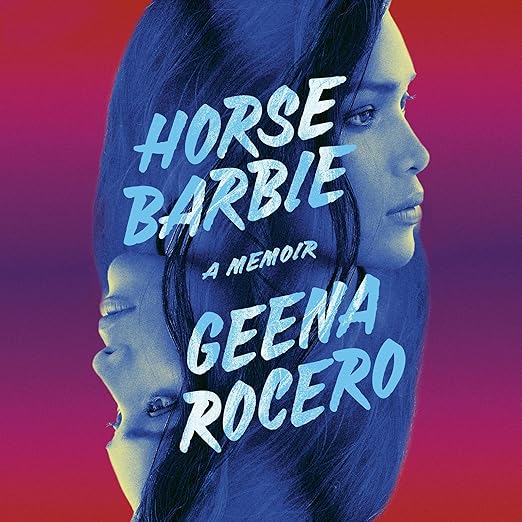
- Performance: Rocero speaks her own Manila, her own eskinita and her own reclaimed nickname, casting that a memoir about being named can hardly do without.
- What it covers: trans girlhood in the Philippines, pageant culture, living stealth, the price of a career built on concealment
- Feel: Buoyant early, tense in the middle
- Our call: The Manila chapters alone justify it, and the concealment years give the book a harder subject than most coming-out memoirs attempt.
Going stealth is the phrase Geena Rocero uses for the years she spent hiding that she is trans, and this audiobook is her account of what both halves of that bargain cost. Legal recognition arrived first, once she had moved from Manila to the United States and could change her name and gender marker on her documents. Safety did not arrive with it. Eleven hours and seventeen minutes of Random House Audio's recording sit between the pageant stages of the Philippines and the decision to stop hiding, and Rocero reads every one of them herself.
Rocero's Migration Runs Backward From the Genre
What surprises most readers is the scale, and the description badly undersells it. A four-star from August 2023 puts the comparison plainly. Trans beauty pageants in the Philippines are enormous. That response compares the crowds to the way Americans watch football, notes that the competitions were folded into Catholic fiestas, and lands on the sentence that reorganizes the whole book: she was not merely tolerated, she was celebrated. Then she comes to the United States, where being visibly different is dangerous. The migration in this memoir runs from acceptance toward concealment, which is the reverse of the direction the genre usually travels.
Rocero's arc is unusually clean for a memoir, at once its strength and the thing she has to work against. Taunted in her eskinita, then mocked on the pageant circuit with a nickname aimed at her build and her coloring, she takes the insult and makes it a name; by seventeen she is the highest-earning trans pageant queen in the country. Everything after that is a second life built on the suppression of the first. Material that shapely risks reading as a parable, and the book keeps pulling itself back toward specifics.
Author narration is doing real work here rather than saving a fee. This is a book about being named by other people and then taking the naming back, and the Manila chapters are full of Filipino speech and of an insult whose sting lives entirely in how it is said. A hired reader could approximate that. Rocero does not have to. The trade-off is the usual one for memoirists at the microphone, since eleven hours is a long stretch to sustain for someone whose training is the runway and the stage, not the booth.
A Steady Emotional Price Paid in Silence
Concealment is where the book does its most serious thinking, and a five-star from September 2024 describes the mechanism accurately: once in the States, Rocero faced a choice between honesty and the career, and staying hidden extracted a steady emotional price, most of it paid in front of friends and employers who did not know. That is a harder subject than either coming out or being outed, because nothing dramatic happens. The damage is cumulative, the secret works, and the modeling career succeeds precisely to the degree that the concealment holds.
Recognition backs it up. The record carries an award for literature, best-of-the-year selections from three magazines, and quoted praise from a fashion title and a women-of-the-year citation, and Rocero herself was named among a list of the most influential LGBTQ storytellers. Awards do not make a book good, and this many of them do tell you the memoir landed with people who read a great deal of this genre. Eleven hours is generous for a single life and the structure earns it, since two countries and two identities need the room.
An Ending That Should Have Been the TED Talk
Useful criticism arrives from an unexpected direction, a five-star filed in March 2024, worth noticing on its own. That listener found the Philippines material and the pageant world the most compelling part because it was entirely unfamiliar, rated the modeling and concealment sections just as highly, and then objected to the ending, saying the memoir would have been stronger closing on the TED talk. It is a structural note and not a complaint about content, and it points at the standard problem with activist memoir, which is that the final act has to compete with the life that produced it.
Prizes occupy the opening of the description. Five separate accolades arrive before the story does, and a listener sampling the page gets a paragraph of citations before learning that this is about pageants in 1990s Manila. The title carries a related problem, since Horse Barbie is a reclaimed insult and reads, out of context, as something considerably lighter than the book is. Anyone browsing by title alone will not guess what this is, and the copy takes too long to tell them.
The written column is thinner than the badge suggests. Eighty-seven ratings stand above a written column of five, and one of those five runs to just three words. What remains is warm and general, praising the perspective and the readability without much detail about how the book is built. Anyone hoping to gauge the recording specifically will find that the responses discuss the text rather than the performance, which on an author-read memoir leaves the central production question untested.
Candid About Ambition, Not Only About Suffering
Give this to someone who has read a lot of trans memoir and thinks they know the shape of one, because the Manila material will not be where they expect it. Readers interested in how differently gender variance is treated across cultures get a first-hand comparison instead of an argument. Anyone who followed Rocero's modeling or advocacy work already has the obvious motive, and listeners who like memoirs where the writer is candid about ambition, not only about suffering, will find the pageant chapters unusually honest about wanting to win.
Pageant glamour is not the whole of it, so anyone here for a fashion memoir should be warned that the middle of the book is about fear. Readers wanting a political history of trans rights will find one life instead, refracted through two countries. Note too that this is the author's own reading, with everything that gains in authority and everything it can shed in polish across eleven hours.
Questions Listeners Ask
What does the title Horse Barbie actually refer to?
It was an insult. Rival competitors used it against Rocero for her height, her long neck, her hair and her dark skin, and she kept it as her own name and never shed it. The reclamation is the book's organizing gesture, which the catalog title alone does not communicate.
How much of the audiobook takes place in the Philippines?
A substantial share, and several listeners rate it the strongest section. The narrative opens in 1990s Manila, moves through the trans pageant circuit where she became the country's highest earner by seventeen, and only then relocates to the United States for the modeling years.
What changes when Rocero performs her own memoir?
Pronunciation and ownership, mainly. The early chapters carry Filipino speech and a taunt whose force depends on delivery, and the author is the one person who cannot get either wrong. What you trade is the vocal range a career narrator would bring across a long running time.
Is this audiobook suitable for a reader new to trans life writing?
Yes, and it is an unusual place to start in a useful way. Because the opening acts are set in a culture that celebrated her, the book explains gender variance through a community, not through a struggle, and the American chapters land harder for the contrast.