Quick Take
- Narration: Saul Reichlin brings a lyrical steadiness to Bristow-Bovey’s prose that matches the book’s contemplative register. He handles the historical sequences and the personal memoir passages with the same care, which is exactly what this hybrid work requires.
- Themes: survival and leadership under catastrophic conditions, our relationship with the natural world, optimism as a practice
- Mood: Lyrical, reflective, and quietly urgent
- Verdict: A genuine literary achievement in the Shackleton genre, and an unusual one: it is as much about why this story speaks to us now as it is about the events themselves.
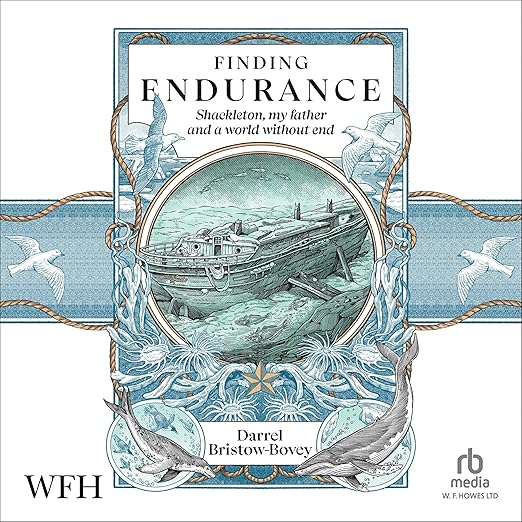
I came to Finding Endurance knowing the Shackleton story reasonably well. Alfred Lansing’s Endurance is one of those narrative nonfiction landmarks that most serious readers have encountered at some point, and Caroline Alexander’s account covers similar ground with impressive archival depth. What Darrel Bristow-Bovey is doing in this book is something distinct from both of those. He is not primarily retelling the story. He is asking why we need it, and why we seem to need it more now than before.
The 2022 discovery of the wreck of Endurance on the floor of the Weddell Sea briefly interrupted the pandemic-era news cycle in the way that only genuinely extraordinary events can. For a few days, people cared about something beautiful and old and far away. Bristow-Bovey, a South African writer with what he describes as a deeply personal relationship with this story, uses that discovery as an entry point for a book that weaves together natural history, polar adventure, personal memoir, and literary reflection. The result is unusual in the best way: it is a book that thinks about why stories survive, not just what happened.
Our Take on Finding Endurance
Bristow-Bovey draws on the diaries of the expedition members with the thoroughness that specialist reviewers note, but he is not a historian presenting evidence. He is a writer responding to evidence, and that distinction matters for the texture of the prose. One reviewer described reading it as watching a suspense-filled movie scene with your hands in front of your face, unable to stop peeking. That is the right description: even if you know how Shackleton’s story ends, Bristow-Bovey finds the scenes that make the terror fresh again. The hypothermia sequences, grounded in physiological specificity as one reviewer noted, work as both science and dread.
Why Listen to Finding Endurance
Saul Reichlin’s narration is well-matched to the material. Bristow-Bovey writes in long, considered sentences that need a reader with patience, and Reichlin has it. He does not rush the personal memoir passages that thread through the historical narrative, the ones about Bristow-Bovey’s own father, the loss that gives this book its private grief alongside its public argument. Those sections require a narrator willing to be quiet in the spaces between sentences, and Reichlin allows that. At 9 hours and 8 minutes, the runtime gives the book room to develop its argument properly, and Reichlin never makes you feel the length.
What to Watch For in Finding Endurance
The book’s central argument is about what Bristow-Bovey calls calculated optimism, the idea that Shackleton’s survival was not luck or bravado but a kind of practiced, deliberate refusal to stop problem-solving. The phrase from the synopsis, that Endurance still whispers not all is lost, and not forever, is the emotional core of why this book exists in 2023 rather than 1993. Bristow-Bovey is making a case for this story as survival instruction for a particular contemporary anxiety, the feeling that the challenges facing the world are too large and too self-inflicted to be survived. That is a significant argument embedded in what looks like a history book, and it is worth knowing it is there before you start listening.
Who Should Listen to Finding Endurance
Readers already familiar with the Shackleton story will find this a worthy addition to the canon rather than a replacement for the foundational accounts. At least one reviewer who has been reading polar exploration literature since the 1980s found this genuinely new and captivating, which is high praise from someone who thought they had read everything. Complete newcomers to the Endurance story will find the book works as an introduction, though they will get more from the layered argument if they have some prior knowledge. Listeners who want pure adventure narrative without the philosophical reflection may find Bristow-Bovey’s essay sections slower. Those who appreciate that blend of history, memoir, and idea will find this one of the more rewarding audiobooks in the genre.
Frequently Asked Questions
Do I need to have read other Shackleton books before Finding Endurance, or does it work for newcomers?
It works for newcomers. Bristow-Bovey provides enough context for the events to land clearly. However, at least one long-time Shackleton reader specifically recommends it as a book that adds something new to an already well-covered story, so prior knowledge enriches the experience without being required.
How personal is the memoir strand in Finding Endurance, and how much does it interrupt the historical narrative?
The memoir strand involves Bristow-Bovey’s relationship with his father, whose loss runs through the book as a private grief alongside the public history. It is woven throughout rather than separated into distinct chapters, and several reviewers specifically praised it as adding depth rather than distraction. Readers who prefer pure history without personal reflection should be aware of this strand.
Is Saul Reichlin’s narration well-suited to Bristow-Bovey’s literary prose style?
Yes. Reichlin brings a measured, patient quality to the narration that suits Bristow-Bovey’s long, reflective sentences. He handles the tonal range between adventure sequences and quieter memoir passages without jarring shifts. Listeners consistently do not flag the narration as a weakness in their reviews.
How does Finding Endurance differ from other Shackleton books like Alfred Lansing’s Endurance?
Lansing’s book is a gripping, chronological account of the expedition itself. Bristow-Bovey’s book is a contemporary reflection on that story and why it resonates now, weaving in natural history, personal memoir, and an argument about optimism as survival strategy. They do very different things with the same historical material.