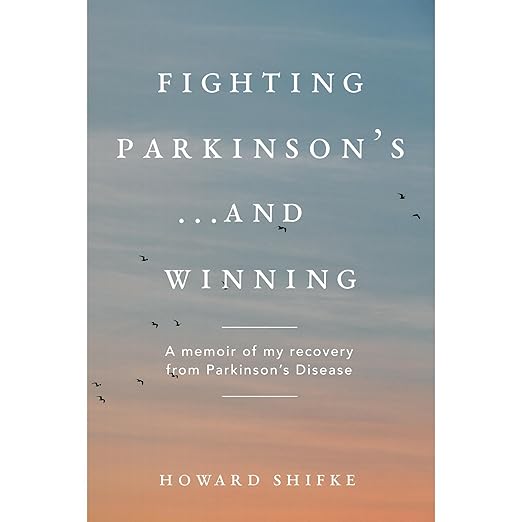
Howard Shifke's Fighting Parkinson's...and Winning operates from its first pages at the intersection of personal testimony and treatment advocacy. Shifke was diagnosed with Parkinson's Disease in the fall of 2009, and by June 2010 - nine months later - his neurologist documented in medical records that there were no signs or symptoms of the disease. That claim is the audiobook's central fact and its most contested element. Virtual Voice narrates the memoir, and the AI-generated delivery is functional but ill-matched to the emotional weight of the subject matter: a memoir about fear, loss, and unlikely recovery reaches for human intimacy that a synthetic voice cannot fully provide.
Building the Parkinson's Recipe for Recovery
Shifke's credibility as a narrator of his own experience is genuine: he describes the specific symptoms he managed - internal tremors, Bradykinesia, rigidity, frozen face, extreme fatigue, constipation, difficulty with basic physical tasks - with the precision of someone who has lived inside them for nine months. His account of watching his mother deteriorate from Parkinson's for twenty-four years before her death in 2007, and of his determination not to follow the same trajectory, provides the emotional foundation for everything that follows. The ten years of prior study in alternative healing and Traditional Chinese Medicine that he brings to his diagnosis give the Parkinson's Recipe for Recovery he develops the internal logic of someone working from a coherent framework rather than improvising desperately. The audiobook presents this framework in detail: what it consists of, how he applied it, and how it evolved across the nine months of his recovery. He also documents six other recoveries that followed his own in the years since, which the synopsis and reviewer testimonials reference as the book's most remarkable and most scrutinized feature. A reviewer with a medical background describes Shifke's case as the only example he knows of a recovery protocol that has produced multiple identifiable recoveries from what conventional medicine considers an irreversible neurodegenerative disease. That characterization should be read carefully: the medical literature on Parkinson's does not recognize spontaneous remission of this kind as established, and the protocol Shifke describes has not been through peer-reviewed clinical study. What the audiobook provides is a first-person account and a community of anecdotal recovery stories, which is meaningful and real to the people it has reached without constituting clinical evidence of the kind that changes treatment guidelines. Shifke's transparency about his neurologist's documented findings - including subsequent visits where the original diagnosis findings could not be replicated - is one of the more honest features of the advocacy-memoir genre.
Symptoms Almost Disappeared, One Purchaser Writes
The audiobook's primary value is community. Parkinson's patients and their caregivers navigating a diagnosis that conventional medicine frames as a one-way deterioration will find in Shifke's memoir a voice that refuses that framing, and the specific protocols he documents give listeners something concrete to discuss with their care teams. One verified purchaser writes that his symptoms almost disappeared after following the recipe for some time - accounts of this kind are subjective and unreproducible in the scientific sense, but they are not fabricated, and the audiobook connects listeners to a community of people for whom this approach has been meaningful. Shifke's account of his mother's twenty-four-year decline and his relationship to that history adds a dimension that pure treatment guides cannot provide: the emotional cost of watching someone you love deteriorate, and the specific fear that shapes every Parkinson's diagnosis. The Virtual Voice narration covers approximately 6 hours and 16 minutes of content, and the material moves at the pace of memoir - episodic, anecdotal, and organized around the arc of recovery rather than a systematic treatment presentation. For listeners who are primarily seeking community connection and alternative frameworks rather than clinical evidence, the format serves those purposes.
Testimony Isn't the Same as a Causal Claim
The audiobook is most useful listened to alongside, rather than instead of, conventional medical guidance. Shifke's Recipe incorporates elements of Traditional Chinese Medicine, Qigong, and mind-body practice that some integrative medicine practitioners would recognize as plausible adjuncts to conventional treatment even if the claimed outcomes exceed what evidence supports. Listeners should be attentive to the distinction between "I recovered and here is what I did" - which is testimonial - and "this protocol causes recovery" - which is a causal claim requiring different evidence. Shifke is generally careful to position his own account as personal testimony, though the accumulated testimonials in the synopsis and the surrounding community create an impression of clinical certainty that the audiobook's actual evidence base cannot support. That does not make the memoir dishonest; it makes it a memoir, operating in the register where all memoirs operate, where the most honest thing you can do is tell your own story with precision and let the reader evaluate its generalizability. The six additional recoveries he references are mentioned as evidence of broader application but are not given full individual case study treatment within the audiobook itself.
A Synthetic Voice Creates Emotional Distance
People with Parkinson's or early-stage diagnoses who are seeking alternative or complementary approaches and want to understand what one person's non-conventional recovery looked like in concrete detail. Caregivers looking for resources that offer a different frame than the conventional prognosis. Skip this audiobook if you need peer-reviewed clinical evidence before considering any treatment approach - the book does not and cannot provide that, and is honest about positioning itself as personal testimony. Listeners who find Virtual Voice narration significantly distracting should also factor in that the synthetic delivery, across six-plus hours of personal memoir, creates a meaningful emotional distance from a story that depends on intimacy to achieve its purpose.
The Short Version
- Performance: Virtual Voice narrates this memoir, and the AI-generated delivery is serviceable for the descriptive and testimonial content but lacks the emotional resonance that a human narrator would bring to a personal recovery story of this kind.
- What it covers: Alternative healing and self-directed recovery, the tension between conventional medicine and patient autonomy, hope as active practice
- Feel: Earnest and intensely personal, with the evangelical quality of someone who survived something they were told was unsurvivable
- Our call: Howard Shifke's recovery account is most valuable as a document of one person's unconventional path and as a source of community connection for those navigating Parkinson's - listeners should approach its medical claims with appropriate critical engagement.
Common Questions
Does the Fighting Parkinson's and Winning audiobook make medical claims that contradict mainstream neurology?
Yes. Shifke claims full recovery from Parkinson's Disease through a self-developed protocol involving Traditional Chinese Medicine, Qigong, and mind-body practice - claims that mainstream neurology does not recognize as established. The audiobook presents these as personal testimony and anecdotal community accounts, not peer-reviewed clinical evidence. Listeners should engage their own medical teams about any protocol they are considering.
Is the narrator of this audiobook a human performer, and how does the narration affect the listening experience?
The narrator is Virtual Voice, an AI-generated performance. For a personal memoir dealing with fear, hope, and physical suffering, the synthetic delivery creates noticeable distance from material that depends on human warmth. The content is accessible but the emotional register is flatter than a skilled human narrator would provide for this subject.
What does Howard Shifke's Parkinson's Recipe for Recovery actually consist of, and is it described in enough detail in the audiobook?
The audiobook describes the recipe's components and logic - elements of Traditional Chinese Medicine, Qigong, specific physical practice, and mental orientation toward recovery - well enough to understand the approach. It does not function as a step-by-step instruction guide; Shifke maintains an active website with more detailed material. The audiobook is primarily the story of how and why he developed the approach.
Are the other recovery cases mentioned in Fighting Parkinson's and Winning covered in detail, or only briefly referenced?
The audiobook tells Shifke's own story in depth. The six additional recoveries he references are mentioned as evidence of the approach's broader application but are not given full individual case study treatment. His own nine-month recovery arc from diagnosis to neurologist-confirmed remission is the primary narrative throughout the audiobook.