Quick Take
- Narration: Silverman narrates his own manifesto with the combative energy you would expect from his Fox News appearances; the voice matches the content completely
- Themes: firebrand versus diplomatic atheism, religion as institutional harm, the politics of self-identification
- Mood: Confrontational, prosecutorial, and unapologetically partisan
- Verdict: A polemical handbook for atheist activism rather than a philosophical inquiry into religion; valuable and energizing for its intended audience, though it will persuade no one who is not already persuaded.
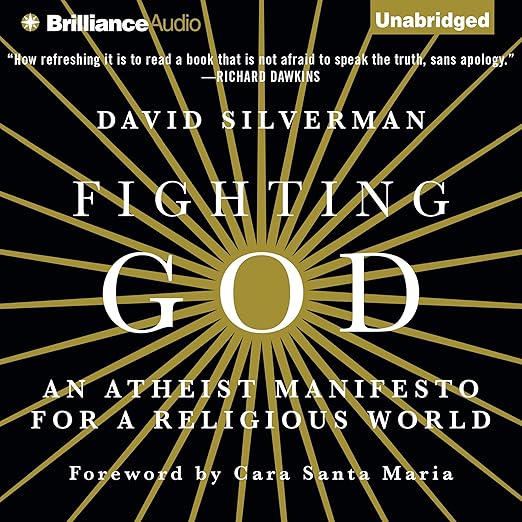
I came to Fighting God from a specific position: someone who has followed the public atheism debates of the past two decades without strong attachment to any of its internal factions. David Silverman occupies a specific lane in that landscape, the firebrand lane, and this audiobook is a full-throated defense of that lane against what Silverman sees as the damaging accommodationism of gentler secular voices. Listening to him narrate his own manifesto, in the direct and combative register he has refined on television, is a particular kind of experience that tells you almost immediately whether this is the book for you.
Silverman was president of American Atheists for fourteen years and one of the most recognizable faces of organized atheism in the United States, known specifically for billboard campaigns designed to provoke exactly the kind of heated public response he believes is necessary for cultural change. His central argument is that religion is not merely incorrect but malevolent, that it causes active harm in areas including science education, women’s rights, and LGBTQ rights, and that the appropriate response to malevolent ideas is not diplomatic distance but direct, persistent confrontation. This is a book that knows what it thinks before it opens and uses its seven hours to build the most forceful case for that position that Silverman can construct.
The Case Against Diplomatic Atheism
The internal atheism debate that Fighting God engages is real and substantive. Silverman’s argument is that so-called friendly atheists, who prefer accommodation and dialogue to confrontation, are undermining the movement’s effectiveness by treating religion’s privileged status in American society as a given rather than a problem to be dismantled. This is a tactical argument as much as a philosophical one, and it is the most interesting part of the book. The evidence Silverman marshals for the harm done by that privileged status, in legislative outcomes, in science education policy, in the constitutional separation of church and state, is specific and largely documented.
One reviewer described the book as a case for being an outspoken atheist rather than an argument for atheism itself, and that is exactly right. Silverman is not trying to convince theists. He is trying to convince atheists who have been quiet that silence is a form of complicity, and the argument he makes for that position has genuine force for the reader who begins from his premises. A reviewer described his writing style as direct, humorous, and easy to read, and that assessment holds in audio as well; the seven hours pass without the exhaustion that more dense polemical texts sometimes produce.
What the Manifesto Assumes and What It Skips
The book’s significant limitation is its near-total lack of engagement with the strongest counterarguments to firebrand atheism’s effectiveness. Silverman makes a case; he does not seriously grapple with the empirical evidence on whether confrontational secular activism actually changes minds or merely energizes existing atheists while hardening religious resistance. One reviewer noted that he presents no counter-evidence, and that critique is structurally accurate. This is advocacy writing, not analytical writing, and the reader who comes to it expecting the rigor of Daniel Dennett or Sam Harris on epistemological questions will find the register less satisfying than its confidence suggests.
The claims that all agnostics are atheists and that atheist Jews who identify with Jewish cultural identity are perpetuating a lie forced on them by religion are stated as conclusions rather than argued through. These are positions with real philosophical content that deserve more careful treatment than they receive here. The book’s rhetorical design treats these claims as settled because the audience it is addressing is assumed to be already sympathetic to them, which is both a reasonable editorial choice and an honest indication of the book’s limits as persuasion.
Silverman Narrating Silverman
Author-narrated polemics are a specific format, and Fighting God exemplifies both the strengths and the limitations of the mode. Silverman’s delivery has the directness and slight combativeness of someone who has spent years in televised debates, and that register is exactly right for a manifesto. He sounds like he means what he says, which matters enormously for persuasive audio content. The humor that several reviewers noted in the written style translates reasonably well to audio, though the delivery is more prosecutorial than comic and more comfortable in extended argument than in the lighter passages that occasionally interrupt the main line of the case.
At seven hours, this is a manageable listen, and Silverman’s prose style is, as one reviewer put it, direct and accessible, making the content digestible even when the positions are blunt. The accompanying PDF noted in the synopsis provides additional reference material for listeners who want to follow up on the sources and arguments after listening.
Who Is This Manifesto Actually For
Fighting God is for atheists and secular humanists who are thinking about whether to be more public about their nonbelief and want a forceful argument for why they should be. It is also valuable as a document of a specific moment in American secular activism and as a case study in advocacy rhetoric and how movements argue about their own tactics. Listeners who approach it looking for philosophical depth or engagement with theology will be disappointed; this is not a book interested in the epistemological arguments that occupy Dawkins or Hitchens. Religious listeners will find nothing here designed to engage them, which is precisely Silverman’s point. The appropriate audience is already nonbelieving and is being invited to stop being politely quiet about it, and for that audience this remains a useful and energizing text.
Frequently Asked Questions
Is Fighting God still relevant given that David Silverman later stepped down from American Atheists amid misconduct allegations?
The book’s arguments stand independently of Silverman’s subsequent personal history. The case for firebrand atheism as a social and political strategy is a position you can evaluate on its merits regardless of the author’s conduct after publication. Many readers separate the argument from the person, as with other polemicists whose personal histories have become complicated.
Does Fighting God address the internal debates about intersectionality and social justice within the atheist movement?
Silverman touches on the movement’s internal divisions but does not engage deeply with the intersectionality debates that were active in secular communities around the time of publication. His primary focus is the firebrand versus diplomat divide rather than the broader identity politics questions the movement was also navigating.
How does Fighting God compare to Richard Dawkins’s The God Delusion or Christopher Hitchens’s God Is Not Great in its approach?
Dawkins and Hitchens make philosophical and historical cases against religion’s truth claims and its historical record. Silverman’s book assumes those cases have already been made and focuses on the strategic question of how atheists should conduct themselves publicly. It is a manual for activism, not a deconstruction of theology.
The synopsis claims all agnostics are atheists. Does Silverman actually make this argument and does it hold up?
He does make this argument, rooting it in a specific definition of atheism as the absence of theistic belief rather than the positive assertion of God’s nonexistence. Under that definition, agnostics who make no claim to knowledge of God’s existence are also not theists and therefore qualify as atheists. The definitional move is philosophically contested, and Silverman presents it as settled rather than argued through.