Quick Take
- Narration: Donald Corren delivers a clear, measured performance well-suited to military history, present throughout without ever overwhelming the material
- Themes: Air war over Europe, the human cost of fighter command, institutional memory of the 352nd Fighter Group
- Mood: Serious and deeply researched, with moments of genuine emotional weight
- Verdict: One of the most thorough and humanizing accounts of a WWII fighter group available in audio, best appreciated by listeners already interested in the air war over Europe.
My grandfather flew transports in the Pacific theater, never combat missions, and he talked about it rarely. The few times he did, it was always about the pilots he knew who didn’t come back, names said quickly, without elaboration. I thought about him often while listening to Fighter Group by Lt. Col. Jay A. Stout, which is precisely the kind of book that holds those names and gives them back their full weight.
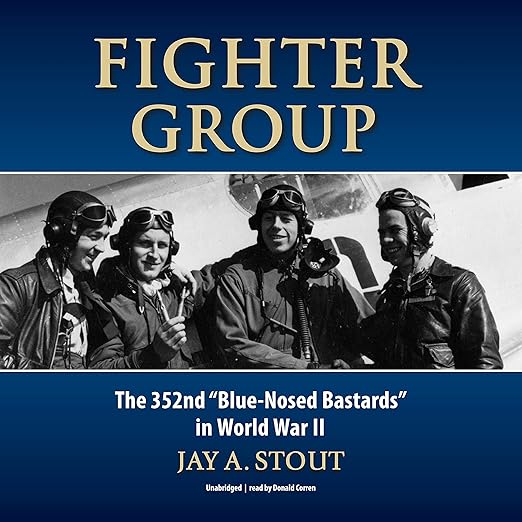
At 17 hours and 12 minutes, narrated by Donald Corren for Blackstone Publishing, this is a substantial commitment. It covers the 352nd Fighter Group, one of the most decorated American fighter units of the Second World War, from the initial training of its pilots through the end of the air war over Europe. Stout brings a dual qualification to the project that is relatively rare in military history: he is both a seasoned historian with the research instincts his subject demands and a former fighter pilot who understands from the inside what the decisions in these cockpits actually required.
Our Take on Fighter Group
What distinguishes this book from the standard unit history, and unit histories can be very dry when they focus on organizational rather than human detail, is Stout’s insistence on the texture of daily life inside the 352nd. One reviewer, the son of a 352nd pilot, wrote that the book goes “well beyond anything I heard before” from the veterans themselves. That is a significant endorsement. Stout captures the relationships between pilots and their ground crews, the dynamics of squadron leadership, the training pipeline that turned young men with varying aptitudes into combat-ready fighter pilots, and the grinding attrition that the air war over Europe exacted on both aircraft and men.
The P-47 Thunderbolts and P-51 Mustangs that the 352nd flew are present throughout not as hardware catalog entries but as machines with personalities, heavy and durable versus nimble and long-ranged, and Stout traces how the transition between them affected tactics and survival rates. The strategic context is handled with similar care: the daylight bombing campaign, the desperate need for long-range escort fighters to protect the B-17 and B-24 crews, and how the 352nd’s performance fit into the broader Allied effort to achieve air superiority over Germany before D-Day.
Why Listen to Fighter Group
Donald Corren’s narration is reliable rather than spectacular, which is the right call for this kind of material. Military history at this level of detail requires a narrator who can make operational information comprehensible without flattening it into mere recitation, and Corren manages that balance throughout a very long listen. He handles both the names of pilots and the technical language of aerial combat with consistent clarity, and he does not impose emotional coloring on passages that Stout has already made emotionally sufficient through the quality of his research.
One reviewer offered a useful comparison: Hell Hawks, a similar treatment of a 9th Air Force fighter group, makes a good companion read. The pairing illuminates the difference between 8th and 9th Air Force operations, strategic escort versus close air support, and shows how different operational demands shaped unit culture. For listeners who finish Fighter Group wanting more, that recommendation is worth following up.
What to Watch For in Fighter Group
The book builds toward D-Day and the air campaign over occupied France as its narrative climax, and Stout earns that climax through the patient accumulation of individual stories. By the time the 352nd is flying missions in support of the Normandy landings, listeners who have followed the training sequences and early combat missions will feel the stakes in a way that parachuting into the battle itself would not produce. This is the reward for committing to the full 17 hours.
Watch for the sections on ace pilots and the particular psychology of men who were extraordinarily good at killing other pilots. Stout approaches this without glorification and without false modesty, these were skilled professionals at a specific and lethal task, and he lets that fact sit at its full complexity. The mechanics of aerial gunnery, of closing angles and deflection shooting, become genuinely interesting in his hands.
Who Should Listen to Fighter Group
Essential for listeners with a serious interest in World War II air history, particularly the European theater. The book rewards dedicated attention and repays those who come with some prior knowledge of the air war, understanding the context of the daylight bombing campaign and why fighter escort was so critical makes Stout’s account of the 352nd’s contribution much more meaningful.
Approach with caution if you are a casual WWII reader looking for a fast-paced overview; the depth and length are genuine commitments. One reviewer noted it “dragged in a few places,” which is fair, Stout’s thoroughness occasionally requires patience. But for the right listener, those stretches of detail are the point.
Frequently Asked Questions
Does Fighter Group cover both the P-47 Thunderbolt and P-51 Mustang phases of the 352nd’s service?
Yes, the transition is treated as a significant narrative moment. Stout covers the tactical and cultural shift that came with transitioning from the heavy P-47 to the longer-ranged P-51, and how that change affected the group’s ability to escort bombers deep into German territory. The aircraft are not just backdrop, they shape the story.
How does Jay Stout’s background as a former fighter pilot change the way he writes about aerial combat?
Substantially. Stout understands the physical and cognitive demands of fighter combat from the inside, which lets him explain maneuvers, decision-making under pressure, and the mechanical performance of the aircraft in terms that feel authentic rather than reconstructed. His descriptions of gunnery technique and the geometry of aerial engagement are notably clearer than what you typically find in histories written by non-pilots.
Is this primarily a tactical history of aerial combat, or does it also cover the human and personal dimensions of the pilots’ lives?
Both, with genuine balance. Stout gives considerable space to the relationships between pilots, the dynamics of ground crews, training culture, and the psychological dimensions of sustained combat, including the very specific stress of flying bomber escort missions where your job is to protect other men at the expense of your own tactical options. The son of a 352nd pilot reviewed it and said it went further than anything the veterans told him personally.
Do I need prior knowledge of the WWII air war to appreciate this book?
Some background helps significantly. Understanding the basics of the 8th Air Force’s daylight bombing campaign, the need for long-range fighter escort, and the general arc of Allied air superiority over Europe will make Stout’s narrative more meaningful. He provides enough context for engaged readers to follow the strategic picture, but listeners coming in completely cold may find the organizational and operational detail harder to absorb.