Key Details
- Narrator: Jeff Fager narrates his own insider account with the direct authority of someone who actually ran the show for over a decade.
- Subjects: Broadcast journalism history, the modern news interview, institutional legacy
- Tone: Authoritative and detail-rich
- Bottom line: A genuinely insider account of American journalism's most enduring broadcast, best listened to with the chapters reordered chronologically.
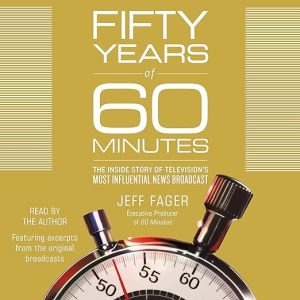
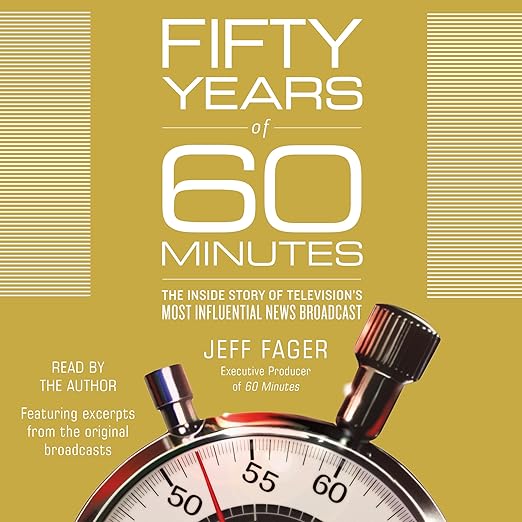
Richard Nixon sat down for a 1968 interview that helped launch what would become the most enduring hour in American broadcast journalism, and Jeff Fager, who ran 60 Minutes as its executive producer for more than a decade, narrates this audiobook history himself. Fifty Years of 60 Minutes moves from that almost accidental debut through landmark sit-downs with Bill Clinton in 1992 and hard-hitting investigations into the tobacco industry, Lance Armstrong's doping, and the Abu Ghraib torture scandal, tracing how one show kept reinventing the news interview across five decades.
Fager Was Actually in the Room
Fager's real advantage as narrator and author is proximity. He isn't reconstructing this history from archives and secondhand interviews, he was in the room for a meaningful chunk of it, and the audiobook benefits from that insider vantage throughout. Correspondents who might otherwise read as distant legends, hard-charging Mike Wallace, the writer's-writer Morley Safer, soft-but-tough Ed Bradley, relentless Lesley Stahl, intrepid Scott Pelley, illuminating Steve Kroft, get described with the specificity of someone who actually worked alongside them, door-slamming arguments and newsroom pranks included.
Kirkus Reviews called this 'an illuminating TV show biography,' and the description holds up against the actual content: this isn't just nostalgia for a beloved brand, it's a genuine account of how founder Don Hewitt's specific editorial philosophies, that hearing a story often matters more than seeing it, that the small picture illuminates the larger one, shaped fifty years of American broadcast journalism and, by extension, how the country encountered its own biggest stories.
Don Hewitt's 'small picture' philosophy, quoted directly in the synopsis, deserves unpacking rather than a passing mention: the idea that a single farmer's specific story about a policy failure lands harder with a national audience than an aggregate statistic ever could. Fager traces how that philosophy, more than any single correspondent's individual style, is really the through-line explaining why 60 Minutes stories still land as personal and specific even when covering enormous, abstract institutional subjects like tobacco regulation or wartime detention policy.
The Washington Post's own assessment, quoted in the synopsis, frames the book's relevance precisely: as traditional reporting is increasingly challenged by high-decibel, opinion-drenched media, Fager's account of 60 Minutes' more deliberate, deeply sourced approach reads less like nostalgia and more like an implicit argument for a specific journalistic method under real pressure today. That framing gives the historical material a present-tense stake it might otherwise lack, positioning this less as a celebration of a bygone era and more as a case study in a style of reporting still very much worth defending.
Self-Narration Turns This Into Oral History
Reviewer Andy Lee, who works in media and entertainment, found the book compelling enough to buy in both hardbound and ebook after already reading a used copy, a strong signal for anyone in adjacent industries. For listeners specifically interested in journalism, television production, or the mechanics of the modern news interview, Fager's account of the editing room, the competitive tension between correspondents, and the decades of institutional decision-making behind the broadcast offers detail a casual retrospective would skip entirely.
The audiobook format suits Fager's material well because so much of the book is really oral history, direct testimony about specific broadcasts and the arguments behind them, closer in spirit to hearing a veteran producer hold court than reading a dry institutional chronicle. Self-narration adds real authority here in the same way it does for any insider account: this is Fager's own memory of events he shaped firsthand, not a journalist's reconstruction of someone else's.
Insider television-history books live or die on specificity, and Fager's account benefits from decades of proximity to exactly the kind of institutional detail that separates a genuinely useful account from a nostalgic highlight reel: contract negotiations, competitive rivalries between correspondents chasing the same story, and the internal debates over which segments actually made air. That granularity is the difference between a fan's retrospective and a working producer's memory.
Reviewer K. Kaye H's complaint about the physical hardcover's peeling dust jacket is worth setting aside for audio buyers specifically, since that's a print-manufacturing issue entirely unrelated to the audiobook edition. The content itself, which K. Kaye H calls 'fabulous,' is what carries over regardless of format.
Five Chapters Numbered Out of Order
Reviewer Robert A. Rifenberick flags something genuinely useful for any prospective listener: the book's five chapters, one per decade, are presented out of chronological order, numbered three, one, two, four, five for reasons the review calls unexplained. Rifenberick found the material easier to follow by mentally reordering into actual chronological sequence, and that advice carries even more weight in audio than in print, since a listener can't as easily flip ahead or check which decade a chapter covers the way a print reader can glance at a table of contents.
At ten hours and twenty-eight minutes covering fifty years of broadcast history and dozens of named correspondents, producers, and newsmakers, this rewards close attention rather than background listening. Anyone hoping for a quick highlight reel of famous interviews should recalibrate toward a fuller institutional history, one genuinely more interested in how the show actually got made than in simply replaying greatest hits.
A 4.6 rating from 285 ratings suggests a smaller but consistently enthusiastic audience, consistent with a title that rewards genuine interest in journalism history and craft over casual, general-audience appeal. The Education and Learning genre tag on this listing is a slightly loose fit for what reads more naturally as media history or journalism nonfiction, though the informative, well-sourced approach does support that broader educational framing reasonably well.
Presidential History Fans Get Two Rare Interviews
Journalism students, media professionals, and anyone who grew up with the show's ticking stopwatch as a weekly television fixture will get the most out of this, especially listeners curious about how a single broadcast format survived and adapted across several genuinely different media eras, from three-network television through the streaming age.
The specific interviews named in the synopsis, Nixon in 1968 and Clinton in 1992, bookend nearly a quarter century apart and both involve presidents whose relationship with the press shaped how their administrations were ultimately remembered. Listeners with any interest in presidential history specifically, not just broadcast journalism as a craft, will find those two sit-downs alone worth the price of admission, treated here with the specific institutional memory only someone who ran the show could offer.
Skip this one if you're looking for a breezy clip-show retrospective rather than a detailed institutional history; Fager's account rewards patience with a full accounting of the competitive, occasionally combative culture that produced fifty years of hard-hitting television, and that depth is the point, not a detour from it.
Before You Listen
Why are the decades covered out of order in this audiobook?
Reviewer Robert A. Rifenberick flags exactly this: the five decade-based chapters run three, one, two, four, five, and following actual chronological order made the material easier to track.
Does this audiobook cover 60 Minutes' most controversial investigations?
Yes, including the tobacco industry exposé, the Lance Armstrong doping investigation, and the Abu Ghraib torture reporting, alongside landmark interviews with Nixon and Clinton.
How long is the Fifty Years of 60 Minutes audiobook?
Ten hours and twenty-eight minutes, covering five decades of correspondents, investigations, and behind-the-scenes newsroom history in real depth.