Quick Take
- Narration: EJ Lavery brings controlled authority to Conant's prose, the delivery matches the subject's unflinching drive without overselling it.
- Themes: Women in war journalism, Cold War media, ambition and professional sacrifice
- Mood: Urgent and absorbing, like the best long-form journalism translated to audio
- Verdict: A genuinely illuminating portrait of a woman the history books have treated badly, Jennet Conant does what she does best: restores a full life to someone reduced to a footnote.
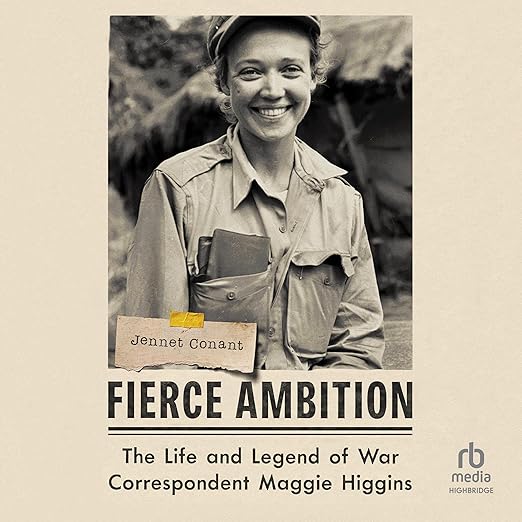
I came to Fierce Ambition already knowing the broad strokes of Marguerite Higgins's story, the Pulitzer Prize, the Korea dispatches, the running battles with male rivals who couldn't decide whether to dismiss or desire her. What I didn't expect was how much Jennet Conant's biography would fill in. I listened through most of a Saturday, the kind of day where you tell yourself you'll stop after one more chapter and don't.
Conant is the author of a string of deeply researched narratives about people who shaped American power in the twentieth century, Tuxedo Park, 109 East Palace, Man of the Hour. One devoted reviewer put it plainly: 'This is Jennet Conant, people. Everything she's written is so good.' That's a bit effusive, but it comes from somewhere real. Conant has a gift for mining archival sources that others overlook and constructing a narrative that doesn't feel reconstructed.
Our Take on Fierce Ambition
Higgins was, as Conant argues, one of the greatest war correspondents of the twentieth century. She covered the liberation of Dachau as a young reporter for the New York Herald Tribune and went on to become the first woman to win a Pulitzer Prize for frontline foreign correspondence, for her reporting from Korea. She was also, by every account, difficult, competitive, sexually unconventional for her era, and utterly indifferent to the social codes that were supposed to limit her.
What Conant does well is refuse the easy rehabilitation narrative. Higgins was not simply a misunderstood hero. She had real enemies, some of whom had legitimate grievances. Her political alignments were complicated. Her rivalry with Homer Bigart was legendary and sometimes ugly. Conant holds all of this without smoothing it out, which makes the biography feel like a reckoning rather than a monument.
Why Listen to Fierce Ambition
The Korea chapters are where this audiobook reaches its highest pitch. Reviewer Salvatore, who lived through Korea and Vietnam, found new information in Conant's account of war correspondents coloring the news through their own political objectives, a dimension of mid-century journalism that rarely receives this kind of sustained attention. The way Conant maps the relationship between reporters, generals, and political agendas during the early Cold War is genuinely illuminating, not just as biography but as media history.
Her entry into the Kennedy circle is treated with appropriate complexity. Higgins was well-connected in Washington power politics in ways that helped her career and complicated her journalism. Conant doesn't let her off the hook for Vietnam, reviewer serenity123 noted with some regret that Higgins didn't take David Halberstam's warnings seriously, and her reporting from Vietnam in the early 1960s reflected assumptions that history would not vindicate.
What to Watch For in EJ Lavery's Narration
EJ Lavery is well cast here. Her delivery has the quality of controlled authority, she doesn't dramatize Conant's prose, which is already muscular enough on its own, but she does sustain the momentum across nearly fourteen hours without the listen feeling like an endurance test. War reporting has a specific register: urgent but not panicked, specific but not clinical. Lavery finds that register and holds it.
The material in the Dachau section demands particular attention. Conant is unsparing about what Higgins witnessed and how she reported it, and Lavery delivers those passages without flinching. That restraint is the right choice. This is the kind of historical material that overdramatic narration would actively damage.
Who Should Listen to Fierce Ambition
Listeners who are drawn to twentieth-century history, women in journalism, or Cold War political culture will find this essential. It's also the right listen for readers who loved books like Susan Orlean's The Library Book or Candice Millard's work, narrative nonfiction where the research is invisible but total. Anyone coming in expecting a straightforward feminist triumph narrative will find something more honest and more interesting than that. Higgins was a complicated person. Conant takes that seriously, and the audiobook is better for it.
Frequently Asked Questions
How much of Fierce Ambition covers the Korea War reporting versus Higgins's full career?
A substantial portion is devoted to Korea, where Higgins won her Pulitzer, but Conant traces the full arc from her early Tribune years through Dachau, the Cold War Washington period, and her controversial Vietnam reporting before her death in 1966.
Is prior knowledge of Marguerite Higgins required to get the most from this biography?
Not at all. Conant is a skilled narrative biographer who builds context as she goes. Listeners unfamiliar with Higgins will be well oriented by the first few chapters.
Does EJ Lavery's narration handle the distinction between Conant's voice and direct quotation from Higgins's dispatches?
Yes, Lavery makes the tonal shift between narrative and sourced material clear without exaggerating the contrast. The dispatches from the front feel like dispatches, not recitation.
How does this compare to other Jennet Conant audiobooks for listeners who have followed her work?
Devoted Conant readers will recognize the deep archival sourcing and the refusal to flatten complicated figures. Several reviewers who had read her previous books called this among her best work. The subject may be less well-known than J. Robert Oppenheimer, but the treatment is equally thorough.