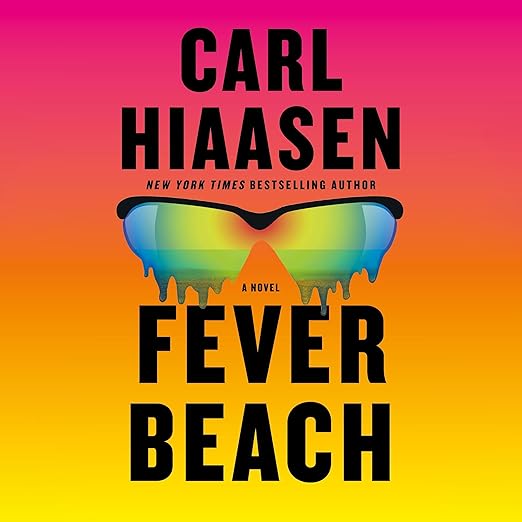
Quick Take
- Narration: Will Damron is a strong fit for Hiaasen’s ensemble-heavy Florida satire, he manages the large cast without losing differentiation and his timing preserves the political comedy’s rhythm without over-telegraphing the jokes.
- Themes: Environmental destruction, political incompetence, the absurdity of modern Florida
- Mood: Gleefully chaotic, Hiaasen’s trademark cocktail of environmental fury and broad comedy with a sharper contemporary edge
- Verdict: Hiaasen’s best novel in years, with Twilly Spree’s return adding emotional continuity and a satirical target that needs no magnification, listeners who have been waiting for him to write this book have been right to wait.
I was halfway through my evening walk when Fever Beach introduced Dale Figgo, a man distinguished by the rare achievement of being kicked out of the Proud Boys for being too dumb. I stopped walking entirely. I then stood on a sidewalk for approximately four minutes laughing while my neighbors probably wondered what had happened to me. This is the Hiaasen effect at its most concentrated, and Fever Beach is the novel that delivers it with a precision and topicality that his recent work has occasionally lacked.
Carl Hiaasen has been writing Florida noir-comedy for over forty years, and the territory he covers, corrupt politicians, rapacious developers, environmental catastrophe, the extraordinary density of human stupidity concentrated in the Florida sun, has become so familiar as a genre that the question is never whether the elements are in place but whether the specific iteration has the timing. Fever Beach has the timing. It also has Twilly Spree, an environmentalist anti-hero with a talent for disproportionate revenge who first appeared in Sick Puppy, returning here to anchor the book’s moral center while everyone around him commits various gradations of fraud, cowardice, and motivated incompetence.
Dale Figgo and the Art of the Sympathetic Idiot
Figgo is the novel’s great comic creation. He is not evil, he is specifically, precisely, constitutionally too dumb to be evil, which is both funnier and more disturbing than villainy would be. His ejection from the Proud Boys for intellectual deficiency is the joke that establishes his character, but Hiaasen is doing something more interesting than pure mockery. Figgo is genuinely trying, in his own catastrophically miscalibrated way, to do what he thinks is right. His decision to pick up a hitchhiker that sets the plot in motion is not malicious, it is simply the decision of someone who has very limited capacity for predicting consequences. Damron’s narration keeps Figgo readable without making him sympathetic in a way that would undercut the satire.
One reviewer noted that this feels like Hiaasen’s best while acknowledging that it does not quite fit the classic template. That departure is instructive. The political targets here are more specific and more recent than Hiaasen usually allows himself, and the novel sits closer to journalism, Slate wrote that no satirist arrived at our dystopian moment better prepared, than his earlier work. The plastic-surgery-obsessed billionaire couple and the clueless congressman are not archetypes; they are sketches of recognizable contemporary figures, lightly fictionalized.
Viva Morales and the Novel’s Emotional Center
Viva Morales, the newcomer trying to rebuild post-divorce while working at the Mink Foundation, is the novel’s emotional center. Hiaasen has always been better at plotting and comedy than at sustained emotional investment in his female characters, and Viva represents a genuine improvement on that front. Her connection to Twilly Spree, the unlikely alliance the synopsis describes, is the novel’s most emotionally functional relationship, partly because both characters share a quality of genuine conviction that the book’s various antagonists lack entirely.
Damron handles the Viva-Twilly dynamic with appropriate care. These scenes have a warmth that contrasts with the broad comedy surrounding Figgo and the conspiracy, and Damron makes the shift feel earned rather than tonally inconsistent. A reviewer called the book fabulously timely and noted the new and fascinating characters, Viva is the primary argument for that assessment.
Damron and the Hiaasen Ensemble
Fever Beach has a large cast, which is standard for Hiaasen, his novels tend to populate themselves with a half-dozen competing parties whose plots converge in the final act. Damron manages the ensemble with clear vocal differentiation. Figgo’s particular brand of vacant determination, the billionaire couple’s studied indifference to ordinary human standards, the congressman’s terrified self-preservation instinct, each gets its own register, and the comedy scenes do not blur together even as the ensemble expands.
Multiple reviewers pointed to the book’s environmental satire as its most effective element. One reader noted that Hiaasen’s Florida with a side of escapism is a blessing for fragile minds at this time. That framing captures what the book provides: it is angry about real things in a way that transforms that anger into something survivable for an audience that shares the anger. The twelve-hour runtime is well-paced, Hiaasen is not a writer who overwrites, and Fever Beach moves.
Who Should Listen and Who Should Skip
Listen if you have any prior Hiaasen experience and want to know if he still has it, the answer is yes, and this is one of the titles to make that case most forcefully. Also listen if you want political and environmental satire delivered by someone who has been paying attention to Florida for long enough to have genuine expertise, or if Twilly Spree’s previous appearances have made you want to know what happened to him.
Skip if you need a consistent tonal register and find the gap between broad comedy and genuine environmental horror uncomfortable. Hiaasen has always asked his readers to hold both things simultaneously, and Fever Beach does it more pointedly than most. Also skip if political satire that names its targets specifically tends to date quickly for your reading habits, the timeliness that makes this book so effective in 2025 will require some contextual knowledge for future listeners.
Frequently Asked Questions
Does Fever Beach require familiarity with Hiaasen’s earlier novels? Is Twilly Spree a character I need to know?
No prior Hiaasen reading is required to follow Fever Beach, Twilly Spree is reintroduced with enough context that new readers will not feel lost. Readers who remember him from Sick Puppy will get an extra layer of pleasure from the continuity, but it is not a prerequisite for engagement.
How political is this book? Is it possible to enjoy it if you do not share Hiaasen’s environmental and political views?
Fever Beach is unambiguously political and specifically targets certain contemporary American political figures and movements, the Proud Boys connection is not subtle. Readers who are unsympathetic to environmental causes or who identify with the political figures being satirized will find the novel actively hostile to their worldview. Hiaasen is not writing for ideological balance; this is advocacy fiction with comedic architecture.
Is Will Damron familiar with the Hiaasen catalog, or is this his first time narrating one of his novels?
Damron has narrated previous Hiaasen titles and brings established familiarity with the Florida ensemble-comedy style. His work with this material is not a first encounter, and the comfort with the register shows in how cleanly he handles the large cast.
Twilly Spree appeared in Sick Puppy, how many years passed between that book and Fever Beach?
Sick Puppy was published in 2000, making Twilly Spree’s return in Fever Beach a gap of roughly twenty-five years. The character’s reappearance is one of the more discussed elements among longtime Hiaasen readers, and Fever Beach contextualizes his current situation clearly enough that the gap in publication timeline does not create confusion for new listeners.